On this page
Top picks at a glance
As an Amazon Associate I earn from qualifying purchases.
- 1
 RDJ Bouns TF42009.7/10View on Amazon
- 2
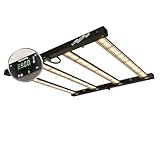 Lucius JY-B537F 400W9.7/10View on Amazon
- 3
 VIPARSPECTRA XS25009.6/10View on Amazon
- 4
 SANSI BR30 24W Bulb9.3/10View on Amazon
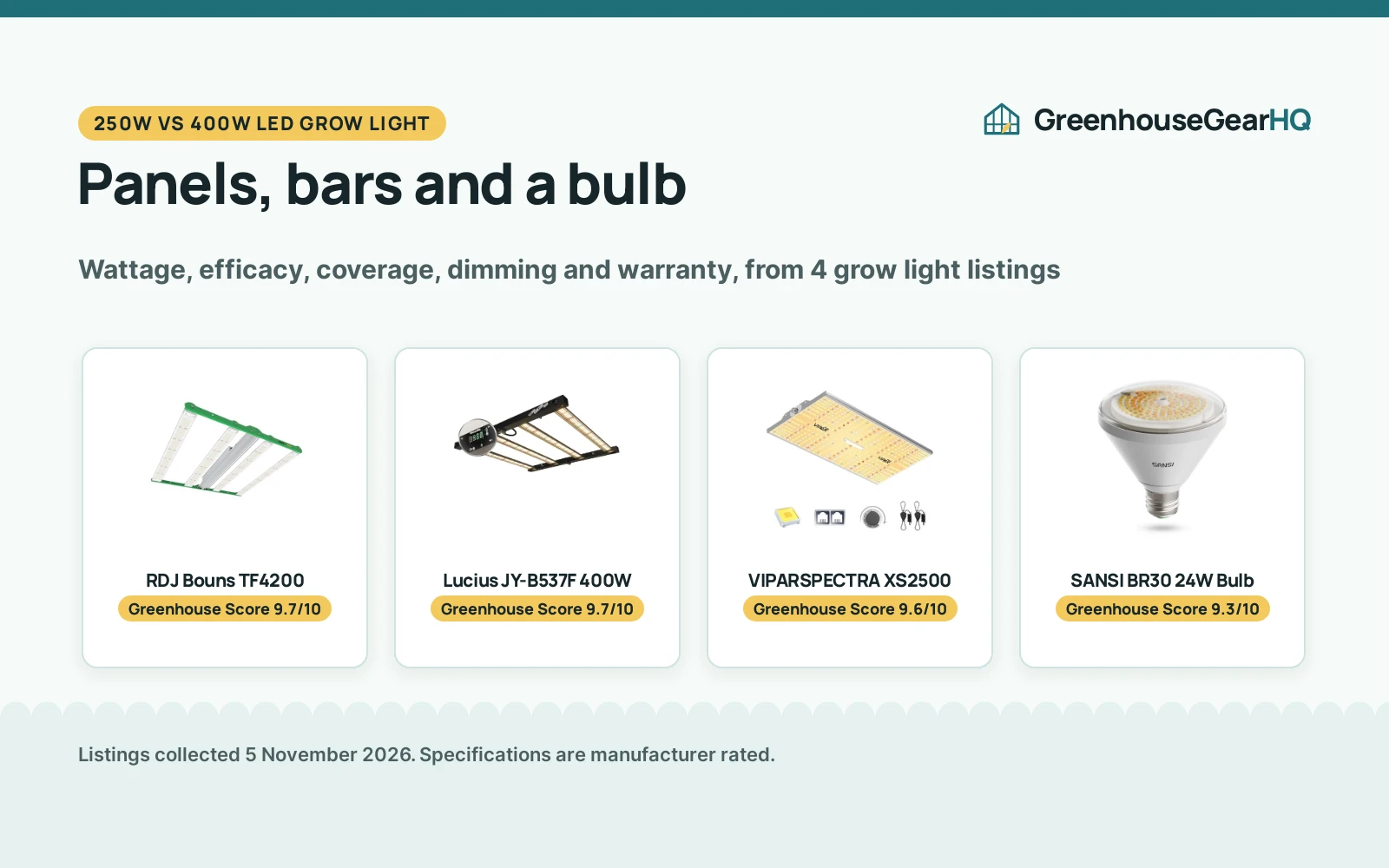
Late winter seed trays sit under a window that never quite gives them enough light, and the seedlings stretch thin. The 250w vs 400w led grow light choice is the next step for growers who want a lamp for a tent or a bench. We compared 4 listings, 2 on each side.
GreenhouseGearHQ earns a commission when you buy through links on this page, at no extra cost to you. As an Amazon Associate I earn from qualifying purchases. Affiliate disclosure.
Quick verdict: pick the 250W side for a 4×2 or 4×3 ft tent: the VIPARSPECTRA XS2500 panel with Samsung LM301H diodes and a dimmer. Pick the 400W side for a 3×3 or 4x4ft area: the Lucius bar light with its timer and sunrise sunset dimming, or the RDJ Bouns panel with its 5-year warranty. The SANSI bulb is the odd one out: a 24W bulb sold as a 250W equivalent, for one plant in an E26 socket, not a tent.
The examples
| # | Product | Greenhouse Score | Buy |
|---|---|---|---|
| 1 | RDJ Bouns TF4200 | 9.7/10 | Buy on Amazon |
| 2 | Lucius JY-B537F 400W | 9.7/10 | Buy on Amazon |
| 3 | VIPARSPECTRA XS2500 | 9.6/10 | Buy on Amazon |
| 4 | SANSI BR30 24W Bulb | 9.3/10 | Buy on Amazon |

RDJ Bouns TF4200
A 400W full spectrum LED grow light with LM281B+ diodes, 2.6-2.8 umol/J efficacy, dimming and fanless cooling for a 3x3 area.
Pros
- 2.6-2.8 umol/J efficacy with LM281B+ diodes and EPI 660nm 45mil LEDs
- Dimmable with an RJ11 daisy chain for PPFD control
- Fanless cooling with a sunflower aluminum heatsink and three-proof paint
- 5-year warranty plus a 30-day satisfaction or return period
Cons
- No PPFD figure is stated
- No diode count is stated
- No spectrum chart is stated
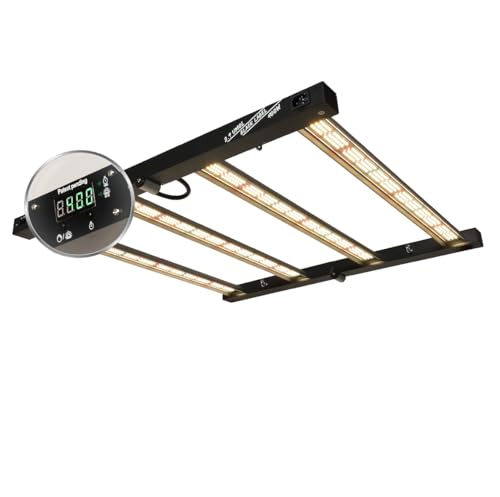
Lucius JY-B537F 400W
A 400W foldable bar light with 972 diodes, 2.9 μmol/J efficacy, master control, timer modes and sunrise sunset dimming for a 4x4ft grow tent.
Pros
- 2.9 μmol/J efficacy, the highest stated figure in this group
- 972 diodes: 468 white, 432 warm white and 72 red
- Master control with LED display, 7 timer modes and sunrise sunset dimming
- 4-level dimming from 25% to 100% with daisy chain support
Cons
- No item weight is stated
- No PPFD figure is stated
- No spectrum chart is stated
- 2-year warranty is the lowest term in this group
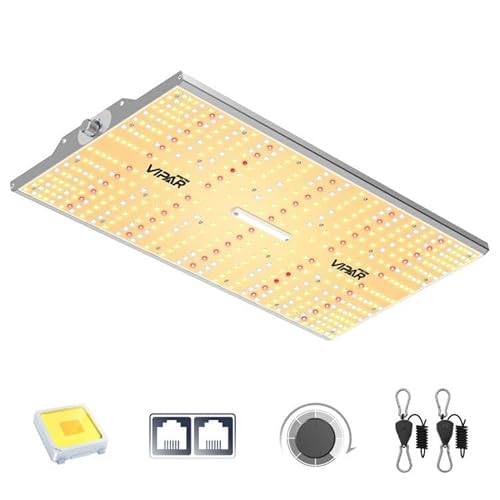
VIPARSPECTRA XS2500
A 250W LED grow light with Samsung LM301H diodes, a 3000K, 5000K, 660nm and 730nm spectrum, a dimmer and daisy chain support for 4x3 ft veg and 4x2 ft flowering.
Pros
- Samsung LM301H diodes with a 3000K, 5000K, 660nm and 730nm spectrum
- Dimmer for light level adjustment, with daisy chain up to 20 units
- Large aluminum heat sinks with no fans and zero noise
- 3-year limited warranty is stated
Cons
- No efficacy figure is stated
- No PPFD figure is stated
- No spectrum chart is stated
- No timer is listed

SANSI BR30 24W Bulb
A 24W BR30 grow bulb with a 3000K, 5000K, 660nm and 730nm spectrum, a 120° beam angle and IP54 stated, sold as a 250W equivalent.
Pros
- PPFD of 122.29 umol/m²/s at 1 ft is stated
- 3000K, 5000K, 660nm and 730nm spectrum across 380nm-780nm
- 120° beam angle for even light over more plants
- 5-year service assistance is stated
Cons
- Draws 24W, not 250W, despite the 250W equivalent title
- Non-dimmable, so the light level is fixed
- No tent size is stated
- No daisy chain is listed
As an Amazon Associate I earn from qualifying purchases.
Other options worth a look
 Spider Farmer G4500 LED Grow Light 320W for 2x4 Grow TentsCheck price on Amazon
 SPF4000 PRO 400W LED Grow Light 5x5ft Coverage with Veg &Check price on Amazon
 SPF4000 400W LED Grow Light 5x5ft Coverage with New Diodes &Check price on Amazon
 SZHLUX 400W LED Grow Light 4×4ft Coverage with Double SwitchesCheck price on Amazon
 4X2Ft 200W LED Grow Lights with 5500K White Spectrum and OverCheck price on Amazon
 LED Plant Grow LightCheck price on Amazon
250w vs 400w led grow light: side by side
| Grow Light | Greenhouse Score | Wattage | Efficacy | Coverage | Dimming | Warranty | Amazon |
|---|---|---|---|---|---|---|---|
| RDJ Bouns TF4200 | 9.7/10 | 400W | 2.6-2.8 umol/J | 3×3 area | Dimmable | 5-year | View on Amazon |
| Lucius JY-B537F 400W | 9.7/10 | 400W | 2.9 μmol/J | 4x4ft tent | 4 levels, 25% to 100% | 2-year | View on Amazon |
| VIPARSPECTRA XS2500 | 9.6/10 | 250W | Not stated | 4×3 ft veg, 4×2 ft flowering | Dimmer | 3-year limited | View on Amazon |
| SANSI BR30 24W Bulb | 9.3/10 | 24W (250W equiv.) | Not stated | PPFD 122.29 at 1 ft | Non-dimmable | 5-year | View on Amazon |
We reproduce the maker’s listed specs without adjustment (collected 5 November 2026).
Wattage and coverage
The wattage gap is real but the listings do not cover the same ground. The VIPARSPECTRA XS2500 draws 250W for 4×3 ft veg and 4×2 ft flowering, the clear tent panel on the 250W side. The SANSI bulb sits on the same side by name only: it draws 24W, sold as a 250W equivalent, with a PPFD figure of 122.29 umol/m²/s at 1 ft for one bulb over one plant.
The 400W side lists larger areas: the Lucius bar light draws 400W for a 4x4ft grow tent, the RDJ Bouns panel 400W for a 3×3 area. Both 400W listings state an efficacy figure, 2.9 μmol/J for the Lucius and 2.6-2.8 umol/J for the RDJ Bouns, while neither 250W listing states one, so the listings alone cannot call either side more efficient.
Spectrum and diodes
All 4 listings use a full spectrum, but they describe it in different detail. The VIPARSPECTRA XS2500 lists Samsung LM301H diodes with 3000K, 5000K, 660nm and 730nm LEDs. The SANSI bulb lists the same mix across 380nm-780nm, with the cool 5000K light linked to germination and the warm 3000K light to blooming.
The 400W listings count diodes instead of naming them. The Lucius lists 972 LEDs, 468 white, 432 warm white and 72 red, with a full spectrum for seeding, vegetation and flowering. The RDJ Bouns lists LM281B+ LEDs with EPI 660nm 45mil LEDs for high PAR output, suited to all stages from seedlings to flowering. No listing states a spectrum chart.
Dimming, timers and controls
Dimming separates these listings more than wattage does. The VIPARSPECTRA XS2500 has a dimmer for light level adjustment. The Lucius goes further: 4 brightness levels from 25% to 100%, a master control with an LED display, 7 built-in timer modes including 18/6, 12/12 and 20/4, and 1 to 23 hour on/off schedules with sunrise sunset dimming.
The RDJ Bouns is dimmable and uses an RJ11 daisy chain for PPFD control. The VIPARSPECTRA and the Lucius also support daisy chain. The SANSI bulb is non-dimmable, so its light level is fixed once it is screwed in.
Heat, drivers and build
None of the 4 listings uses a fan. The VIPARSPECTRA XS2500 lists large aluminum heat sinks, no fans and zero noise, with a high-safety LED driver. The Lucius lists a built-in driver and 5mm heat sinks for passive cooling. The RDJ Bouns lists fanless cooling with a sunflower aluminum heatsink, a three-proof paint protection layer and silicone protection on the solder joints.
The SANSI bulb takes a different path: Chip on Ceramic technology solders the LED chip on a ceramic heat sink, with aluminum heat dissipation, and the maker says the bulb lasts 25,000 hours. The bulb also lists IP54, which the maker links to water splashes while watering.
Warranties and listing gaps
All 4 listings state a warranty term. The RDJ Bouns states a 5-year warranty plus a 30-day satisfaction or return period. The SANSI states 5-year service assistance, the VIPARSPECTRA a 3-year limited warranty and the Lucius a 2-year manufacturer warranty.
The gaps matter as much as the terms. The SANSI title calls a 24W bulb a 250W equivalent, so read 24W as the draw and 250W as the maker’s equivalence, not as a 250W panel. The RDJ Bouns bullets give efficacy as 2.6-2.8 umol/J while the spec table gives 2.8 μmol/J, so use the bullet range. The VIPARSPECTRA compares itself with a 500W HPS/MH light and claims yields rise by 30% with lower running costs, the maker’s claim.
Which should you choose?
Choose a 250W LED grow light if your space is a 4×2 or 4×3 ft tent and you want a panel with Samsung LM301H diodes, a dimmer and daisy chain support: the VIPARSPECTRA XS2500 is the only 250W panel in this group. Compare more seedling options in our best grow lights for seedlings picks.
Choose a 400W LED grow light if your space is a 3×3 or 4x4ft area and you want the stated efficacy figures and the controls. The Lucius suits growers who want a timer, sunrise sunset dimming and a display; the RDJ Bouns suits growers who want the 5-year warranty and fanless cooling. More lights for young plants are in our best grow lights for seed starting picks.
If you only need light for one plant on a shelf, the SANSI bulb in an E26 socket may cover the job without a panel. It is non-dimmable, with its PPFD figure stated at 1 ft.
In the Greenhouse
- Hang the VIPARSPECTRA panel over a 4×3 ft veg area or a 4×2 ft flowering area.
- Screw the SANSI bulb into an E26 base above one plant; its PPFD figure is stated at 1 ft.
- Set the Lucius timer to one of its 7 modes, including 18/6, 12/12 and 20/4.
- Give the RDJ Bouns panel its 3×3 area, and let its fanless heatsink move heat without a fan.
Scoring notes
| Product | Greenhouse Score | Perf. /35 | Build /25 | Value /25 | Safety /10 | Warranty /5 |
|---|---|---|---|---|---|---|
| RDJ Bouns TF4200 | 9.7 | 30 | 21 | 20 | 6 | 4 |
| Lucius JY-B537F 400W | 9.7 | 32 | 22 | 21 | 5 | 3 |
| VIPARSPECTRA XS2500 | 9.6 | 29 | 21 | 20 | 5 | 3 |
| SANSI BR30 24W Bulb | 9.3 | 21 | 15 | 15 | 4 | 3 |
Every score falls within 9.2 and 9.8, and a pick moves toward the top end only by earning more weighted points.
The Greenhouse Score weighs performance, build, value, safety and warranty, as explained on our How we pick page. For grow lights, safety reflects a stated driver, heat sink or cooling design and any IP figure, and all 4 listings state one of these. All 4 listings also state a warranty term, with the 5-year terms scoring higher than the 2-year term. The RDJ Bouns leads on warranty length and the Lucius on stated efficacy and controls, while the SANSI trails because a 24W bulb cannot cover a tent like a 250W panel.
FAQ for growers
Can I dim these grow lights for seedlings?
3 of the 4: the VIPARSPECTRA has a dimmer, the Lucius 4 brightness levels from 25% to 100%, and the RDJ Bouns is dimmable. The SANSI bulb is non-dimmable.
Do these grow lights need a fan to stay cool?
No listing in this group uses a fan: the VIPARSPECTRA lists large aluminum heat sinks, the Lucius 5mm heat sinks, the RDJ Bouns fanless cooling with a sunflower aluminum heatsink, and the SANSI a ceramic heat sink.
Which of these grow lights has the longest warranty?
2 share the longest term: the RDJ Bouns states a 5-year warranty and the SANSI 5-year service assistance. The VIPARSPECTRA states a 3-year limited warranty and the Lucius a 2-year manufacturer warranty.
Keep reading
See every grow light guide and all light and heat guides.
More picks: grow lights for seedlings, grow lights for seed starting, cool white vs warm white grow lights and incandescent vs LED grow lights.