On this page
Top picks at a glance
As an Amazon Associate I earn from qualifying purchases.
- 1
 Hydropolis 4x8 Grow Tent9.7/10View on Amazon
- 2
 VIVOSUN S558 5x5 Grow Tent 60"x60"x80" High Reflective MylarView on Amazon
- 3
 MARS HYDRO 4x4 Advanced Grow TentView on Amazon
- 4
 VIVOSUN S848 4x8 Grow Tent 96"x48"x80" High Reflective MylarView on Amazon
- 5
 VIVOSUN Larger 4X8 Grow Tent 108"x48"x80" Mylar Clone ChamberView on Amazon
- 6
 4x8 Grow TentView on Amazon
- 7
 96x48x78 Reflective Indoor Grow Tent 4x8View on Amazon
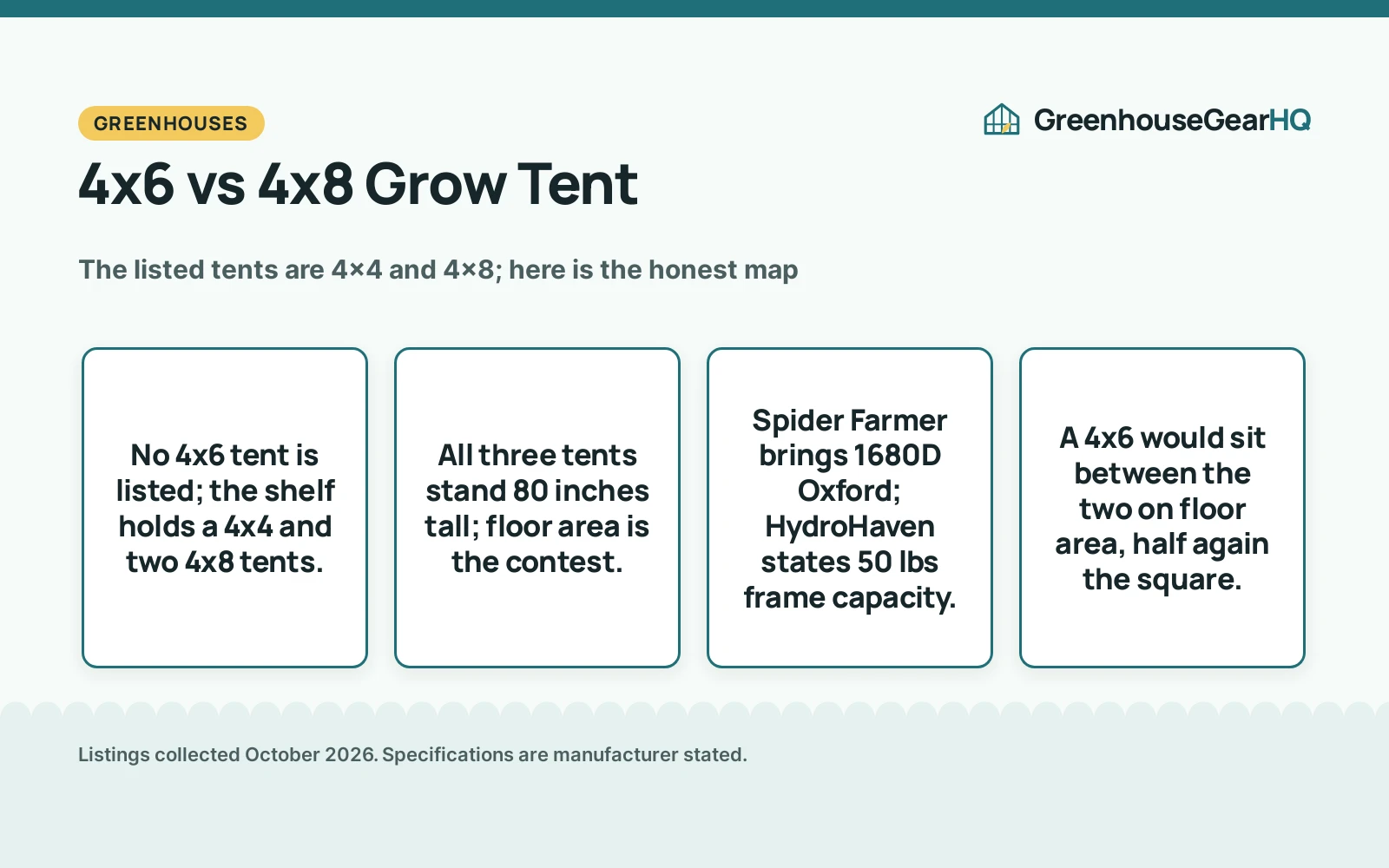
The 4×6 vs 4×8 grow tent question has a wrinkle in the listings gathered for it: no 4×6 tent is among them. What the shelf actually holds is a 4×4 from MARS HYDRO and two 4×8 tents, from Spider Farmer and HydroHaven, plus a Quictent raised bed with a mini greenhouse cover that is not a grow tent at all. So this guide answers honestly in two parts. It compares the tents that exist, the compact square against the long rectangle, on canvas, frame and fittings. And it places the missing 4×6 where it belongs, between them, so a reader who finds one elsewhere knows what it would gain and give up against both.
Other options worth a look
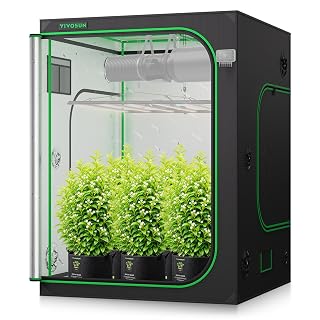 VIVOSUN S558 5x5 Grow Tent 60"x60"x80" High Reflective MylarCheck price on Amazon
 MARS HYDRO 4x4 Advanced Grow TentCheck price on Amazon
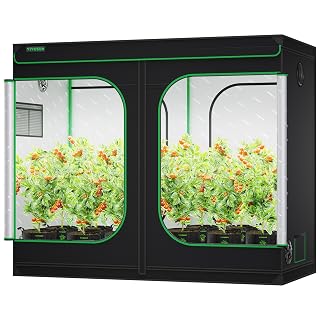 VIVOSUN S848 4x8 Grow Tent 96"x48"x80" High Reflective MylarCheck price on Amazon
 VIVOSUN Larger 4X8 Grow Tent 108"x48"x80" Mylar Clone ChamberCheck price on Amazon
 4x8 Grow TentCheck price on Amazon
 96x48x78 Reflective Indoor Grow Tent 4x8Check price on Amazon
GreenhouseGearHQ earns a commission when you buy through links on this page, at no extra cost to you. As an Amazon Associate I earn from qualifying purchases. Affiliate disclosure.
The short answer: 4×6 vs 4×8 grow tent
Choose the smaller footprint when one light, one crop cycle and one corner of a room describe your growing: the 4×4 pattern, and a true 4×6 where found, serves a single harvest rhythm with less air to condition and less canopy to fill. Choose the 4×8 when you run two zones, seedlings beside flowering, a mother plant beside her cuttings, or simply a long wall that suits a rectangle. The 4×8 doubles the floor of the 4×4 and asks for roughly double the light and extraction; the 4×6, at half again the square’s area, is the compromise size, one and a half zones rather than two.
The tents, compared
| Tent | Footprint | Height | Canvas | Notable fittings |
|---|---|---|---|---|
| MARS HYDRO Advanced | 48 x 48 in (4×4) | 80 in | 1680D, diamond mylar | Zipper shade flap, floor tray, window |
| Spider Farmer 8×4 | 96 x 48 in (4×8) | 80 in | 1680D Oxford, diamond mylar | Cable pass-through, enlarged window, floor tray |
| HydroHaven 8×4 Kit | 96 x 48 in (4×8) | 80 in | 600D, diamond mylar 98% | 16mm poles to 50 lbs, viewing window, floor tray |
All three stand 80 inches tall, so the contest is floor area and fabric. The MARS HYDRO 4×4 wraps its square in 1680D canvas, double stitched and tear proof by its account, with an exclusive shade cloth on the zipper stitching against pinhole leaks, a reflective diamond mylar interior, metal poles and corner adapters, an observation window and a floor tray. It is the complete small tent, light locked and controller ready with hangers for the controller and hub.
The Spider Farmer answers at twice the floor with the same 1680D class, in Oxford canvas with premium SBS zippers, a flap and dual stitching, an enlarged viewing window, a cable pass-through port and a controller lanyard, plus hooks and a removable floor tray. The HydroHaven kit takes the same 96 by 48 by 80 inch shell in a lighter 600D cloth, states 98 percent reflectivity for its diamond mylar, heavy duty zippers with double flaps, a viewing window and a frame of 16mm poles rated to 50 lbs of lights and fans. Between the two 4×8 tents the trade is cloth weight against stated frame capacity and price class: the Spider Farmer’s canvas is the heavier armour, the HydroHaven’s listing the more explicit about what its poles carry.
Where the 4×6 would sit
A true 4×6, half again the square’s floor and three quarters of the long tent’s, is the one-light-and-a-half size: room for a main canopy plus a propagation corner under a divider, without the second full light and extraction run a 4×8 invites. Judged against these listings it should match their shared standards before its size earns anything: 1680D class canvas or a stated reason otherwise, a zipper flap against pinhole leaks, a floor tray, a viewing window, and a frame rating in pounds rather than adjectives. A 4×6 that meets that bar beats the 4×4 for growers who chronically overflow it; a 4×6 that skips the bar is a bigger tent doing a worse job. The Quictent in the listings, an 8×4 by 2 ft galvanized raised bed with a dismountable mini greenhouse cover, belongs to another page entirely: it grows outdoors in soil, and its presence here only underlines that footprint numbers alone do not make a tent.
Sizing the room, not just the tent
The tent’s footprint is half the decision; the room’s share is the other half. An 80 inch tent in a low room leaves no hand space above for ducting, and a 4×8 along a wall consumes the wall’s whole working length, doors, windows and all. Extraction scales with volume, so the 4×8’s double air asks a larger fan run harder or a second one, and its canopy wants roughly double the light wattage of the square to reach the same intensity at the leaf. Growers stepping up usually keep the 4×4 as a mother and propagation tent beside the 4×8, which is the strongest argument for buying the size your next year needs rather than the size this season fills. The rest of the structure shelf is in the greenhouse guides.
In the Greenhouse
Glasshouse growers borrow tents for the jobs glass does badly: a light-tight dark period in a bright house, a quarantined bench for new plants, a warm pocket for propagation in a cold month. For those, the 4×4 pattern is the usual purchase, big enough for a bench’s worth of plants and small enough to stand in a corner, while the 4×8 earns its floor only when a whole crop stage moves indoors. Whichever size, site it out of the house’s dripline and vent it independently; a tent inside a greenhouse is a room within a room, and its climate is yours alone to run.
FAQ for growers
Is there a 4×6 tent in this comparison?
No. The listings gathered hold a 4×4 and two 4×8 tents, so the guide compares those and places the 4×6 between them on area and equipment standards rather than inventing one.
How much more light does a 4×8 need than a 4×4?
About double, on floor area, at the same height of 80 inches and the same target intensity at the canopy: the 4×8 footprint is twice the 4×4.
Which 4×8 has the heavier canvas?
The Spider Farmer, at 1680D Oxford against the HydroHaven’s 600D. The HydroHaven answers with a stated frame capacity of 50 lbs on 16mm poles.
What is the Quictent doing here?
It was gathered with the listings but it is a galvanized raised bed, 8×4 by 2 ft, with a mini greenhouse cover for outdoor soil growing, not an indoor grow tent.
Keep reading
See every greenhouse guide.
More from the structure shelf: browse hygrometers for grow tents.