On this page
Top picks at a glance
As an Amazon Associate I earn from qualifying purchases.
- 1
 Coolaroo 50% UV Block Garden Shade Cloth9.8/10View on Amazon
- 2
 Amgo 30% Shade Cloth 8' x 16' Mesh Tarp with Grommets9.7/10View on Amazon
- 3
 ColourTree 30% Black Shade Cloth9.7/10View on Amazon
- 4
 BeGrit Shade Cloth for Garden 50% 6x6.5ft Sun Shade withView on Amazon
- 5
 10x20FT Shade ClothView on Amazon
- 6
 Cool Area Sun Shade Cloth with Grommets for GardenView on Amazon
- 7
 vensovo 50% Black Shade ClothView on Amazon
- 8
 vensovo 30% Black Shade ClothView on Amazon
- 9
 vensovo 40% Black Shade ClothView on Amazon
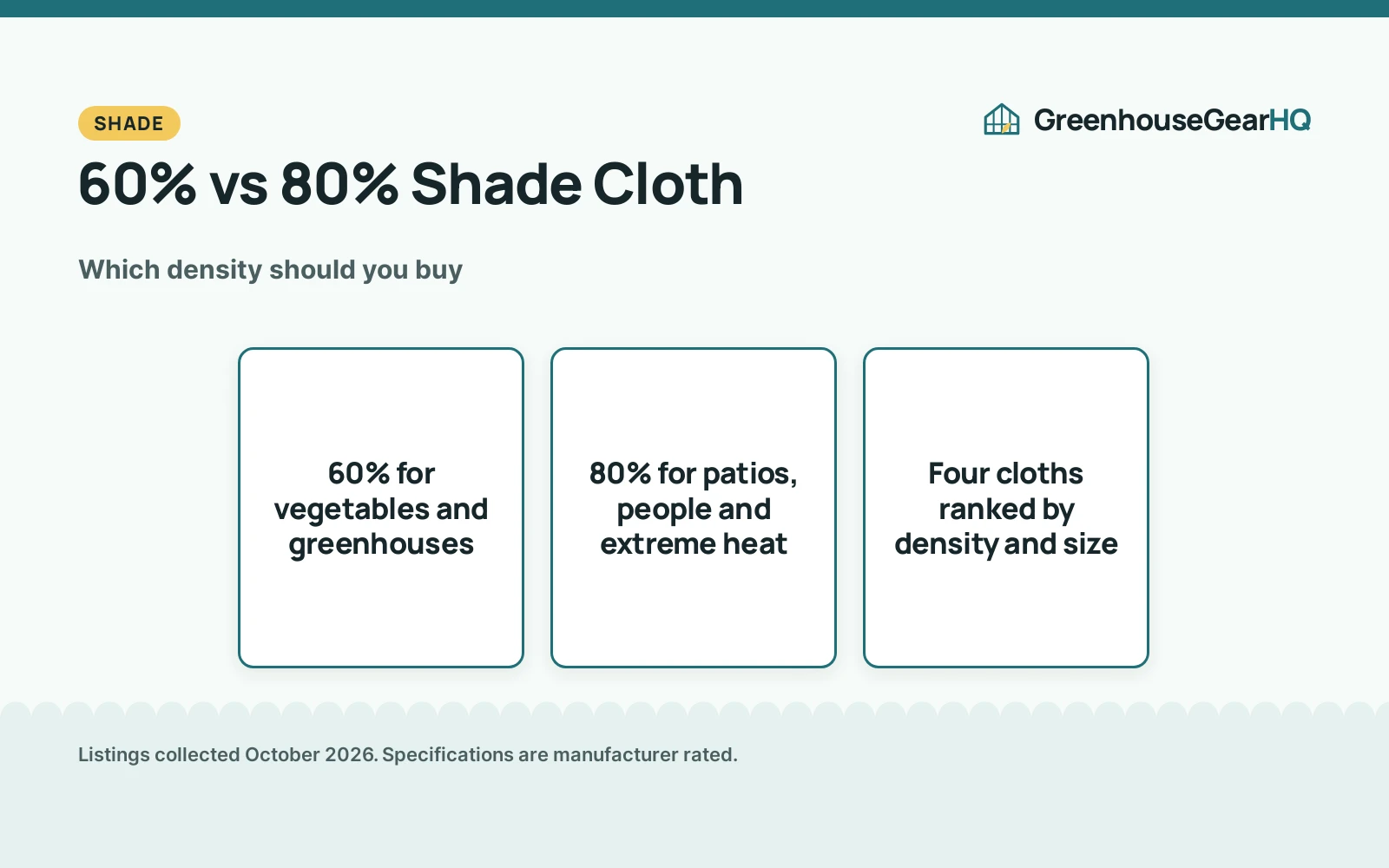
60% vs 80% shade cloth: which one should you buy? Pick 60% for vegetables and greenhouses that still need strong light; pick 80% for patios, people and heat-sensitive plants in brutal sun. The percentage is the share of sunlight blocked, so 80% is darker and cooler. We compare the two densities and four cloths below, using only what each listing publishes.
Other options worth a look
 BeGrit Shade Cloth for Garden 50% 6x6.5ft Sun Shade withCheck price on Amazon
 10x20FT Shade ClothCheck price on Amazon
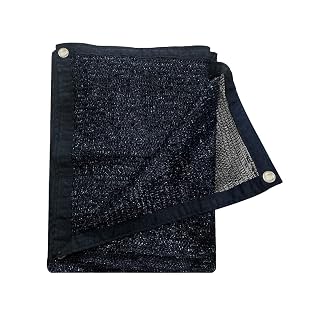 Cool Area Sun Shade Cloth with Grommets for GardenCheck price on Amazon
 vensovo 50% Black Shade ClothCheck price on Amazon
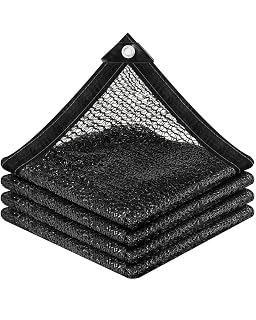 vensovo 30% Black Shade ClothCheck price on Amazon
 vensovo 40% Black Shade ClothCheck price on Amazon
GreenhouseGearHQ earns a commission when you buy through links on this page, at no extra cost to you. As an Amazon Associate I earn from qualifying purchases. Affiliate disclosure.
60% vs 80% shade cloth: the direct answer
60% shade cloth blocks 60% of sunlight and lets 40% through: enough for vegetables, seedlings and greenhouses. 80% blocks 80% and lets 20% through: better for patios, livestock and extreme heat. The listings here cover 40% to 60%; none states 80%, but the principle scales: more block means cooler and darker. Vegetables need light, so stay at 60% or below for growing.
The gear, ranked
1. e.share 40-50% Black, 20×48 ft
The e.share is the biggest cloth here: 20 by 48 ft of 40-50% black shade cloth in high-density polyethylene, 12.9 pounds. The listing states grommets every 2 feet, UV-stabilized tear-resistant material, and breathable weave for air and water. It is the pick for large gardens and greenhouses.
2. HOLAA 60% Black, 8×10 ft
The HOLAA is the 60% pick: 8 by 10 ft of heavy-duty HDPE with reinforced corners and edges. The listing states it keeps the area up to 15 degrees F cooler than direct sunlight, with tear-resistant breathable knit. It is the pick for a patio or a small greenhouse at the 60% density.
3. WindscreenSupplyCo 60% Tan, 5 ft 10 in x 100 ft
The WindscreenSupplyCo is the roll pick: 5 ft 10 in by 100 ft of 60% tan HDPE, 9.73 pounds. The listing states it can be cut to size without fraying, with eyelets for installation. It is the pick for long runs: fences, pergolas and kennels.
4. BeGrit 50% Black, 6×6.5 ft
The BeGrit is the small pick: 6 by 6.5 ft of 50% black shade cloth in polyethylene, 8.48 ounces. The listing states reinforced edges with grommets, tear-resistant and weatherproof. It is the pick for a single bed or a small patio.
60% vs 80% by use
Vegetables and greenhouses
Pick 60% or less. The e.share at 40-50% and the HOLAA at 60% both suit vegetables: the e.share listing states balanced sunlight blocking for tomatoes and greens, and the HOLAA states 60% block with enough light for plants to thrive. 80% would starve vegetables of light.
Patios and people
Pick 80% for people. The HOLAA at 60% keeps the area up to 15 degrees F cooler; 80% would be cooler still. For a patio where people sit, darker is better. The BeGrit 50% suits a small patio where some sun is welcome.
Large areas
The e.share 20 by 48 ft covers a greenhouse or a barn; the WindscreenSupplyCo 100 ft roll covers a fence line. Both are HDPE with grommets or eyelets. For a chicken coop or kennel, either works; match the density to the animals: 60% for shade with airflow.
What to check before you buy
Density
The densities here run from 40-50% (e.share) to 60% (HOLAA, WindscreenSupplyCo), with the BeGrit at 50%. None states 80%. Match the density to the use: growing needs 60% or less, people want 80%.
Material and edges
Three are HDPE; the BeGrit is polyethylene. The e.share has grommets every 2 feet; the HOLAA has reinforced corners and triple-reinforced edges; the BeGrit has stainless steel aluminum grommets. Strong edges matter in wind.
Size
Sizes run from 6 by 6.5 ft (BeGrit) to 20 by 48 ft (e.share), with the HOLAA at 8 by 10 ft and the WindscreenSupplyCo at 5 ft 10 in by 100 ft. Measure the area before ordering; a cloth that is too small leaves gaps.
Setting up the cloth
Hang the cloth with ropes or hooks through the grommets, keeping it taut to shed wind. The e.share installs with standard ropes; the WindscreenSupplyCo cuts to size. Leave an air gap above the plants for airflow; the HOLAA breathable knit lets hot air escape. Take the cloth down in winter storms if the listing does not rate it for snow.
FAQ for growers
Is 60% or 80% better for vegetables?
60% or less. Vegetables need light; 80% blocks too much for growing.
Is 80% better for a patio?
Yes. For people and pets, darker is cooler; 80% beats 60% for comfort.
Which of these is 80%?
None. The listings here cover 40% to 60%; the HOLAA and WindscreenSupplyCo are the 60% options.
Which is the largest?
The e.share at 20 by 48 ft, then the WindscreenSupplyCo at 5 ft 10 in by 100 ft.
Which keeps the area coolest?
The HOLAA states up to 15 degrees F cooler than direct sunlight at 60% density.
Keep reading
See our shade cloth guides.
More guides: shade cloth and grow tents for the full setup.
In the Greenhouse
The right shade, the right density, and plants that never wilt.