On this page
Top picks at a glance
As an Amazon Associate I earn from qualifying purchases.
- 1
 Yardenaler 8x16 FT Wooden Greenhouse9.6/10View on Amazon
- 2
 AirWire 8x16 FT Wooden Walk in Polycarbonate Greenhouse forView on Amazon
- 3
 8x16 FT Durable & Easy Assembly Aluminum GreenhouseView on Amazon
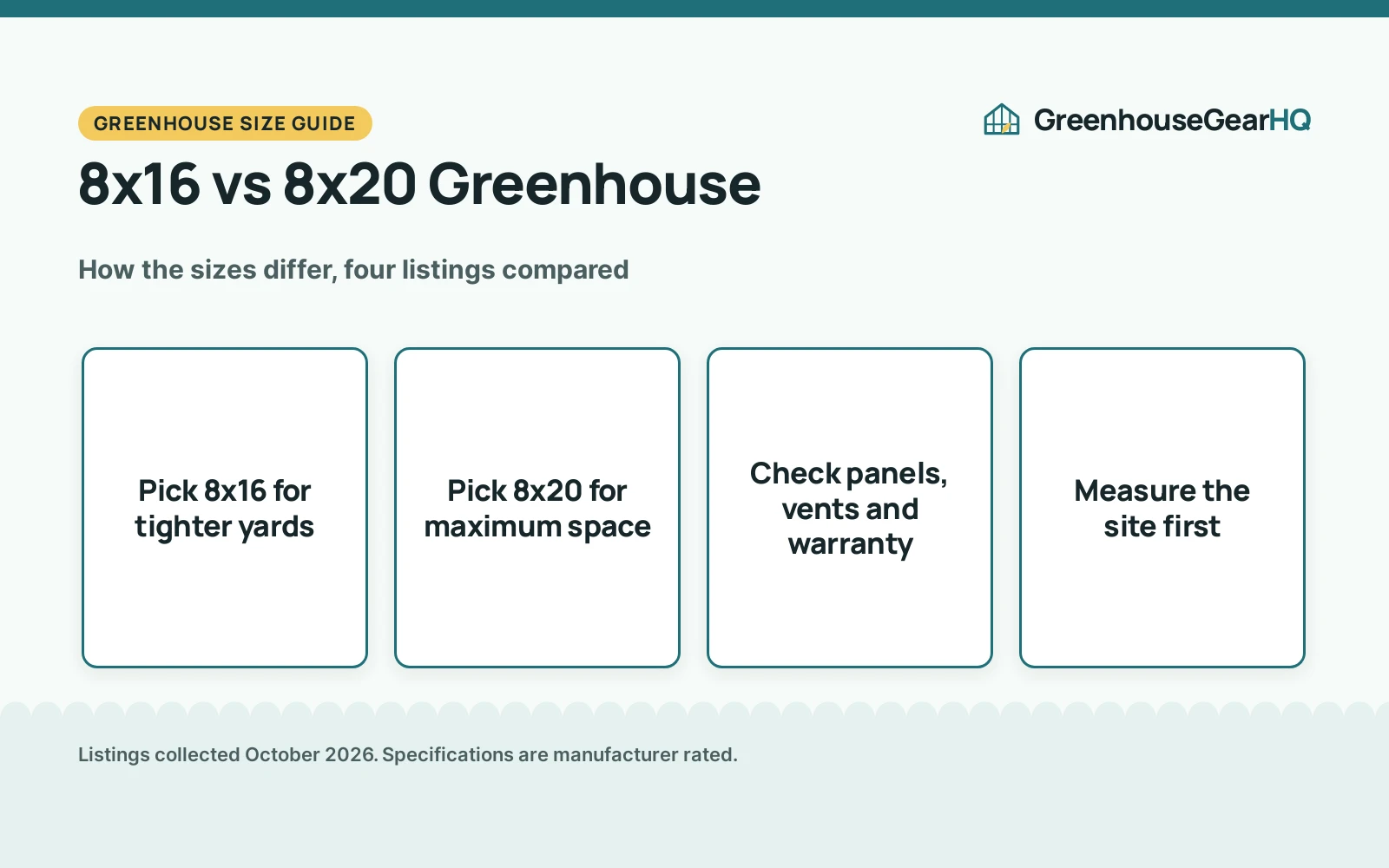
Late winter, seed trays crowding the windowsill, and you are ready for a real greenhouse. The 8×16 vs 8×20 greenhouse decision comes down to how much growing space you need: the 8×20 is the longer house, so it fits more benches, more plants and more working room. Pick the 8×16 for a tighter yard or a smaller project; pick the 8×20 when you want the maximum space in this width class and have the room for it.
Other options worth a look
 AirWire 8x16 FT Wooden Walk in Polycarbonate Greenhouse forCheck price on Amazon
 Yardenaler 8x16 FT Greenhouse for OutdoorCheck price on Amazon
 8x16 FT Durable & Easy Assembly Aluminum GreenhouseCheck price on Amazon
GreenhouseGearHQ earns a commission when you buy through links on this page, at no extra cost to you. As an Amazon Associate I earn from qualifying purchases. Affiliate disclosure.
8×16 vs 8×20 greenhouse: what changes with length
Both houses are 8 feet wide; the difference is the length. A longer house means a longer ridge, more roof vents and more wall panels, which is why the 8×20 typically lists more vents and a higher price than the 8×16 from the same maker. The footprint also matters for the yard: measure the site, allow working space around all four sides for the door swing and for cleaning, and check local rules before you order. If the 8×16 already feels big, our 8×8 vs 8×16 greenhouse guide walks through the smaller step.
Four listings to compare
We ranked four listings by the completeness of their stated specs, warranty and size. The Palram Canopia Snap and Grow 8×16 is the only true 8×16 here and the most complete listing: 8 by 16 feet with 132 square feet of growing space, 6.8 feet of head room, polycarbonate panels with 100% UV protection and over 90% light transmission, a heavy-duty aluminum frame, double doors, three roof vents and a 5-year limited warranty. It lists at 192 by 96 by 108 inches and 246 pounds.
The AMERLIFE 8×12 is the next most detailed: an 8 by 12 foot house with 4mm twin-wall polycarbonate panels, an aluminum frame, four vent windows and a swing door, 480 cubic feet of usable space and a listed weight of 163.2 pounds. The listing says two people can assemble it in 5 to 6 hours and recommends anchoring to a hard, level surface. It is shorter than the 8×16, so it suits a smaller yard.
The Jocisland 6×16 is a narrower option: 6 by 16 feet with 4mm polycarbonate panels that block 99.99% of UV rays, an aluminum frame, two roof vents and a swing door. The listing says two people can assemble it in 2 to 3 hours and includes ground stakes and bolts. It is 6 feet wide, not 8, so compare the footprint carefully.
The EAGLE PEAK 12×8 is listed by title only; the listing provides no dimensions, materials or warranty in the data we compared, so it cannot be ranked on specs. If you are choosing between 8-foot widths, our 8×12 vs 8×16 greenhouse guide compares two of the sizes above in detail.
8×16 vs 8×20 greenhouse: which should you choose?
Choose the 8×16 if the yard is tight, the budget is fixed, or the growing plans fit in 132 square feet. The Palram 8×16 is the only listing here at that exact size, with the most complete specs. Choose the 8×20 if the site allows the longer footprint and you want room to expand into; none of the four listings is an 8×20, so use the Palram’s spec list as a checklist when you shop that size. Either way, confirm the panel thickness, vent count and warranty before ordering.
What to check before you buy
Start with the site: the 8×20 needs a longer level pad than the 8×16, and both need room around the doors. Check the panel thickness in the listing; the AMERLIFE and Jocisland state 4mm twin-wall polycarbonate, while the Palram lists 0.0472-inch panels with 100% UV protection. Count the vents: the Palram lists three roof vents, the AMERLIFE four windows and the Jocisland two. Confirm the door style and whether it locks, and read the warranty term: only the Palram states one here, at 5 years limited. For anchoring, the AMERLIFE recommends concrete, wood or compacted gravel, and the Jocisland includes stakes.
FAQ for growers
How much bigger is an 8×20 than an 8×16?
The 8×20 is the longer house. Both are 8 feet wide, so the extra length goes directly into growing space, benches and working room.
Which of the four listings is actually 8×16?
The Palram Canopia Snap and Grow 8×16. The AMERLIFE is 8×12, the Jocisland is 6×16 and the EAGLE PEAK is listed as 12×8.
Do any of these state a warranty?
Only the Palram, with a 5-year limited warranty. The AMERLIFE, Jocisland and EAGLE PEAK listings state no warranty term in the data compared.
How long does assembly take?
The AMERLIFE lists 5 to 6 hours for two people; the Jocisland lists 2 to 3 hours for two people. The Palram and EAGLE PEAK state no assembly time.
What panel thickness should I look for?
The AMERLIFE and Jocisland list 4mm twin-wall polycarbonate. The Palram lists 0.0472-inch panels. Thicker twin-wall insulates better than single-wall.
Keep reading
See every Greenhouses guide.
More picks: 8×8 vs 8×16 greenhouse, 8×12 vs 8×16 greenhouse.