On this page
When the first seed trays go out in late winter and the house is still too cold for tender starts, a grow tent in a spare corner can carry the season forward. This AC Infinity Cloudlab 733 review looks at the maker’s 3×3 tent: a 36 x 36 x 72 inch unit with a 2000D mylar canvas, 1 inch steel poles and a stated 2 plant capacity in 5-gallon pots. We have not used this tent ourselves; this review is based on the AC Infinity listing on Amazon and the specs published there, including two points in the spec table that do not agree with the title and bullets.
GreenhouseGearHQ earns a commission when you buy through links on this page, at no extra cost to you. As an Amazon Associate I earn from qualifying purchases. Affiliate disclosure.
The tent

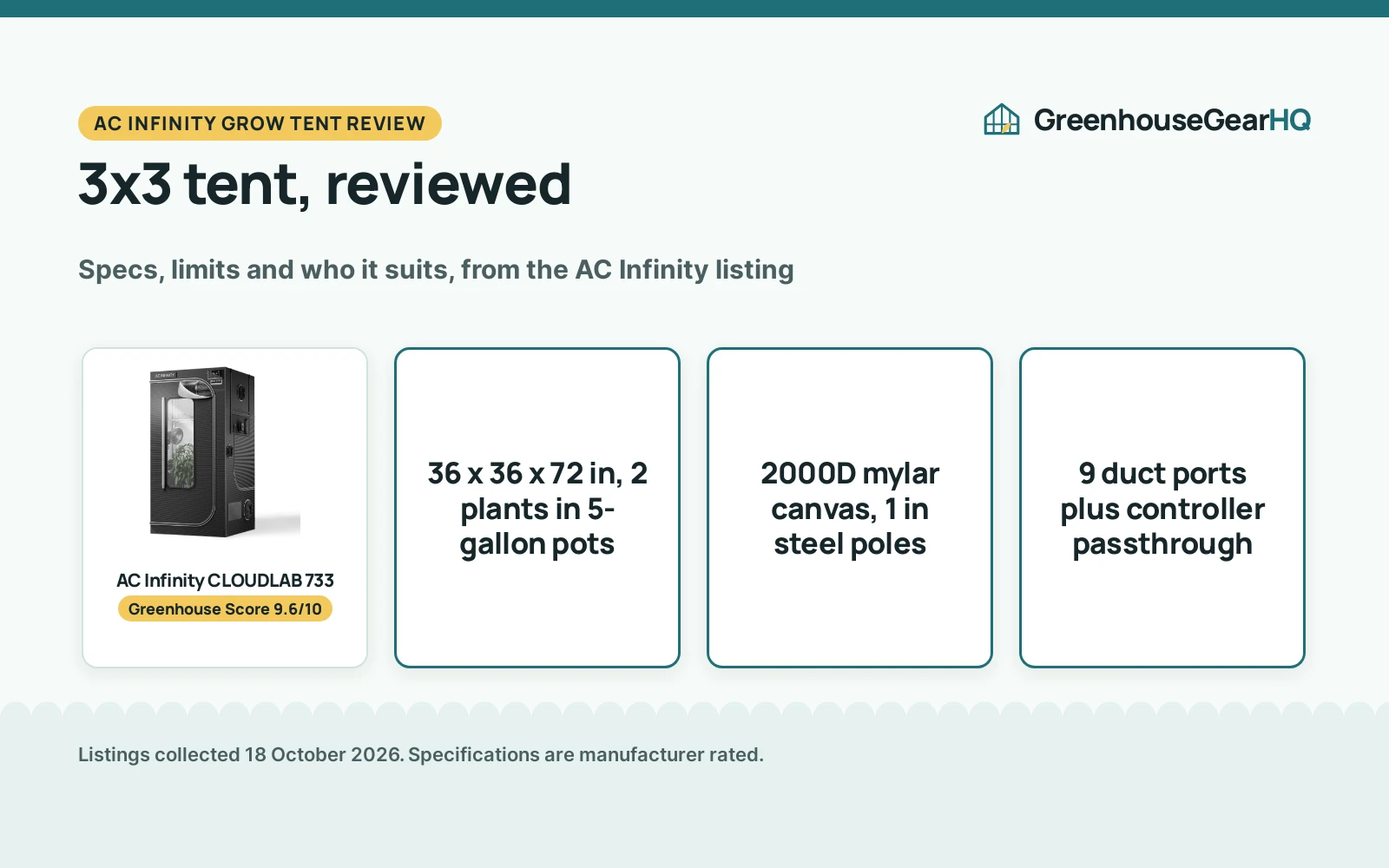
AC Infinity CLOUDLAB 733
A 36 x 36 x 72 inch grow tent rated for 2 plants in 5-gallon pots, with a 2000D mylar canvas, 1 inch steel poles and 9 duct ports.
Pros
- 36 x 36 x 72 in tent rated for 2 plants in 5-gallon pots, with 1 inch steel poles per the listing
- 2000D mylar canvas shell with stated high-reflectivity interior and SBS zippers
- Nine duct ports (4x 4-inch, 2x 6-inch, 3x 8-inch) plus a lightproof controller cable passthrough
- Front zipper flaps against light leaks, reinforced corners, 2 extra hanging bars and a catch tray
Cons
- No warranty term is stated in the listing
- The maker's superlative claims about reflectivity and strength are not checkable figures
As an Amazon Associate I earn from qualifying purchases.
AC Infinity Cloudlab 733 review: the short verdict
A grow tent has one job: hold a controlled climate around your plants while keeping light in and the room out. The CLOUDLAB 733 does that in a 36 x 36 x 72 inch footprint, which the listing rates for 2 plants in 5-gallon pots. The black tent is built from a 2000D mylar canvas with 1 inch steel poles, and the item weight in the spec table is 14.27 kg.
The case for it rests on the stated build and the port count. The bullets list a mylar interior the maker describes as highly reflective, taller windows with SBS zippers, front zipper flaps as an extra layer against light leaks, reinforced corners, a white stain resistant catch tray, 2 hanging bars plus 2 extra, a tool bag with a release buckle, and an innovative controller mounting plate with a lightproof cable passthrough. Ducting is generous: 4 four-inch ports, 2 six-inch ports and 3 eight-inch ports, with extra ports for humidifiers, heaters and air conditioners.
The case against it comes from the spec table. It lists two different weight capacities, 150 pounds and a 250 pound maximum, while the title and bullets give no load figure at all. It also lists a 10 cubic foot chamber volume, which does not match the stated 36 x 36 x 72 inch dimensions. And the listing states no warranty term. Read all three points before you buy.
Key specs
| Grow tent | Greenhouse Score | Size | Poles | Duct ports |
|---|---|---|---|---|
| AC Infinity CLOUDLAB 733 | 9.6/10 | 36 x 36 x 72 in | 1 in steel poles | 9 total: 4×4 in, 2×6 in, 3×8 in |
We reproduce the maker’s listed specs without adjustment (collected 18 October 2026). Where the spec table disagrees with the title and bullets, the title and bullets carry more weight.
What the CLOUDLAB 733 does well
A 3×3 footprint with room for two plants
At 36 x 36 x 72 inches, the tent holds what the listing rates as 2 plants in 5-gallon pots, a common size for a first tent. The 72 inch height leaves room for a hanging light, a small fan and the plants below it, while the square 3×3 base fits a closet corner or a garage wall. Our 3×3 vs 4×4 grow tent comparison shows what the next size up buys you.
Nine duct ports and a controller passthrough
Ventilation is where cheap tents show their limits, and the port list here is long: four 4-inch ports, two 6-inch ports and three 8-inch ports, plus the maker’s note about additional ports for humidifiers, heaters and air conditioners. The controller mounting plate with a lightproof cable passthrough keeps sensor and controller cables tidy without opening a light leak, which is the kind of detail that matters once the tent runs daily.
Light-leak details in the build
The listing puts work into keeping light where it belongs: taller windows with SBS zippers for a full view of the grow, front zipper flaps as an extra layer of protection against leaks, and reinforced tent corners. The 2000D mylar canvas is the maker’s stated shell, with 1 inch steel poles carrying the frame. Those are the maker’s claims rather than figures you can check, but the parts list is specific about what is in the box.
Catch tray and hanging bars included
Small inclusions add up: a white stain resistant catch tray under the plants, 2 hanging bars plus 2 extra for lights and filters, and a tool bag with a release buckle for the bits that always go missing. The 2 side doors give access without opening the full front, which helps when the tent sits against a wall.
Limitations
- Two weight capacities in the spec table: the table lists 150 pounds and a 250 pound maximum, while the title and bullets state no load figure. Treat the hanging load as unstated and hang heavy filters with care.
- Chamber volume does not match the dimensions: the spec table lists 10 cubic feet, but 36 x 36 x 72 inches is a far larger space. Trust the stated dimensions, not the volume figure.
- No warranty term is stated: the listing gives no warranty information, so there is no stated coverage to fall back on.
- Superlative claims are the maker’s: the listing calls the mylar the most reflective and the tent the strongest of its kind, which no buyer can verify from the listing; treat them as marketing, not specs.
- Black only: the spec table lists a black color, so the tent will stand out in a bright room.
How we scored it
| Product | Greenhouse Score | Perf. /35 | Build /25 | Value /25 | Safety /10 | Warranty /5 |
|---|---|---|---|---|---|---|
| AC Infinity CLOUDLAB 733 | 9.6 | 29 | 20 | 20 | n/a | 0 |
Every score falls within 9.2 and 9.8, and a pick moves toward the top end only by earning more weighted points. If there is no power source and no stated safety feature, the safety criterion is left off and 90 points remain.
The Greenhouse Score weighs performance, build, value, safety and warranty, as explained on our How we pick page. For a grow tent, performance covers the stated size, plant capacity and ventilation options; build covers the stated frame, canvas and zipper details. The CLOUDLAB 733 earns solid marks for its specific parts list, 9 duct ports and light-leak details, held back by the spec table contradictions and the missing warranty. No safety or warranty points are awarded because the listing states neither a certification nor a warranty term.
Who should buy the CLOUDLAB 733, and who should skip it
Buy it if
- You want a 3×3 tent rated for 2 plants in 5-gallon pots, in a corner or closet.
- You run ducted ventilation and want 9 ports plus a lightproof controller passthrough.
- Light control matters to you: zipper flaps, SBS zippers and reinforced corners are all stated.
- You are comfortable buying without a stated warranty term.
Skip it if
- You need a stated hanging load for a heavy carbon filter; the listing gives two conflicting figures.
- You want a larger footprint; compare the next tent size up before you buy.
- You want a stated warranty on the tent; this listing has none.
- You would rather compare shell materials first; our mylar vs white vinyl grow tent guide covers the options.
Before you set it up
Assemble the 1 inch pole frame on a flat, dry floor and check every corner connector before hanging anything. Route ducting through the closest port size, 4, 6 or 8 inch, and cap the ports you do not use so light and air stay controlled. Hang lights and filters from the hanging bars within a load you are comfortable with, given the conflicting weight figures in the spec table. Set the catch tray in place before the first watering, since the white stain resistant tray is easier to keep clean than the tent floor.
In the Greenhouse
- 3×3 corner tent: the 36 x 36 x 72 inch size suits 2 plants in 5-gallon pots in a spare room or garage corner.
- Plan the ducting: nine ports across three sizes cover intake, exhaust and accessories; cap what you do not use.
- Check the load: the spec table gives two weight figures, so hang heavy gear with care and check the bars.
- Keep it dry underneath: use the included catch tray and keep the tent floor off damp concrete.
FAQ for growers
What size is the AC Infinity CLOUDLAB 733?
The listing states 36 x 36 x 72 inches, a 3×3 footprint, rated for 2 plants in 5-gallon pots. The spec table’s 10 cubic foot chamber volume does not match those dimensions, so use the stated measurements.
How many duct ports does the CLOUDLAB 733 have?
Nine: four 4-inch ports, two 6-inch ports and three 8-inch ports, plus a lightproof cable passthrough on the controller mounting plate and extra ports for humidifiers, heaters and air conditioners.
What is the weight capacity of the CLOUDLAB 733?
The listing does not give a reliable figure. The spec table lists both 150 pounds and a 250 pound maximum, while the title and bullets state no load capacity, so treat the hanging load as unstated.
Does the CLOUDLAB 733 have a warranty?
No warranty term is stated in the listing. Keep your order record, since there is no stated coverage to claim against.
Keep reading
See every grow tents guide and all indoor growing guides. Also see our 3×3 vs 4×4 grow tent comparison. Also see our grow tent vs greenhouse comparison. Also see our mylar vs white vinyl grow tent guide.
More picks: grow tent vs grow box, tall vs standard height tents and multi vs single chamber tents.