On this page
Top picks at a glance
As an Amazon Associate I earn from qualifying purchases.
- 1
 JFWOD 6lb Hard Akadama9.6/10View on Amazon
- 2
 JK Global Pumice 20 Quarts9.6/10View on Amazon
- 3
 NOHOBE 5lb Hard Akadama9.6/10View on Amazon
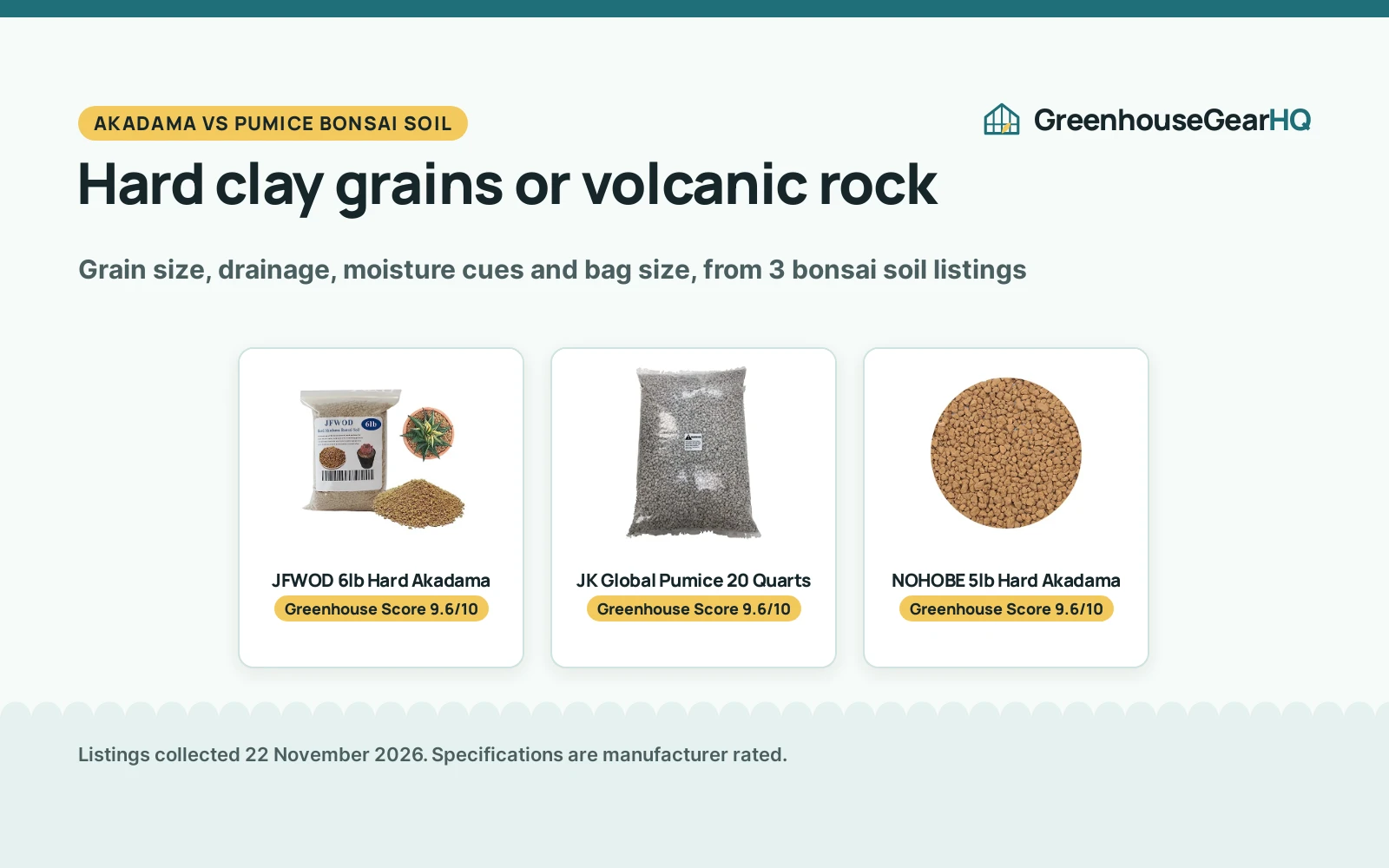
On a cold morning in late winter, when the first seed trays are out on the bench and a bonsai waits for repotting, the akadama vs pumice bonsai soil choice decides how water moves through the pot. Both are volcanic, both drain freely, and both appear in bonsai mixes, yet they behave differently once wet. This guide compares hard akadama bags against a pumice bag, using what each listing states about grain, drainage, moisture cues and bag size.
GreenhouseGearHQ earns a commission when you buy through links on this page, at no extra cost to you. As an Amazon Associate I earn from qualifying purchases. Affiliate disclosure.
Quick verdict: pick akadama if you want a moisture cue you can see, since both akadama bags darken when wet, and the JFWOD bag adds a reusable sealing bag at 6 pounds. Pick pumice if you want a 20-quart sack of 1/4 inch particles that the maker says holds over 70 trace minerals and does not break down. The NOHOBE 5-pound bag suits growers who want a 1/8 to 1/4 inch grain for use as a soil amendment or top dressing.
The examples
| # | Product | Greenhouse Score | Buy |
|---|---|---|---|
| 1 | JFWOD 6lb Hard Akadama | 9.6/10 | Buy on Amazon |
| 2 | JK Global Pumice 20 Quarts | 9.6/10 | Buy on Amazon |
| 3 | NOHOBE 5lb Hard Akadama | 9.6/10 | Buy on Amazon |

JFWOD 6lb Hard Akadama
A 6-pound bag of 3-6mm hard akadama in a reusable sealing bag, with a color cue that darkens when wet and fast drainage for bonsai, cactus and succulents.
Pros
- Darkens when wet, showing when to water
- Reusable sealing bag keeps the 6-pound supply tidy between mixes
- Highly porous fired clay with faster drainage
- Spreads nutrients to bonsai roots, as the maker states
Cons
- Rarely used on its own, so it suits mixing rather than a fill on its own
- No pH figure is stated
- No warranty term is stated
- Color cue only helps while the surface is visible, so a top dressing can hide it

JK Global Pumice 20 Quarts
A 20-quart bag of 1/4 inch pumice that the maker says is 100% natural, non-decomposing and packed with over 70 trace minerals, for bonsai, succulents and tropical aroids.
Pros
- 20-quart bag covers several pots from one sack
- Non-decomposing stone holds its structure in the mix
- Over 70 trace minerals stated by the maker
- Can be used on its own or blended with a preferred soil
Cons
- No color cue shows when it needs water
- No pH figure is stated
- No warranty term is stated
- Only one particle size, 1/4 inch, is offered in this bag

NOHOBE 5lb Hard Akadama
A 5-pound bag of 1/8 to 1/4 inch hard akadama with a moisture color cue, fast drainage and a stable pH claim, for use as an amendment or top dressing.
Pros
- Darkens when wet, showing when to water
- Stable pH stated for potted plants
- Fast drainage with airflow around bonsai roots
- Works as a soil amendment or top dressing for many plant types
Cons
- 5-pound bag is the lighter of the two akadama bags
- No warranty term is stated
- Stable pH is stated with no figure
- Rarely used on its own, so it suits mixing rather than a fill on its own
As an Amazon Associate I earn from qualifying purchases.
Other options worth a look
 NOHOBE 2.5lb 1/8-1/4 inch Hard Akadama Bonsai Soil forCheck price on Amazon
 5 Qt Premium Bonsai Mix with AkadamaCheck price on Amazon
 2.5 Qt Premium Bonsai Mix with AkadamaCheck price on Amazon
 Bonsai Soil Mix by TinyrootsCheck price on Amazon
 Horticultural Akadama SoilCheck price on Amazon
 ZzbTwinkle Japanese Hard Akadama Soil for PlantsCheck price on Amazon
Akadama vs pumice bonsai soil: side by side
| Bonsai Soil | Greenhouse Score | Side | Grain size | Bag size | Moisture cue | Warranty | Amazon |
|---|---|---|---|---|---|---|---|
| JFWOD 6lb Hard Akadama | 9.6/10 | Akadama | 3-6mm | 6 pounds | Darkens when wet | Not stated | View on Amazon |
| JK Global Pumice 20 Quarts | 9.6/10 | Pumice | 1/4 inch | 20 quarts | Not stated | Not stated | View on Amazon |
| NOHOBE 5lb Hard Akadama | 9.6/10 | Akadama | 1/8 to 1/4 inch | 5lb | Darkens when wet | Not stated | View on Amazon |
Each figure is the brand’s own rating, taken from its product page on 22 November 2026.
Grain size and drainage
The grain sets the drainage. JFWOD lists a 3-6mm small grain of hard akadama, fired clay from volcanic soil, and describes it as highly porous with faster drainage. NOHOBE lists a 1/8 to 1/4 inch hard akadama grain and ties it to fast drainage and aeration, with airflow around bonsai roots. The pumice bag lists a 1/4 inch particle size and calls pumice a crucial element in any soil mixture. All of the listings describe free drainage, so the choice is between two akadama grain ranges and one pumice size.
Both akadama listings say the material is rarely used on its own and that mixing particles with different water retention properties opens up nearly limitless bonsai mixes. The pumice listing goes further and says it can be used on its own or blended with a preferred soil. That makes pumice the only one of the 3 that the maker presents as a stand-alone fill, while both akadama bags are framed as mix parts.
Moisture cues and watering
Akadama gives a visible watering cue that pumice does not. Both the JFWOD and NOHOBE listings say akadama soil darkens when wet, showing when to water, and both say it keeps its form when dry and absorbs water when wet. JFWOD adds that the clay provides the tree with moisture while preventing compaction, and NOHOBE adds that it prevents compaction and holds a stable pH. The pumice listing states no color change and no pH figure, so a grower using pumice watches the plant and the pot instead of the soil color.
The pumice listing points to a different strength: it says the stone is non-decomposing and packed with over 70 trace minerals, promoting plant health and thriving growth. Akadama, as fired clay, is described as highly porous and as spreading nutrients to bonsai roots in the JFWOD listing. Neither side states a nutrient figure beyond the pumice mineral count, so compare them on structure and moisture behavior, not on feeding.
Bag size and mixing use
The bags come in different measures. JFWOD sells 6 pounds per bag in a reusable sealing bag, with stated dimensions of 9.0 inches by 3.0 inches by 10.0 inches. NOHOBE sells a 5lb bag with stated dimensions of 10.0 inches by 3.0 inches by 1.0 inches. The pumice bag is sold by volume at 20 quarts, in a bag made from recycled material, and the maker says it comes from trusted sources in the United States. Pounds and quarts do not convert here, since no density is stated, so match the bag to the job by what you plan to mix, not by comparing the numbers across units.
All 3 suit more than bonsai alone. JFWOD names cactus, succulents and bonsai plants. NOHOBE names bonsai, succulents, cacti, lithops, jade plants, snake plants, terrariums and drought-tolerant houseplants, and says the material works as a soil amendment or top dressing. The pumice listing names bonsai, succulent, cactus, alocasia, monstera and tropical aroids. A grower with several pots on the bench gets use from any of the 3 beyond one bonsai.
How to choose the best akadama vs pumice bonsai soil
Match the grain to the pot
Start with grain. The JFWOD 3-6mm grain and the NOHOBE 1/8 to 1/4 inch grain are both small grains, while the pumice bag holds a 1/4 inch particle size. Small pots and shallow bonsai trays suit small grains, and the fixed pumice size suits a grower who wants one uniform particle through the mix. The best bonsai pots picks show the shallow trays these grains are made for.
Decide how you want to water
Akadama darkens when wet, so the two akadama bags give a watering cue without lifting the pot. Pumice gives no color cue, so watering relies on habit and feel. If you water many pots in a row, the visible cue saves attention; if you already water on a set routine, the pumice bag works the same. A bonsai tool kit helps with repotting either way, since both sides are mixed and moved by hand.
Buy the bag that fits the bench
Match the bag to the bench, not to the other bags. A sealing bag keeps a small supply tidy, a volume bag suits a row of pots, and an amendment bag suits top dressing across many plants.
| If you need | Look at |
|---|---|
| A moisture cue and a sealing bag | JFWOD 6lb Hard Akadama |
| A 20-quart sack for several pots | JK Global Pumice 20 Quarts |
| A 1/8 to 1/4 inch grain for amendment or top dressing | NOHOBE 5lb Hard Akadama |
In the Greenhouse
- Keep the JFWOD bag sealed in its reusable bag between mixes, and use the darkening color as the watering cue.
- Mix akadama with other particles rather than filling a pot with it alone, as both akadama listings advise.
- Use the pumice on its own or blended, and store the 20-quart sack where it stays dry before use.
- Repot in late winter before the growing season, when the bench is clear and the trees are still dormant.
Scoring notes
| Product | Greenhouse Score | Perf. /35 | Build /25 | Value /25 | Safety /10 | Warranty /5 |
|---|---|---|---|---|---|---|
| JFWOD 6lb Hard Akadama | 9.6 | 30 | 21 | 20 | n/a | 0 |
| JK Global Pumice 20 Quarts | 9.6 | 29 | 20 | 21 | n/a | 0 |
| NOHOBE 5lb Hard Akadama | 9.6 | 28 | 20 | 20 | n/a | 0 |
We rescale the weighted total onto a range that ends at 9.2 and 9.8; nothing in the conversion can reorder two picks. If there is no power source and no stated safety feature, the safety criterion is left off and 90 points remain.
The Greenhouse Score weighs performance, build, value, safety and warranty, as explained on the How we pick page. For bonsai soil, safety reflects stated handling or material safety detail; none of the 3 listings states a safety certification, so none earns safety points. None of the 3 states a warranty term either, so no warranty points are given. The JFWOD bag leads on performance for its moisture cue, fast drainage and nutrient spreading, plus a reusable sealing bag. The pumice bag scores well on value for its 20-quart size and non-decomposing stone, while the NOHOBE bag scores on its stable pH claim and wide plant list.
FAQ for growers
Is akadama or pumice better for bonsai soil?
It depends on the job. The JFWOD and NOHOBE akadama bags darken when wet and drain fast, while the pumice bag offers a 20-quart sack of 1/4 inch particles with over 70 trace minerals that does not break down.
Can pumice be used on its own for bonsai?
Yes, the maker says pumice can be used on its own or blended with a preferred soil. Both akadama listings say akadama is rarely used on its own and is mixed with other particles.
How do you know when akadama needs water?
Both akadama listings say the soil darkens when wet, indicating when to water, and that it keeps its form when dry and absorbs water when wet. Pumice states no color cue.
What grain size is the akadama in this comparison?
JFWOD lists a 3-6mm small grain and NOHOBE lists a 1/8 to 1/4 inch grain. The pumice bag lists a 1/4 inch particle size.
Keep reading
See every bonsai supplies guide and all bonsai and houseplant care guides.
More picks: bonsai pots, bonsai tool kits, bonsai scissors and ceramic vs plastic bonsai pots.