On this page
Top picks at a glance
As an Amazon Associate I earn from qualifying purchases.
- 1
 VIVOSUN 4 Inch Flexible Aluminum Ducting9.6/10View on Amazon
- 2
 VIVOSUN 4 Inch Flex Aluminum DuctingView on Amazon
- 3
 VIVOSUN 4 Inch 25 Feet Flexible Aluminum Ducting with 2 ClampsView on Amazon
- 4
 VIVOSUN 6 Inch Flex Aluminum DuctingView on Amazon
- 5
 Aluminum Foil Duct Tape Heavy Duty WaterproofView on Amazon
- 6
 Eastman 8 Foot ArmorFlex Dryer VentView on Amazon
- 7
 VIVOSUN 3 Inch 16 Feet Flexible Aluminum Ducting with 2 ClampsView on Amazon
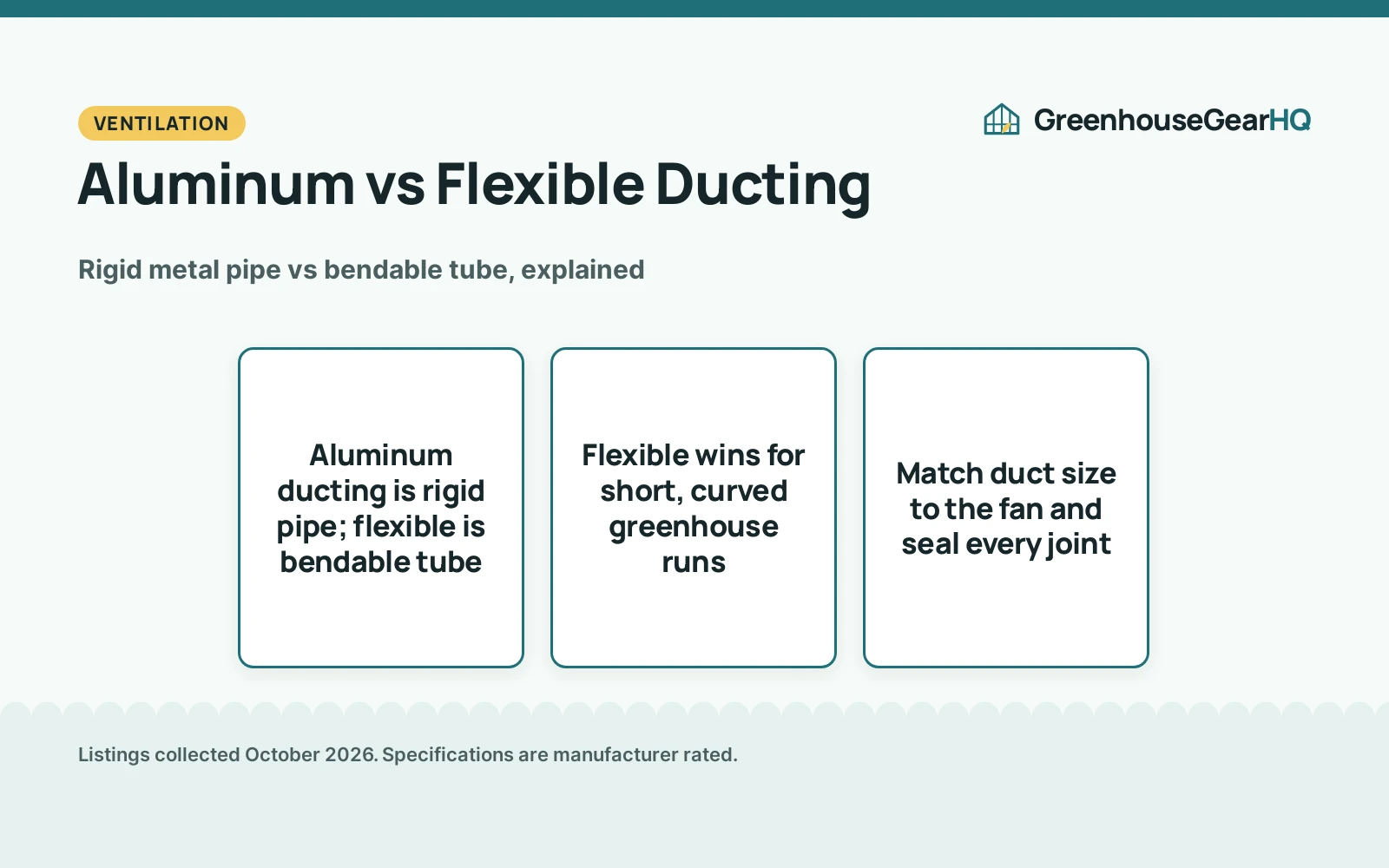
Aluminum vs flexible ducting: aluminum ducting is rigid metal pipe, while flexible ducting is bendable tube, usually aluminum foil around a steel-wire spiral. For a greenhouse, flexible ducting wins in almost every real case: it bends around frames, reaches hard places and costs less to install, while rigid aluminum only earns its place in long straight runs where smooth walls matter. This guide explains the tradeoff step by step, using figures from real listings.
Other options worth a look
 VIVOSUN 4 Inch Flex Aluminum DuctingCheck price on Amazon
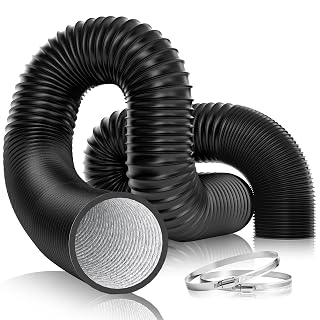 VIVOSUN 4 Inch 25 Feet Flexible Aluminum Ducting with 2 ClampsCheck price on Amazon
 VIVOSUN 6 Inch Flex Aluminum DuctingCheck price on Amazon
 Aluminum Foil Duct Tape Heavy Duty WaterproofCheck price on Amazon
 Eastman 8 Foot ArmorFlex Dryer VentCheck price on Amazon
 VIVOSUN 3 Inch 16 Feet Flexible Aluminum Ducting with 2 ClampsCheck price on Amazon
GreenhouseGearHQ earns a commission when you buy through links on this page, at no extra cost to you. As an Amazon Associate I earn from qualifying purchases. Affiliate disclosure.
What each one is
Rigid aluminum ducting is smooth metal pipe, sold in straight lengths that join with elbows. It has low friction, so air moves through it with little resistance, but every bend needs a fitting and the pipe cannot curve around a greenhouse frame. Flexible ducting is a tube of aluminum foil, thermoplastic and steel wire that bends by hand. The listings here are all flexible: AC Infinity sells it in 6, 8, 10 and 12 in diameters and 8 or 25 ft lengths with a four-layer build and a steel-wire spiral, while VIVOSUN sells 4 and 6 in diameters in 8 or 25 ft with a triple-layer build and built-in steel wire. The wire spiral holds the tube open when bent, which rigid pipe never needs to do.
Airflow and resistance
The smooth inside wall of rigid aluminum is its one real advantage: air meets less friction, so a fan delivers more of its rated CFM through a straight run. Flexible ducting has a ribbed inner surface from the wire spiral, and every bend adds resistance. The practical answer is to keep flexible runs short and straight: pull the tube taut instead of letting it sag, and avoid sharp bends. For fans that push through ducting, our best ducting for inline fan picks pair fans with the right size, and our exhaust fan sizing guide explains CFM against space.
Sizes, lengths and clamps
Match the duct size to the fan diameter for a tight fit; the VIVOSUN listing says this directly, with the example of pairing a 4 in fan with 4 in ducting. Flexible ducting ships in standard diameters from 4 to 12 in across these listings, in 8 or 25 ft lengths. Buy more length than you need: the AC Infinity tube can be shortened for retrofit projects, and the TEAIERXY listing advises choosing 1.5 ft longer than the actual length used, since the hose stretches and compresses. Every listing here includes two clamps: AC Infinity ships two stainless steel clamps in the duct size, VIVOSUN ships two heavy-duty steel clamps. Seal joints with aluminum foil tape; the SmaringWing tape here is 2 in wide, 65 ft long and 3.9 mil thick.
Heat, moisture and layers
Greenhouses are hot and humid, so layers matter. The AC Infinity four-layer build wraps flame-resistant aluminum inside PVC thermoplastic; the VIVOSUN triple-layer build sandwiches PET thermoplastic between flame-retardant aluminum foil layers, with the foil resisting high temperatures and corrosion. The TEAIERXY hose goes further with six layers: 2 aluminum foil, 2 PET, steel wire and PVC film, with a 1 mm steel wire diameter to prevent deformation, and the PVC film adds light-proofing, noise reduction and insulation. One AC Infinity listing states a maximum pressure of 4 bar. For tape near hot ducting, the SmaringWing aluminum foil tape is stated to resist 120 C long term and 350 C short term. Rigid aluminum handles heat well too, but its joints are the weak point; wrap them in foil tape either way.
Installation effort
This is where flexible ducting wins outright. It bends 360 degrees by hand, threads through tight spots, cuts to length, and hangs with straps; no elbows, no sheet-metal screws, no measuring angles. Rigid ducting needs elbows for every turn, sealed joints at every connection, and hangers rated for the metal’s weight, which is far heavier than the 0.34 kg of a VIVOSUN 4 in 8 ft run or the 3.9 kg of an AC Infinity 12 in 25 ft run. For a greenhouse with curved frames and short runs, flexible ducting installs in an afternoon; rigid ducting is a workshop project.
Aluminum vs Flexible Ducting: Which Should You Choose?
Choose flexible ducting if the run is short, curved or temporary, if you are connecting an inline fan to a vent, or if you want the simplest install. The listings here cover diameters from 4 to 12 in and lengths of 8 or 25 ft, all with clamps included.
Choose rigid aluminum if the run is long and straight, if maximum airflow matters more than easy installation, or if the duct must hold its shape without support. Seal every joint with aluminum foil tape and support long spans.
Whichever you pick, size it to the fan, seal the joints, and keep the run as short and straight as the layout allows.
In the Greenhouse
- Pull flexible ducting taut; sagging tube adds resistance.
- Keep intake ends screened so leaves and insects stay out of the fan.
- Seal joints with aluminum foil tape, not cloth duct tape.
- Support long flexible runs so the wire spiral does not stretch under its own weight.
- Check clamps each season; heat cycles loosen them.
FAQ for growers
Is flexible ducting worse for airflow?
Its ribbed inside wall adds more resistance than smooth rigid pipe, so keep runs short and straight and pull the tube taut.
What size ducting do I need?
Match it to the fan diameter: a 4 in fan takes 4 in ducting, per the VIVOSUN listing. Listings here run from 4 to 12 in.
Can I cut flexible ducting shorter?
Yes. The AC Infinity tube can be shortened for retrofit projects, and the TEAIERXY hose can be cut to the required length; buy 1.5 ft longer than needed.
Do I need clamps and tape?
Clamps come with the ducting here, two per listing. Aluminum foil tape seals the joints; the SmaringWing tape is 2 in wide and 65 ft long.
Can flexible ducting handle heat?
The listings state flame-retardant aluminum layers and high-temperature resistance; the TEAIERXY adds PVC insulation, and the foil tape is stated to resist 120 C long term.
Keep reading
See every greenhouse fan guide and all ventilation guides.
More picks: ducting for inline fans, exhaust fans for hoop houses and exhaust fan sizing.