On this page
Top picks at a glance
As an Amazon Associate I earn from qualifying purchases.
- 1
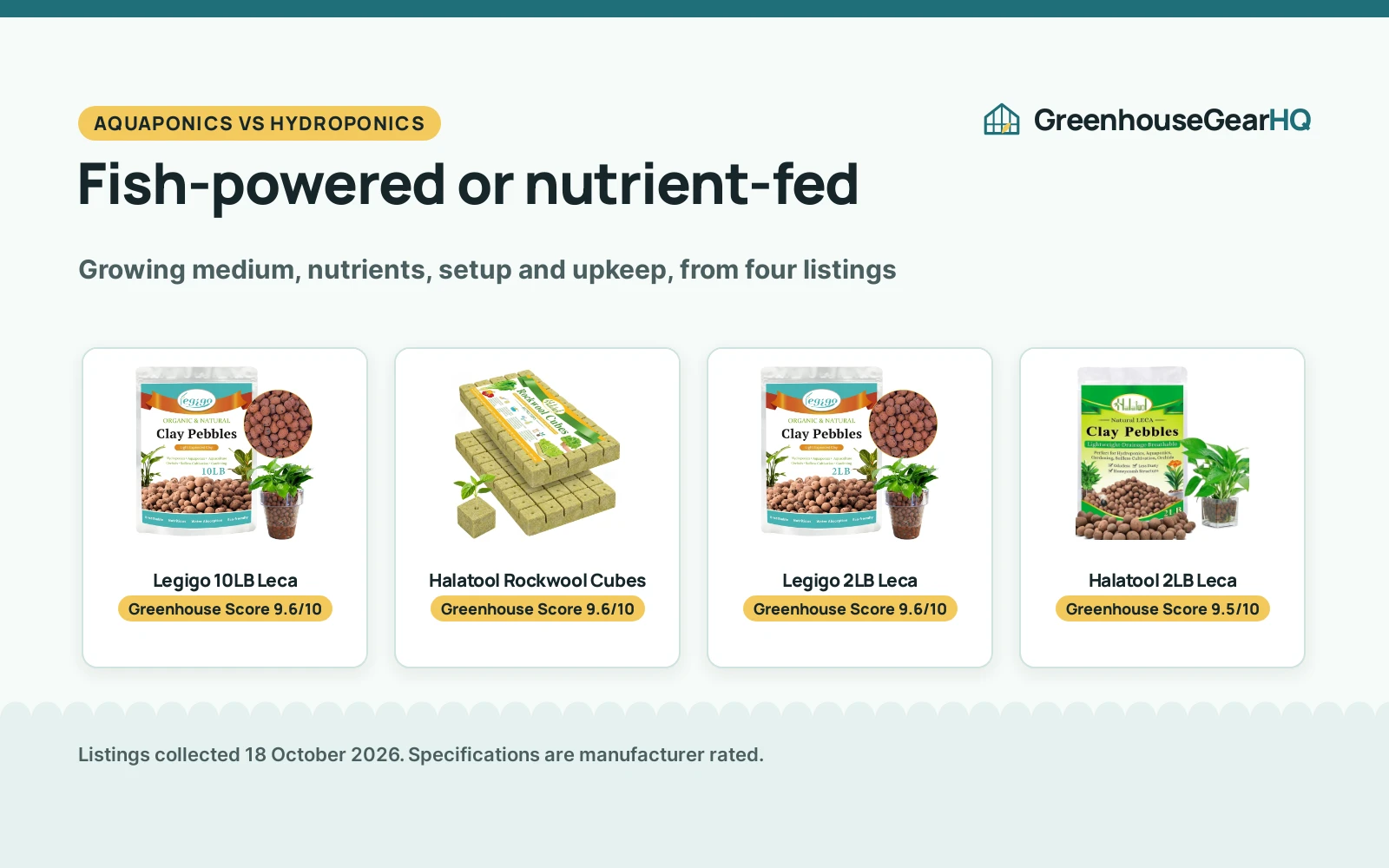
 Legigo 10LB Leca9.6/10View on Amazon
- 2
 Halatool Rockwool Cubes9.6/10View on Amazon
- 3
 Legigo 2LB Leca9.6/10View on Amazon
- 4
 Halatool 2LB Leca9.5/10View on Amazon
Aquaponics vs hydroponics comes down to where the nutrients come from: aquaponics feeds plants with fish waste in a recirculating loop, while hydroponics feeds them with a nutrient solution the grower mixes. We compared four growing-medium listings, two tagged for each side, to show what separates the methods in practice. A figure from one listing describes that listing only; where a listing states nothing, we say so.
GreenhouseGearHQ earns a commission when you buy through links on this page, at no extra cost to you. As an Amazon Associate I earn from qualifying purchases. Affiliate disclosure.
Quick verdict: choose aquaponics if you want fish and plants in one recirculating system and you accept the extra care a living loop needs. Choose hydroponics if you want direct control over the nutrient mix and a setup focused on plants alone. The listings here are the media both sides grow in: expanded clay pebbles for drainage and aeration, and rockwool cubes for starting seeds.
Four examples
| # | Product | Greenhouse Score | Buy |
|---|---|---|---|
| 1 | Legigo 10LB Leca | 9.6/10 | Buy on Amazon |
| 2 | Halatool Rockwool Cubes | 9.6/10 | Buy on Amazon |
| 3 | Legigo 2LB Leca | 9.6/10 | Buy on Amazon |
| 4 | Halatool 2LB Leca | 9.5/10 | Buy on Amazon |

Legigo 10LB Leca
10-pound bag of 4 to 16 mm expanded clay pebbles, pH neutral and reusable, listed for aquaponics.
Pros
- 10-pound bag with 160 fluid ounces of pebbles, the largest quantity here
- 4 to 16 mm size suits small to medium pots
- pH neutral clay stated to help remove excess acidity
- Reusable: rinse and dry between plantings
Cons
- No warranty term is stated
- No safety certification is stated
- Heaviest bag here at 10 pounds to carry and pour
- Pebbles vary 4 to 16 mm, so sizing is not uniform

Halatool Rockwool Cubes
100 pre-drilled 1-inch basalt stonewool cubes for starting seeds in DWC, NFT and Kratky setups.
Pros
- 100 cubes across 2 sheets, the highest piece count here
- Pre-drilled holes for fast, clean seed starting
- Single cube measures about 0.94 by 0.94 by 0.98 inches
- Fits 1020 trays and 2-inch net cups
Cons
- No warranty term is stated
- No safety certification is stated
- pH of the cubes is not stated; the listing says to soak and adjust pH/EC
- For starting seeds only, not a full grow medium

Legigo 2LB Leca
2-pound bag of 4 to 16 mm expanded clay pebbles, pH neutral and reusable, listed for aquaponics.
Pros
- 4 to 16 mm pebbles suit small to medium pots
- pH neutral clay stated to help remove excess acidity
- Reusable: rinse and dry between plantings
- Resealable foil pouch for storage
Cons
- No warranty term is stated
- No safety certification is stated
- 2-pound quantity fills fewer pots than the 10-pound Legigo
- Pebbles vary 4 to 16 mm, so sizing is not uniform

Halatool 2LB Leca
2-pound bag of 4 to 16 mm expanded clay pebbles, pH-neutral and reusable, listed for hydroponics.
Pros
- Inert, pH-neutral clay stated with less chalking in water
- 4 to 16 mm size range for aeration and drainage
- Reusable after cleaning
- 96 ounces stated per bag
Cons
- No warranty term is stated
- No safety certification is stated
- Listing gives less usage detail than the Legigo leca listings
- Pebbles vary 4 to 16 mm, so sizing is not uniform
As an Amazon Associate I earn from qualifying purchases.
Other options worth a look
 Penn-PlaxCheck price on Amazon
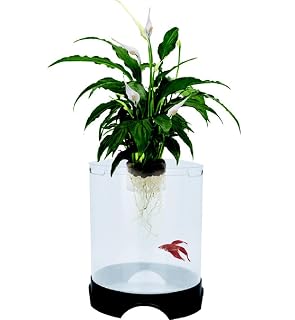 Penn-Plax Aquaponic Planter and Aquarium for Betta FishCheck price on Amazon
 Hydroponic Garden Aquaponic Fish Tank Plants Growing SystemCheck price on Amazon
Aquaponics vs hydroponics: side by side
| Medium | Greenhouse Score | Size | Weight / count | Material | pH | Reuse | Amazon |
|---|---|---|---|---|---|---|---|
| Legigo 10LB Leca | 9.6/10 | 4 to 16 mm | 10 lb | Expanded clay | Neutral | Yes | View on Amazon |
| Halatool Rockwool Cubes | 9.6/10 | 1 in cubes | 100 pieces | Basalt stonewool | Not stated | Not stated | View on Amazon |
| Legigo 2LB Leca | 9.6/10 | 4 to 16 mm | 2 lb | Expanded clay | Neutral | Yes | View on Amazon |
| Halatool 2LB Leca | 9.5/10 | 4 to 16 mm | 2 lb | Expanded clay | Neutral | Yes | View on Amazon |
We reproduce the maker’s listed specs without adjustment (collected 18 October 2026).
Nutrient source
This is the real divide, and none of the four listings states a nutrient figure. In aquaponics, fish waste supplies the nutrients and the plants clean the water in return; in hydroponics, the grower mixes the nutrient solution and adjusts it directly. The Legigo leca listings say the pebbles can store nutrients and release them slowly to roots, while the Halatool rockwool listing says to soak cubes in nutrient solution to adjust pH and EC. Neither side’s listing publishes a concentration, so the comparison rests on method, not numbers.
Growing medium
Three of the four listings are expanded clay pebbles from 4 to 16 mm: the Legigo 10LB and 2LB bags tagged for aquaponics, and the Halatool 2LB bag tagged for hydroponics. All three state pH-neutral, reusable clay with a porous structure for drainage and aeration. The fourth listing, Halatool rockwool, is a different medium entirely: 100 pre-drilled 1-inch cubes of spun basalt fiber for starting seeds, with cubes about 0.94 by 0.94 by 0.98 inches. The medium does not decide the side: the same leca suits both methods.
Listing gaps to check
None of the four listings states a warranty term or a safety certification. The rockwool listing does not state the cubes’ pH, only that you soak them to adjust pH and EC. The leca listings give pebble size as a range, 4 to 16 mm, not a uniform figure. Bag quantities differ in how they are stated: the Legigo 10LB lists 160 fluid ounces, the Legigo 2LB lists 32 ounces and 0.9 kg, and the Halatool 2LB lists 96 ounces.
Which should you choose?
Choose aquaponics if you want fish and plants supporting each other in one loop, and you are ready to manage water quality for living animals as well as plants. The Legigo leca bags are tagged for aquaponics beds. Choose hydroponics if you want to dial nutrients directly and keep the system plant-only. The Halatool rockwool cubes and leca suit hydroponic setups from seed to harvest. Compare more hydroponic system guides before deciding.
In the Greenhouse
- Rinse leca thoroughly before first use to remove shipping dust, as the Halatool listing advises.
- Soak rockwool cubes in nutrient solution to adjust pH and EC before placing seeds, and wear gloves when cutting the sheets.
- Match cube size to your containers: the 1-inch Halatool cubes fit 2-inch net cups and 1020 trays.
- Reuse leca by rinsing and drying the pebbles between plantings, per the Legigo listings.
Scoring notes
| Product | Greenhouse Score | Perf. /35 | Build /25 | Value /25 | Safety /10 | Warranty /5 |
|---|---|---|---|---|---|---|
| Legigo 10LB Leca | 9.6 | 30 | 21 | 21 | n/a | 0 |
| Halatool Rockwool Cubes | 9.6 | 30 | 21 | 20 | n/a | 0 |
| Legigo 2LB Leca | 9.6 | 29 | 21 | 19 | n/a | 0 |
| Halatool 2LB Leca | 9.5 | 29 | 20 | 19 | n/a | 0 |
Every score falls within 9.2 and 9.8, and a pick moves toward the top end only by earning more weighted points. An unpowered frame or shelf with no listed safety features is scored without safety, across the other 90 points.
The Greenhouse Score weighs performance, build, value, safety and warranty, as explained on our How we pick page. For growing media, safety reflects a stated material-safety claim; none of the four listings states a certification, so none earns safety points, and none states a warranty term either. The Legigo 10LB leca ranks first on the largest stated quantity, while the Halatool rockwool earns its place with exact cube dimensions and a 100-piece count.
FAQ for growers
Can the same growing medium be used for aquaponics and hydroponics?
Yes. The Legigo leca listings name aquaponics among their uses while the Halatool leca listing names hydroponics; all three are 4 to 16 mm pH-neutral expanded clay.
What size are leca clay pebbles?
The three leca listings all state 4 to 16 mm. The size varies within the bag rather than being uniform.
How do you start seeds in rockwool cubes?
The Halatool listing says to soak the cubes in nutrient solution to adjust pH and EC, place seeds in the pre-drilled holes, and transplant when roots penetrate 0.5 to 1 inch.
Keep reading
See every hydroponic system guide and all indoor growing guides.
More picks: RDWC vs DWC, ebb and flow vs DWC and DWC vs NFT.