On this page
Top picks at a glance
As an Amazon Associate I earn from qualifying purchases.
- 1
 VEVOR Greenhouse Plastic Sheeting 24 x 100 ft 5 Mil Clear9.6/10View on Amazon
- 2
 Sinimaka 10 Pack Polycarbonate Greenhouse Panels9.6/10View on Amazon
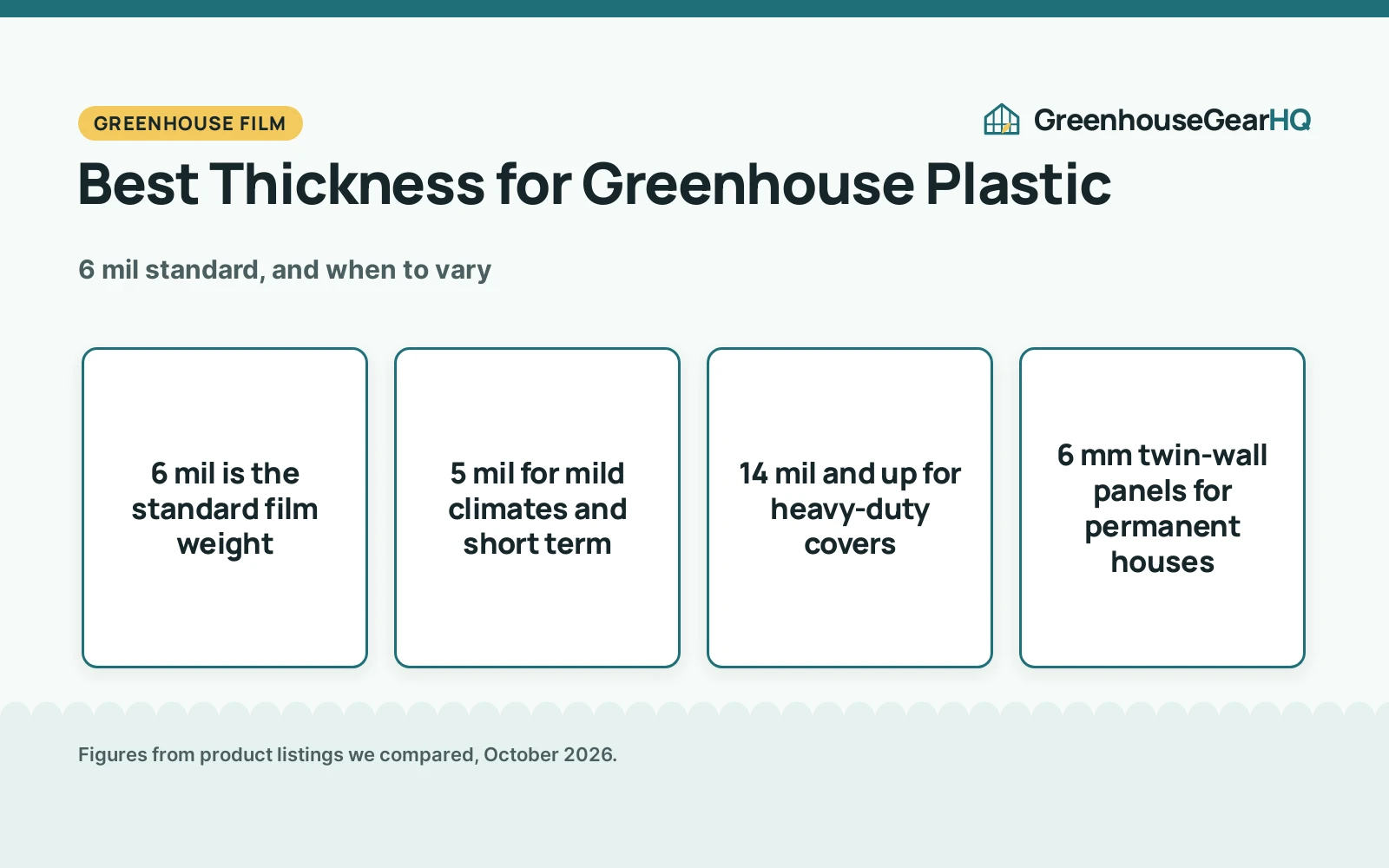
The best thickness for greenhouse plastic is 6 mil for most growers. It is the standard greenhouse film weight: strong enough for multi-season use, light enough to handle, and widely available with UV protection. Thinner 5 mil film suits mild climates and short-term covers, while 14 mil and thicker tarps handle heavy-duty jobs. Rigid twin-wall polycarbonate panels, at 6 mm, are the step up for permanent houses. This guide explains each choice step by step. Where a number appears, it comes from a product listing we compared, and we name the listing so you can check it.
Other options worth a look
 9.8" X 115' Greenhouse Repair Tape 6.3mil Thickness HeavyCheck price on Amazon
 11.8" X 115' Greenhouse Repair Tape 6.3mil Thickness HeavyCheck price on Amazon
 Vevitts Greenhouse Plastic FilmCheck price on Amazon
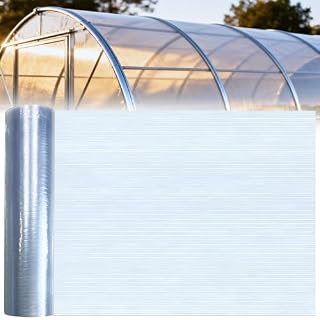 Tacsal 32.81×3.94 Ft Polycarbonate Roofing SheetCheck price on Amazon
GreenhouseGearHQ earns a commission when you buy through links on this page, at no extra cost to you. As an Amazon Associate I earn from qualifying purchases. Affiliate disclosure.
What is the best thickness for greenhouse plastic?
The short answer: 6 mil film for most growers, 5 mil for mild climates and short-term covers, and 14 mil or thicker for heavy-duty or exposed sites. For rigid panels, 6 mm twin-wall polycarbonate is the common choice. The sections below explain when each one earns its place.
Why 6 mil is the standard
Six mil is the thickness most greenhouse films are sold in, and for good reason. The VEVOR 6 mil sheeting at 32 by 25 feet is marketed as tear-resistant with UV protection for long-lasting outdoor use, and the Rohseson 6 mil at 25 by 40 feet lists 90% light transmission with anti-drip treatment. The ZSLTLDU 6 mil (on Amazon) at 13 by 100 feet claims over 92% light transmission with 4-year UV protection, and the Farm Plastic Supply 6 mil overwintering film at 20 by 100 feet is built for winter heat retention. Across brands, 6 mil is the weight that balances strength, light and price.
When 5 mil is enough
Five mil film is a step lighter and usually a step cheaper. The VEVOR 5 mil (on Amazon) at 24 by 100 feet is described as thick yet flexible, resisting tearing during installation while covering hoop houses and garden beds. Choose 5 mil for mild climates, single-season covers, or small structures where wind loads are low. It will not last as long as 6 mil in harsh sun, so treat it as the shorter-term option.
When to go thicker: 14, 16 and 20 mil
Heavy-duty clear tarps start where greenhouse film leaves off. The KGOSAUO 14 mil vinyl tarp at 8 by 10 feet lists 99% light transmission with grommets every 17 to 20 inches, and it is rated from minus 32 degrees F to 176 degrees F. The frtzal 16 mil at 30 by 40 feet lists 90% light transmission with a lifespan of up to 4 years. The Ansgery 20 mil at 16 by 20 feet adds grommets every 18 to 23 inches for windproof fastening. Thicker film resists punctures and wind far better, at the cost of weight and stiffness. Pick these for exposed sites, chicken coops, or covers that stay up year-round.
Panels instead of film: 6 mm twin-wall
For a permanent house, rigid panels beat film. The Sinimaka twin-wall polycarbonate panels (on Amazon) at 8 by 4 feet and 0.24 inches thick list 89% light transmission while blocking 99.9% of UV, with a range of minus 40 C to 120 C. The EVERECO 8 by 4 foot panels at 0.24 inches list 90% light transmission with twin-wall heat retention. Panels cost more up front but last far longer than any film, and they need no re-covering.
Thickness versus light
Thicker is not always darker, but the numbers tell the story. The Rohseson 6 mil lists 90% light transmission, the ZSLTLDU 6 mil over 92%, and the KGOSAUO 14 mil 99%. The Farm Plastic Supply 6 mil overwintering film lists only 55%, because it is an opaque diffuser designed to even out winter light, not maximize it. Match the film to the crop: seedlings want maximum light, while winter greens do fine under diffusion. For winter-specific picks, see our greenhouse plastic for winter guide, and for hoop houses, greenhouse plastic for hoop house.
FAQ for growers
How do I install greenhouse plastic properly?
Unroll the film on a calm day, cut it oversize, and fasten it with clips, wood strips or grommets; the VEVOR listing notes small tears can be fixed with repair tape. Pull it snug but not drum-tight, so wind does not fatigue the edges.
How do I replace plastic on a greenhouse?
Strip the old film, check the frame, then re-cover with the same thickness or step up a weight. Panels like the 6 mm twin-wall sheets are a longer-term replacement for film.
Are plastic greenhouses any good?
Yes, for the price. Film houses at 6 mil give multi-season growing with good light; rigid 6 mm polycarbonate houses last far longer. Match the material to how permanent the house is.
What plastic sheeting should I use for a greenhouse?
Use 6 mil UV-protected polyethylene for a standard film house, 5 mil for short-term or mild climates, and 14 mil or thicker for heavy-duty or exposed sites. For panel houses, 6 mm twin-wall polycarbonate is the common choice.
Keep reading
See every greenhouse film and tape guide and all greenhouses guides.
More picks: browse greenhouse plastic sheeting, greenhouse plastic for cold climates and greenhouse plastic for winter.