On this page
Top picks at a glance
As an Amazon Associate I earn from qualifying purchases.
- 1
 Aoxun 6x8 Wooden Greenhouse with Adjustable Roof Vent and9.6/10View on Amazon
- 2
 Giantex Wood Cold Frame9.5/10View on Amazon
- 3
 Backyard Discovery Aggie 4x2 Ft Cedar Cold Frame with9.7/10View on Amazon
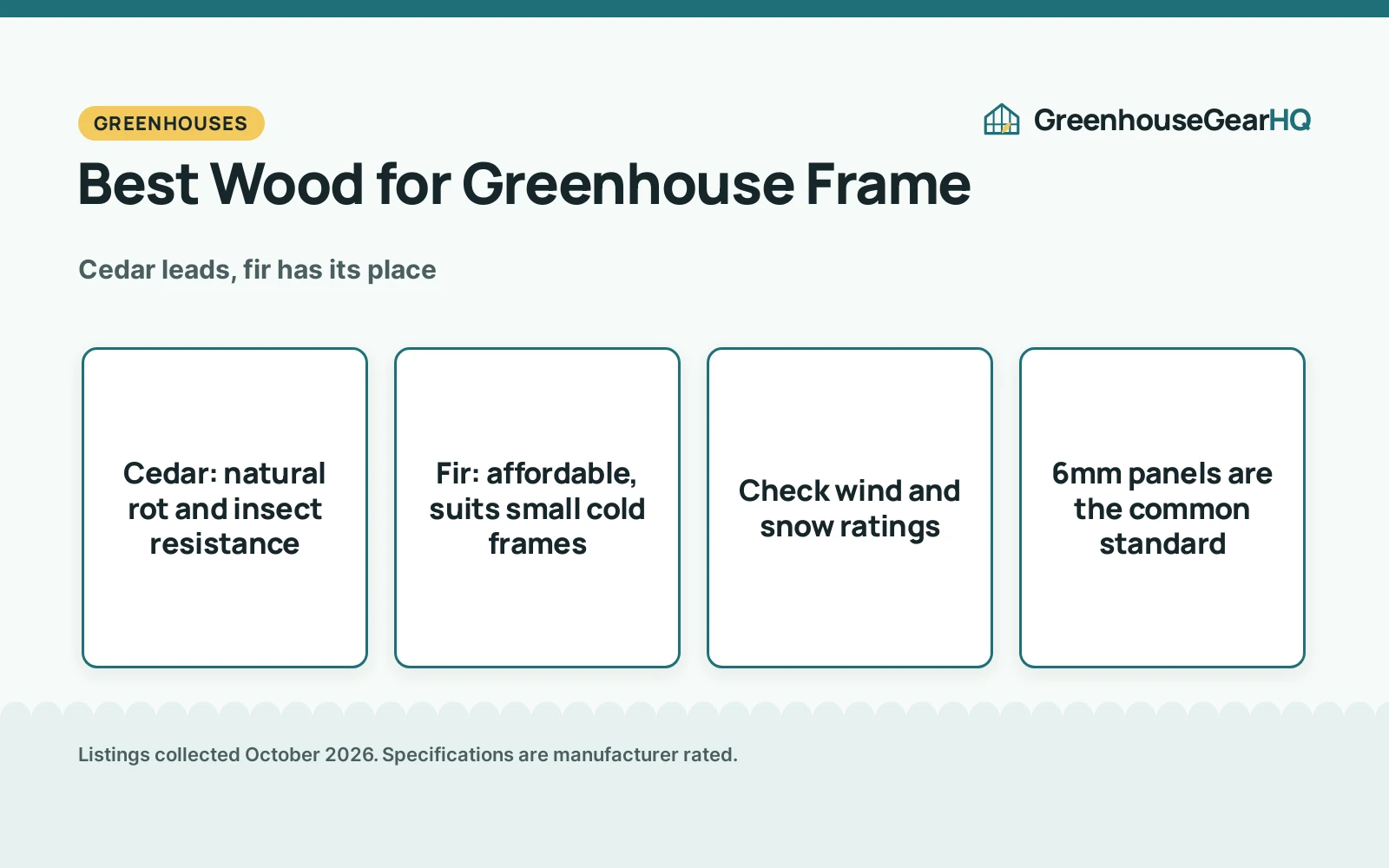
The best wood for greenhouse frame builds is cedar: it resists rot and insects naturally, holds up outdoors for years, and the reference listings show it in everything from 4-foot cold frames to 10 by 13.2-foot walk-in kits, collected 19 October 2026. Fir is the budget-friendly alternative, best for small cold frames and portable mini greenhouses.
Other options worth a look
 GIANTEX Wood Cold Frame with Flip-Top RoofCheck price on Amazon
 BlueWish 8x12 FT Greenhouse for OutdoorsCheck price on Amazon
 BlueWish 8x16FT Wood GreenhouseCheck price on Amazon
 Wood Lattice Fence Panels for Outside 13.4"x78.8" ExpandableCheck price on Amazon
 Wooden Lattice Panels 4PackCheck price on Amazon
GreenhouseGearHQ earns a commission when you buy through links on this page, at no extra cost to you. As an Amazon Associate I earn from qualifying purchases. Affiliate disclosure.
The best wood for greenhouse frame builds: why cedar wins
Cedar dominates the wooden greenhouse listings for one reason: natural resistance to decay and insects. The Aoxun 6×8 (on Amazon) listing describes cedar with insect-proof capabilities that withstand long-time use without severe cracking or distortion. Backyard Discovery calls its 100% cedar wood exceptionally strong with natural resistance to decay, and backs the Aggie 4 by 2 cold frame with a 5-year warranty, the longest stated here.
That resistance matters because a greenhouse frame lives in constant humidity. Cedar’s natural oils do the work that other woods need chemical treatment for, which also keeps the growing space free of treatment leaching. The Modern Shade 6.5 by 8 greenhouse uses FSC certified cedar, a sustainability credential worth noting if the frame’s sourcing matters to you.
Where fir fits
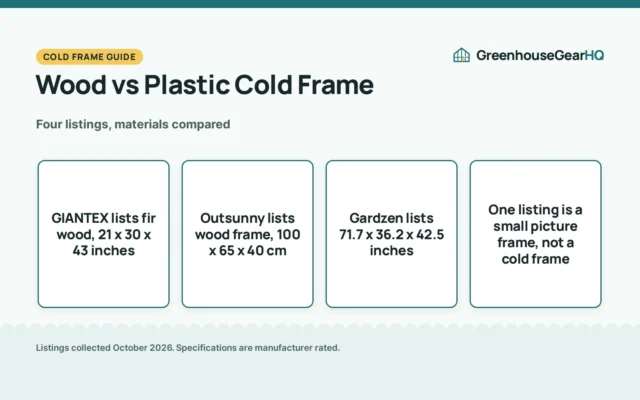
Fir appears in the smaller and lighter listings. The Giantex cold frame (on Amazon) uses premium natural fir at 40 by 21 by 28 inches and just 8 pounds, a portable mini greenhouse for balconies. The GRAFFY cold frame uses a natural fir frame at 27 by 16 by 58 inches and 20 pounds, with 3 removable shelves. The MUPATER 8 by 12 walk-in uses pure fir wood with a 56 mph wind rating, 18 psf snow load and 1000 pound weight capacity, showing fir can scale up when the engineering is right.
Fir is generally the more affordable wood, but it lacks cedar’s natural decay resistance. In a humid greenhouse it needs more attention: keep it ventilated, avoid ground contact, and recoat it when the finish wears. For a small cold frame you move around the garden, fir’s lighter weight is a genuine advantage.
What the listings show about ratings
Wood species is only half the story; the frame’s ratings tell you what it survives. The Aoxun 6×8 supports 6 inches of snow and 60 to 70 mph winds with its anchoring stakes and expansion bolts. The Jocisland 6×8 lists a 24 to 38 mph wind rating and 440 pound load capacity. The MUPATER 8×12 leads with 56 mph, 18 psf snow and 1000 pounds. Whatever wood you choose, anchor it: the stakes and bolts are what turn a wooden box into a structure that survives a storm.
Panels and frame go together
Most wooden frame listings pair the frame with 6mm polycarbonate panels: Aoxun, MUPATER and Modern Shade all state 6mm. The MUPATER 6×10 claims up to 90% light transmission with UV blocking, and the Sylviera 6×8 notes 1000g 6mm panels with high light transmission and UV protection. The frame holds the structure; the panels set the light. A cedar frame with 6mm panels is the standard combination in these listings, and it is the pairing to look for first.
Choosing between them
Choose cedar for a permanent walk-in greenhouse: the 6×8 to 10×13.2 kits in the listings are all cedar, and the 5-year warranty on the Backyard Discovery cold frame (on Amazon) shows how makers stand behind it. Choose fir for a small, portable cold frame where light weight matters more than decades of service. Either way, check the wind and snow ratings against your climate before buying.
In the Greenhouse
- Place cedar frames on level ground with the included anchoring stakes; the Aoxun kit lists 6-inch snow and 60-70 mph wind ratings when anchored.
- Keep fir frames ventilated and off bare soil to slow moisture damage.
- Open adjustable roof vents on warm days; several listings include vents up to a 45-degree angle.
- Use the heavy-duty hooks, rated 55 lbs on the Aoxun, for lights rather than overloading the frame.
- In winter, clear snow before it reaches the listed depth: 6 inches on the Aoxun, 18 psf on the MUPATER 8×12.
FAQ for growers
Is cedar or fir better for a greenhouse frame?
Cedar is better for permanent greenhouses thanks to natural rot and insect resistance. Fir suits small portable cold frames where weight matters.
How long does a cedar greenhouse frame last?
Listings describe cedar withstanding long-time use without severe cracking. Backyard Discovery backs its cedar cold frame with a 5-year warranty.
Do wooden greenhouses need anchoring?
Yes. Listings include anchoring stakes and expansion bolts, and wind ratings assume the frame is anchored.
What panel thickness pairs with a wood frame?
6mm polycarbonate is the common standard in the listings, with UV protection and high light transmission.
Keep reading
See every greenhouses guide and our walk-in greenhouses category.