On this page
Top picks at a glance
As an Amazon Associate I earn from qualifying purchases.
- 1
 NFAMRZCAR Brass Misting Nozzles9.6/10View on Amazon
- 2
 NFAMRZCAR 20-Pack Brass Misting Nozzles9.7/10View on Amazon
- 3
 NFAMRZCAR Brass Misting Nozzles9.6/10View on Amazon
- 4
 Brass Misting Nozzles for Outdoor Cooling System 22 pcsView on Amazon
- 5
 32 Pack- Brass Misting Nozzles For Outdoor Cooling SystemView on Amazon
- 6
 Sunmns 20 Pack Brass Misting Nozzles for Outdoor CoolingView on Amazon
- 7
 Beduan Brass Misting Nozzles Low Pressure Atomizing MistingView on Amazon
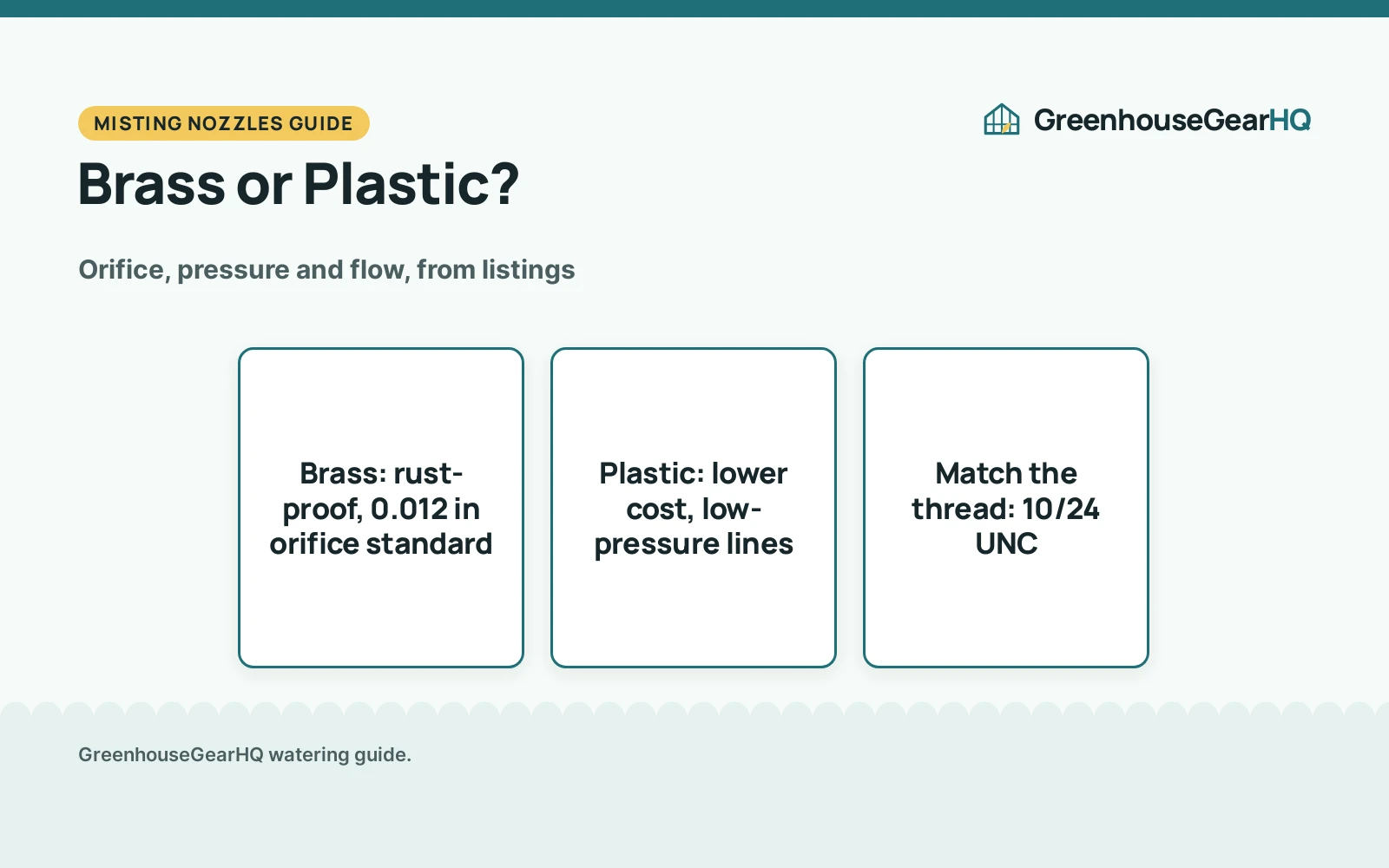
The brass vs plastic misting nozzles choice comes down to durability against cost: brass nozzles resist rust and handle high pressure, while plastic nozzles cost less and suit low-pressure lines. Every brass listing here uses a 0.012 inch (0.3 mm) orifice on a 10/24 UNC thread, with working pressures from 20 to 70 kg per square cm and flows of 80 to 145 ml per minute. This guide walks through material, pressure and maintenance, step by step, so you can match the nozzle to your misting system.
Other options worth a look
 Brass Misting Nozzles for Outdoor Cooling System 22 pcsCheck price on Amazon
 32 Pack- Brass Misting Nozzles For Outdoor Cooling SystemCheck price on Amazon
 20 Pack Brass Misting Nozzles 10/24 UNC 0.020"Check price on Amazon
 Sunmns 20 Pack Brass Misting Nozzles for Outdoor CoolingCheck price on Amazon
 Beduan Brass Misting Nozzles Low Pressure Atomizing MistingCheck price on Amazon
GreenhouseGearHQ earns a commission when you buy through links on this page, at no extra cost to you. As an Amazon Associate I earn from qualifying purchases. Affiliate disclosure.
How brass nozzles work
Brass nozzles are the standard the listings describe: solid brass bodies, often with a stainless steel orifice, that screw into any 10/24 UNC threaded opening. The Aootech 22-pack lists operation pressure of 20 to 70 kg per square cm with a flow of 80 to 145 ml per minute, or about 1/2 gallon of water per hour per nozzle. The Aootech 32-pack lists 60 to 995 psi with the same 80 to 145 ml per minute flow. A self-sealing O-ring comes with each nozzle on the RESNSTAR and Awpeye listings, so no tape or sealant is needed. The listings call brass rust-proof for outdoor use with cold water; the Aootech 32-pack carries a 90-day manufacturer warranty.
Choosing your brass vs plastic misting nozzles, step by step
Step 1: Check your water pressure
Brass nozzles span a wide pressure range: the listings give 20 to 70 kg per square cm, 4 to 70 kg per square cm (60 to 995 psi), 2 to 70 kg per square cm, 20 to 80 kg per square cm, 3 to 70 kg, and a 3 bar maximum on the NFAMRZCAR. Plastic nozzles suit low-pressure lines; the listings do not give a plastic figure, so keep plastic on a household-pressure line and reserve brass for pumped systems. Match the nozzle to the pump you own, not the pump you plan to buy.
Step 2: Pick the orifice size
Most brass nozzles here use a 0.012 inch (0.3 mm) orifice. The ZXUEZHENG lists a finer 0.004 inch (0.1 mm) orifice with a 10 to 30 ml per minute flow, and the NFAMRZCAR lists a wider 0.020 inch (0.5 mm) orifice. Finer mist cools better but clogs faster; the ZXUEZHENG listing recommends a filter at the water inlet to avoid clogging. A water filter protects any nozzle: see our best water filter for misting system guide.
| Nozzle | Orifice | Pressure (stated) | Flow (stated) |
|---|---|---|---|
| Brass, standard | 0.012 in (0.3 mm) | 20 to 70 kg/cm; 60 to 995 psi | 80 to 145 ml/min; 1/2 gal/hr |
| Brass, fine | 0.004 in (0.1 mm) | 3 to 70 kg | 10 to 30 ml/min |
| Brass, wide | 0.020 in (0.5 mm) | 3 bar max | Not stated |
| Plastic | Not stated | Not stated | Not stated |
Step 3: Count the nozzles and fittings
Nozzles come in packs: the listings show 10, 12, 20, 22, 32, 36 and 50 packs, and the Ripeng kit bundles 30 tees, 36 brass nozzles and 6 end plugs for 1/4 inch tubing. Check the thread: nearly every listing uses 10/24 UNC. Brass nozzles outlast plastic in sun and mineral water, per the listings’ rust-proof claims; plastic costs less per nozzle when you need many.
Step 4: Plan for clogs
Mineral buildup clogs fine orifices first. The ZXUEZHENG listing notes its 0.1 mm nozzle has no filtering device and recommends a filter at the inlet. Brass nozzles unscrew for cleaning; several listings note easy disassembly. Soak and rinse nozzles when the mist turns uneven, and winterize the line before the first freeze.
Where misting fits in the greenhouse
Misting cools and raises humidity for seedlings and tropical plants. For whole-house cooling, compare misting against other options in our evaporative cooler vs misting system guide, or see complete kits in our best misting system for greenhouse comparison.
What this guide does not cover
This guide does not cover pump sizing, pipe layout or water treatment chemistry. It does not give cooling or temperature-drop figures, because those depend on the climate, the enclosure and the airflow. Follow the pump maker’s pressure ratings and your local codes for outdoor plumbing.
FAQ for growers
Do brass nozzles fit any misting system?
Most listings use a 10/24 UNC thread that screws into any 10/24 threaded opening. The Ripeng kit uses 1/4 inch tubing tees instead. Check your system’s thread before ordering.
How much water does one nozzle use?
The listings give 80 to 145 ml per minute, or about 1/2 gallon per hour per nozzle. The 0.1 mm ZXUEZHENG nozzle lists 10 to 30 ml per minute.
Why does my mist turn into drips?
Low pressure or a clogged orifice. The listings give working pressures from 20 to 70 kg per square cm; below that range the mist weakens. Clean or replace the nozzle and check the filter.
Keep reading
See every misting systems guide and all greenhouse ventilation and watering guides.
More picks: misting systems for greenhouses, water filters for misting systems and evaporative cooler vs misting system.