On this page
Top picks at a glance
As an Amazon Associate I earn from qualifying purchases.
- 1
 JOAPRIL Butyl Joist Tape9.6/10View on Amazon
- 2
 GE Silicone Caulk, Clear9.6/10View on Amazon
- 3
 GE Silicone Caulk, White9.6/10View on Amazon
- 4
 TAPEBEAR Joist Tape9.6/10View on Amazon
Butyl tape vs silicone sealant is the choice when a seam needs sealing: a tape that covers the seam, or a sealant that fills it. The tape listings here are joist tapes for decks, and the sealant listings are caulk tubes for kitchens and bathrooms, so this comparison uses them as concrete examples of each form, not as products made for greenhouses.
GreenhouseGearHQ earns a commission when you buy through links on this page, at no extra cost to you. As an Amazon Associate I earn from qualifying purchases. Affiliate disclosure.
Quick verdict: choose butyl tape if you want to cover a seam or joist with a strip that sticks over the surface, as the tape listings show. Choose silicone sealant if you want to fill a joint with a flexible seal that stays flexible, as the caulk listings show. Neither side wins on temperature range, because only the tape listings state one, and neither side wins on coverage, because the sealant listings do not state how much joint a tube fills.
Our picks for the greenhouse
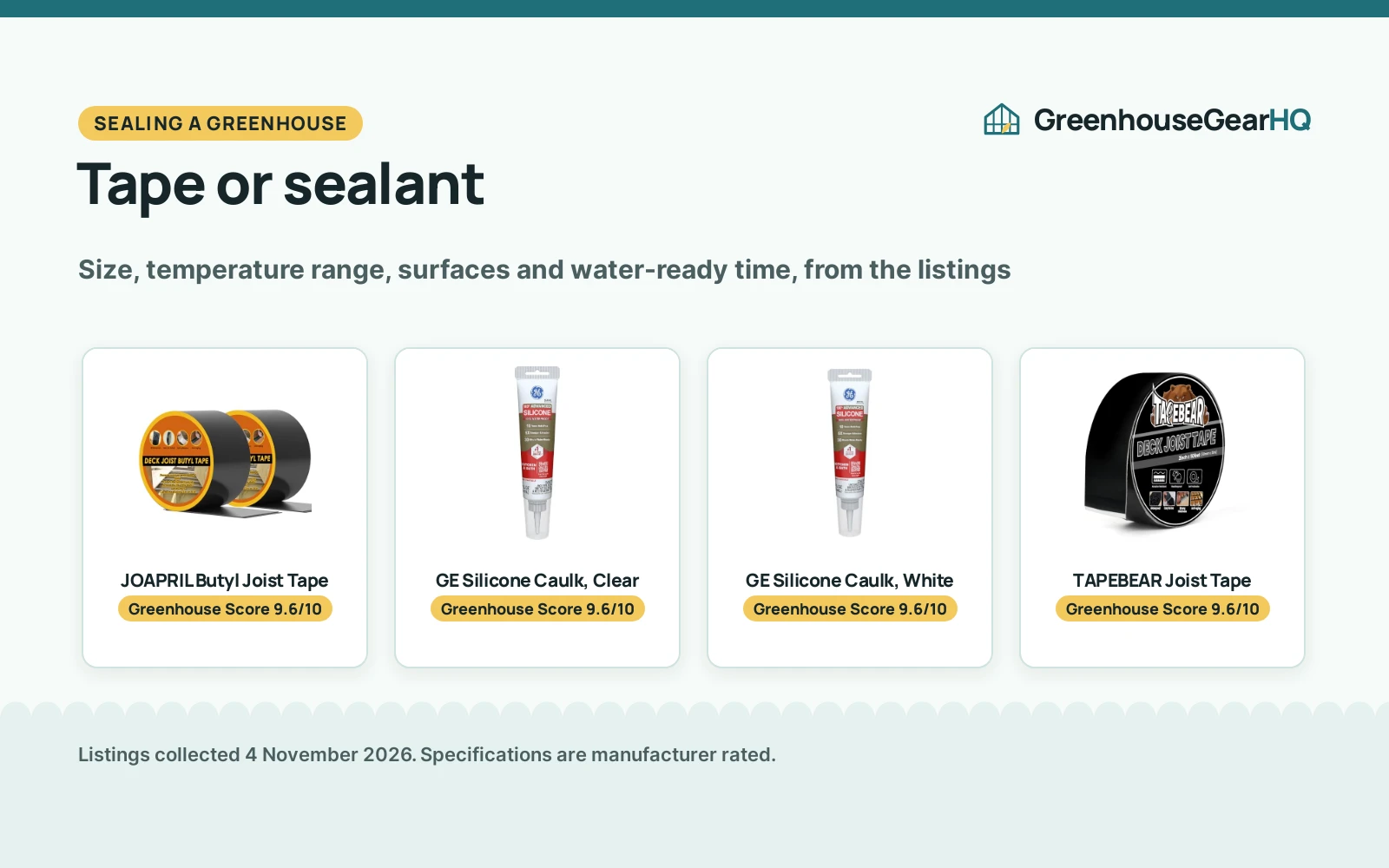
| # | Product | Greenhouse Score | Buy |
|---|---|---|---|
| 1 | JOAPRIL Butyl Joist Tape | 9.6/10 | Buy on Amazon |
| 2 | GE Silicone Caulk, Clear | 9.6/10 | Buy on Amazon |
| 3 | GE Silicone Caulk, White | 9.6/10 | Buy on Amazon |
| 4 | TAPEBEAR Joist Tape | 9.6/10 | Buy on Amazon |

JOAPRIL Butyl Joist Tape
A butyl joist tape in 2 rolls for covering deck joists, beams and roofs, suited to a reader who wants a strip that covers a seam rather than a sealant squeezed into a joint.
Pros
- 2 rolls, each 2 inch wide and 50 feet long, for a total length of 100 feet.
- Butyl adhesive creates an airtight seal to block water, as described in the listing.
- Stated temperature range of -20°F to 230°F.
- Sticks to wood, metal, plastic and rubber, for decks, joists, roofs, beams, doors and fences.
Cons
- No water-ready time is stated, so the listing does not say when the seal can face water exposure.
- No warranty term is stated.
- Tape form covers a surface; it does not fill a joint the way a squeezed sealant does.
- Listing describes deck and joist uses, not greenhouse use, so check suitability for greenhouse materials first.

GE Silicone Caulk, Clear
A clear silicone caulk in a 2.8 fl oz tube for kitchen and bathroom joints, suited to a reader who wants a flexible seal squeezed into a joint.
Pros
- 100% silicone formula, as described in the listing, with a permanently flexible seal.
- Water-ready in as little as 30 minutes, as stated in the listing.
- Stated to resist shrinking and cracking with temperature changes.
- Adheres to most metals, plastics and woods, plus glass, drywall, plaster, granite, cultured marble, ceramic and porcelain tile.
Cons
- No temperature range is stated, so the listing leaves temperature limits unclear.
- Listing claims 5X stronger adhesion without stating what the comparison is against.
- Caution in the listing says methanol and ammonia are released during application.
- No concrete warranty term is stated; the spec table gives only the word Warranty.

GE Silicone Caulk, White
A white silicone caulk in a 2.8 fl oz tube for kitchen and bathroom joints, suited to a reader who wants a white seal with a low-odor formula for indoor use.
Pros
- Described as 100% silicone caulk, for areas with consistent water exposure.
- Water-resistant in just 30 minutes, as stated in the listing.
- Stays permanently flexible and resists shrinking and cracking with temperature changes.
- Low-odor formula described for indoor use.
Cons
- No temperature range is stated, so temperature limits stay unclear.
- Listing claims 5X stronger adhesion in the title without stating what it is compared with.
- No concrete warranty term is stated; the spec table gives only the word Warranty.
- Listing describes kitchen and bathroom uses, not greenhouse use, so check suitability for greenhouse materials first.

TAPEBEAR Joist Tape
A butyl joist tape for decking, suited to a reader who wants a paper-backed tape strip for joists, beams and rim joists.
Pros
- For joists, rim joists, beams, steps and ledger boards, as listed.
- Stated temperature range of -20°F to 230°F.
- Paper backing for easier peeling during application.
- Sticks to wood, metal, plastic and rubber.
Cons
- Listing says the tape may not be very sticky at first, reaching maximum stickiness after 24 hours.
- Listing notes colder weather affects stickiness, with a hair dryer suggested to soften the tape.
- No water-ready time is stated.
- No warranty term is stated.
As an Amazon Associate I earn from qualifying purchases.
Other options worth a look
 Permatex 81158 Black Silicone Adhesive SealantCheck price on Amazon
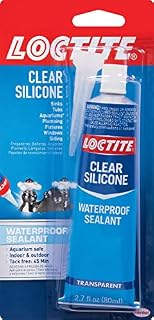 Loctite Silicone SealantCheck price on Amazon
 Silicone Caulk & Sealant ClearCheck price on Amazon
 Typar Butyl Flashing TapeCheck price on Amazon
 Rtcimoic Butyl Sealant Tape 2mCheck price on Amazon
 Second Skin Butyl TapeCheck price on Amazon
Butyl tape vs silicone sealant: side by side
| Product | Greenhouse Score | Side | Size | Temperature range | Water-ready | Amazon |
|---|---|---|---|---|---|---|
| JOAPRIL Butyl Joist Tape | 9.6/10 | Butyl tape | 2 inch x 50 feet, 2 rolls | -20°F to 230°F | Not stated | View on Amazon |
| GE Silicone Caulk, Clear | 9.6/10 | Silicone sealant | 2.8 fl oz tube | Not stated | 30 minutes | View on Amazon |
| GE Silicone Caulk, White | 9.6/10 | Silicone sealant | 2.8 fl oz tube | Not stated | 30 minutes | View on Amazon |
| TAPEBEAR Joist Tape | 9.6/10 | Butyl tape | 2 inch x 50 feet | -20°F to 230°F | Not stated | View on Amazon |
Each figure is the brand’s own rating, taken from its product page on 4 November 2026.
How each side seals
A butyl tape is a strip with adhesive on one side. The JOAPRIL listing describes peeling the tape and sticking it to a clean surface, with an instant bond to uneven surfaces, while the TAPEBEAR listing says the tape may not be very sticky at first and reaches maximum stickiness after 24 hours. That difference matters: one tape listing promises an instant bond, the other warns of a delay, so do not assume every butyl tape behaves the same way.
A silicone sealant is squeezed from a tube into a joint, where it forms a flexible seal. Both GE listings say the seal stays permanently flexible and resists shrinking and cracking, and both say it is water-ready in 30 minutes. The sealant form suits a joint that needs filling, while the tape form suits a surface that needs covering, and that form difference is the main divide between the sides.
Size and coverage
The tape listings give size as width and length: both tapes are 2 inch wide and 50 feet long, and the JOAPRIL listing adds a second roll, for a total length of 100 feet. The sealant listings give size as tube volume: both GE tubes are 2.8 fl oz. A tape length and a tube volume cannot be compared directly, and the sealant listings do not state how much joint a tube fills, so this comparison does not declare a coverage winner.
Temperature and flexibility
Both tape listings state a temperature range of -20°F to 230°F. The silicone listings do not state a temperature range. They say the seal stays flexible with temperature changes, and resists shrinking and cracking, but they give no temperature figures, so a reader who needs a stated range should not pick a side on temperature from these listings alone.
Surfaces and uses
The tape listings name wood, metal, plastic and rubber as surfaces, with uses on decks, joists, roofs, beams, doors and fences. The silicone listings name most metals, plastics and woods, plus glass, drywall, plaster, granite, cultured marble, ceramic and porcelain tile, with kitchen and bathroom uses. The surfaces overlap on wood, metal and plastic, but the stated uses differ, and neither listing names a greenhouse use, so check the material of the greenhouse seam against the listing before buying.
Listing gaps to check
Some gaps deserve a check before buying. The GE listings give only the word Warranty in the spec table, with no term, so treat them as stating no concrete warranty term. The silicone titles claim 5X stronger adhesion without stating what the claim is compared with, so do not read it as a measured win over tape. The GE Clear listing carries a caution about methanol and ammonia released during application, while the GE White listing describes a low-odor formula for indoor use, so keep the Clear and White listings separate.
Which should you choose?
Choose butyl tape if you want to cover a seam or joist with a strip, with a stated temperature range and a length you can measure in feet. Compare more tape options in our butyl tape picks.
Choose silicone sealant if you want to fill a joint with a flexible seal that is water-ready in 30 minutes, for kitchen and bathroom style joints. Our plastic sealant picks compare more sealants.
If the job is a greenhouse panel seam, check the panel material against the listing first, since neither listing names a greenhouse use. Our panels for a greenhouse picks cover panel options.
In the Greenhouse
- Check the tape width against the seam: both tapes are 2 inch wide.
- Clean the surface before sticking tape, as the JOAPRIL listing describes.
- Do not stretch the tape during application, and let it fall naturally, as the TAPEBEAR listing describes.
- Allow 30 minutes before water exposure for the silicone sealant listings.
- Check the material of the seam against the listing, since neither listing names a greenhouse use.
Scoring notes
| Product | Greenhouse Score | Perf. /35 | Build /25 | Value /25 | Safety /10 | Warranty /5 |
|---|---|---|---|---|---|---|
| JOAPRIL Butyl Joist Tape | 9.6 | 30 | 21 | 21 | n/a | 0 |
| GE Silicone Caulk, Clear | 9.6 | 30 | 21 | 20 | n/a | 0 |
| GE Silicone Caulk, White | 9.6 | 29 | 21 | 20 | n/a | 0 |
| TAPEBEAR Joist Tape | 9.6 | 28 | 21 | 20 | n/a | 0 |
We rescale the weighted total onto a range that ends at 9.2 and 9.8; nothing in the conversion can reorder two picks. An unpowered frame or shelf with no listed safety features is scored without safety, across the other 90 points.
The Greenhouse Score weighs performance, build, value, safety and warranty, as explained on our How we pick page. For sealants and tapes, safety reflects a stated safety feature or certification; none of the listings states one, so none earns safety points. None of the listings states a concrete warranty term, so none earns warranty points either. The JOAPRIL tape scores highest for its 2-roll length and stated temperature range, while the TAPEBEAR tape scores lowest for its delayed stickiness and cold-weather note.
FAQ for growers
Should I pick butyl tape or silicone sealant for a seam I need to cover?
Pick tape for covering, since the tape listings describe a strip that sticks over a surface. Pick sealant for filling, since the caulk listings describe a seal squeezed into a joint.
Do the silicone listings state a temperature range?
No, the silicone listings give no temperature figures, while both tape listings state a range of -20°F to 230°F.
How long before silicone sealant can face water exposure?
Both GE listings say 30 minutes.
Do any of these listings state a warranty term?
No, the tape listings state no warranty term, and the GE listings give only the word Warranty in the spec table, with no term.
Keep reading
See every greenhouse film and tape guide and all greenhouse guides.
More picks: greenhouse film, greenhouse film vs polycarbonate and wooden greenhouses.