On this page
Top picks at a glance
As an Amazon Associate I earn from qualifying purchases.
- 1
 Hurricane 6-Inch Inline Fan with Steel Housing9.7/10View on Amazon
- 2
 VIVOSUN M4 4-Inch EC Motor Inline Duct Fan9.7/10View on Amazon
- 3
 VIVOSUN R6 6 Inch Inline Fan9.7/10View on Amazon
- 4
 Fantech Inline Centrifugal Duct FansView on Amazon
- 5
 Suncourt 6-Inch Centrax Inline Centrifugal FanView on Amazon
- 6
 Fantech FR 150 Inline Centrifugal 6" Duct FanView on Amazon
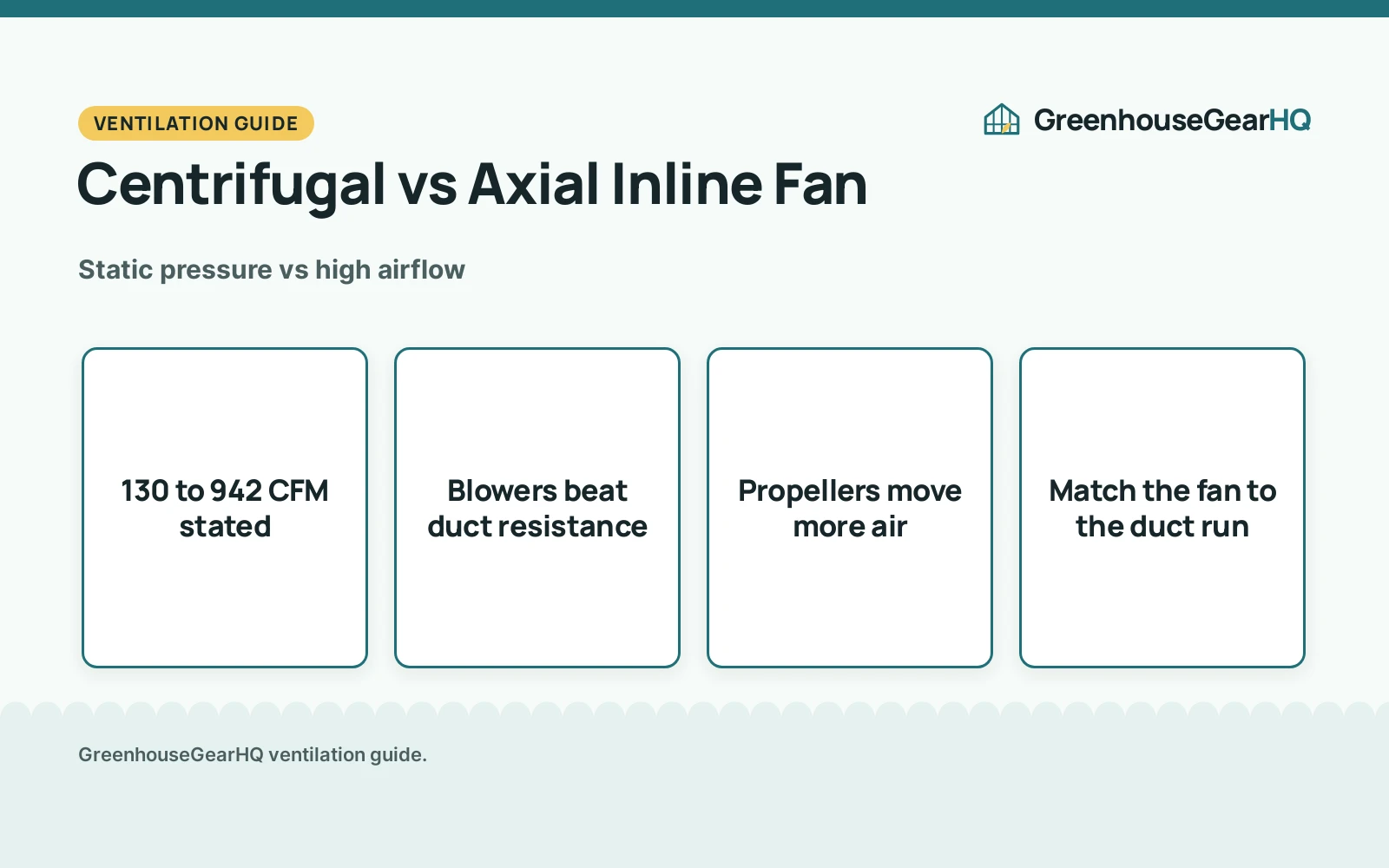
A centrifugal vs axial inline fan choice comes down to what the air has to push through. A centrifugal inline fan uses a blower wheel that throws air outward and builds static pressure, so it keeps moving air through long ducts, bends and carbon filters. An axial inline fan uses a propeller that moves a high volume of air in a straight line, which suits open runs with little resistance. In these listings, centrifugal models range from the 170 CFM SUPROCKY to the 942 CFM FICBXRA, while the mixed-flow AC Infinity CLOUDLINE S4 sits between the two types at 205 CFM. Choose centrifugal when the duct run fights back; choose axial when the path is short and open.
Other options worth a look
 Fantech Inline Centrifugal Duct FansCheck price on Amazon
 Suncourt 6-Inch Centrax Inline Centrifugal FanCheck price on Amazon
- Fantech FR 150 Inline Centrifugal 6" Duct FanCheck price on Amazon
GreenhouseGearHQ earns a commission when you buy through links on this page, at no extra cost to you. As an Amazon Associate I earn from qualifying purchases. Affiliate disclosure.
Centrifugal vs axial inline fan: the short answer
| Fan listing | Type stated | Airflow stated | Noise stated | Power | Standout |
|---|---|---|---|---|---|
| MIDCVFRUN 4 in radon | Centrifugal | 260 / 188 CFM | 45 / 32 dB | 98 W | IP67, indoor or outdoor |
| FANTECH 4 in | Centrifugal | 650 CFM | 30 dB | 83.4 W | Air up to 140°F |
| Suncourt 6 in Centrax | Centrifugal | 350 CFM | 59 dB | 140 W | UL 507, 5-year warranty |
| FICBXRA 12 in | Centrifugal | 942 CFM | 65 dB | 295 W | Galvanized steel blades |
| SUPROCKY 4 in | Centrifugal blower | 170 CFM | 1.5 sones | 54 W | 3-year warranty |
| AC Infinity CLOUDLINE S4 4 in | Mixed flow | 205 CFM | 28 dBA | 21 W | ETL, IP-44, 10-speed |
How a centrifugal inline fan works
A centrifugal fan spins a blower wheel inside a scroll housing, flinging air outward and building the static pressure that pushes through resistance. That is why centrifugal listings show up wherever ducts get long or filtered: the MIDCVFRUN radon listing states a centrifugal design at 260 CFM on high and 188 CFM on low, with noise of 45 dB and 32 dB respectively, and an IP67 waterproof build for indoor or outdoor mounting. The FANTECH listing states 650 CFM at 30 dB with air-stream temperatures up to 140°F, and the Suncourt Centrax listing states 350 CFM at 140W with UL 507 and CSA certification and a 5-year warranty. At the large end, the FICBXRA 12-inch listing states a centrifugal design moving 942 CFM at 65 dB on 295W, with galvanized steel blades. The SUPROCKY listing calls its design a centrifugal blower at 170 CFM and 1.5 sones, meant to mount away from the room so the noise never reaches it.
How an axial inline fan works
An axial fan is a propeller in a tube: it moves a large volume of air straight through with little pressure rise, which is ideal for short, straight duct runs and open-air circulation. None of these listings is labeled a pure axial fan, but the mixed-flow AC Infinity CLOUDLINE S4 shows the middle ground: its listing describes a mixed flow design with a stator blade for airflow delivery in high resistance areas, at 205 CFM and 28 dBA on a 21W EC motor, with ETL certification, an IP-44 rating and a 10-speed controller. Mixed flow borrows the propeller’s efficiency and some of the blower’s pressure, which is why it appears in grow tent listings that need both quiet and duct runs.
Which should you choose?
Choose centrifugal when the air has to work: long duct runs, several bends, a carbon filter, or a radon mitigation pipe like the MIDCVFRUN listing’s use case. The FANTECH listing’s 650 CFM at 30 dB shows how much air a small centrifugal can push, and the Suncourt listing’s certifications suit permanent installs. Choose axial, or a mixed-flow model like the AC Infinity, when the run is short and the goal is moving volume quietly: 205 CFM at 28 dBA needs little pressure to do its job. When in doubt, count the bends and the filter; each one is a reason to pick the blower. More inline options are compared in our inline fan for grow tents picks.
What the listings tell you to check
- Noise: stated noise spans 22 to 65 dB; the FICBXRA is the loudest at 65 dB, while the ONVEAN states 22 to 24 dB.
- Power: the ONVEAN runs on 8W while the FICBXRA draws 295W, so check the circuit for large models.
- Certifications: the ACTIVE AIR listing states UL, the Suncourt UL 507 and CSA, and the AC Infinity ETL with an IP-44 rating.
- Warranty: the Suncourt states 5 years, the SUPROCKY 3 years, the ONVEAN 2 years, and the ACTIVE AIR 1 year; the FANTECH listing states no warranty.
- Listing gaps: the Josmimic bullets state 130 CFM while its spec table says 210 CFM, and the ONVEAN title states 22 dB while its spec table says 24 dB; we cited the bullet figures first.
FAQ for growers
Which type is better for long duct runs?
Centrifugal. Its blower wheel builds the static pressure that keeps air moving through long ducts, bends and filters. The FANTECH listing states 650 CFM in a 4-inch centrifugal, and the MIDCVFRUN is built for radon piping.
Which listing is the quietest?
The ONVEAN listing states 22 dB in its title and 24 dB in its spec table, the lowest figures here. The AC Infinity CLOUDLINE S4 states 28 dBA.
What does mixed flow mean?
The AC Infinity listing describes a mixed flow design with a stator blade that delivers airflow in high resistance areas. It sits between axial and centrifugal: more pressure than a propeller, less than a blower.
Which listings state a warranty?
The Suncourt states 5 years, the SUPROCKY 3 years, the ONVEAN 2 years, and the ACTIVE AIR 1 year. The FANTECH listing states no warranty.
Keep reading
See every greenhouse fans guide and all ventilation and watering guides.
More picks: inline fans for grow tents, quietest inline fans, 4-inch inline fans.