On this page
Top picks at a glance
As an Amazon Associate I earn from qualifying purchases.
- 1
 Spider Farmer G5000 480W Bar-Style LED Grow Light9.7/10View on Amazon
- 2
 Sunlite MH250/U/MOG M58 Metal Halide LampView on Amazon
- 3
 Horticulture Ceramic Metal HalideView on Amazon
- 4
 Sunlite M102/O Protected Metal Halide Lamp 150W ClearView on Amazon
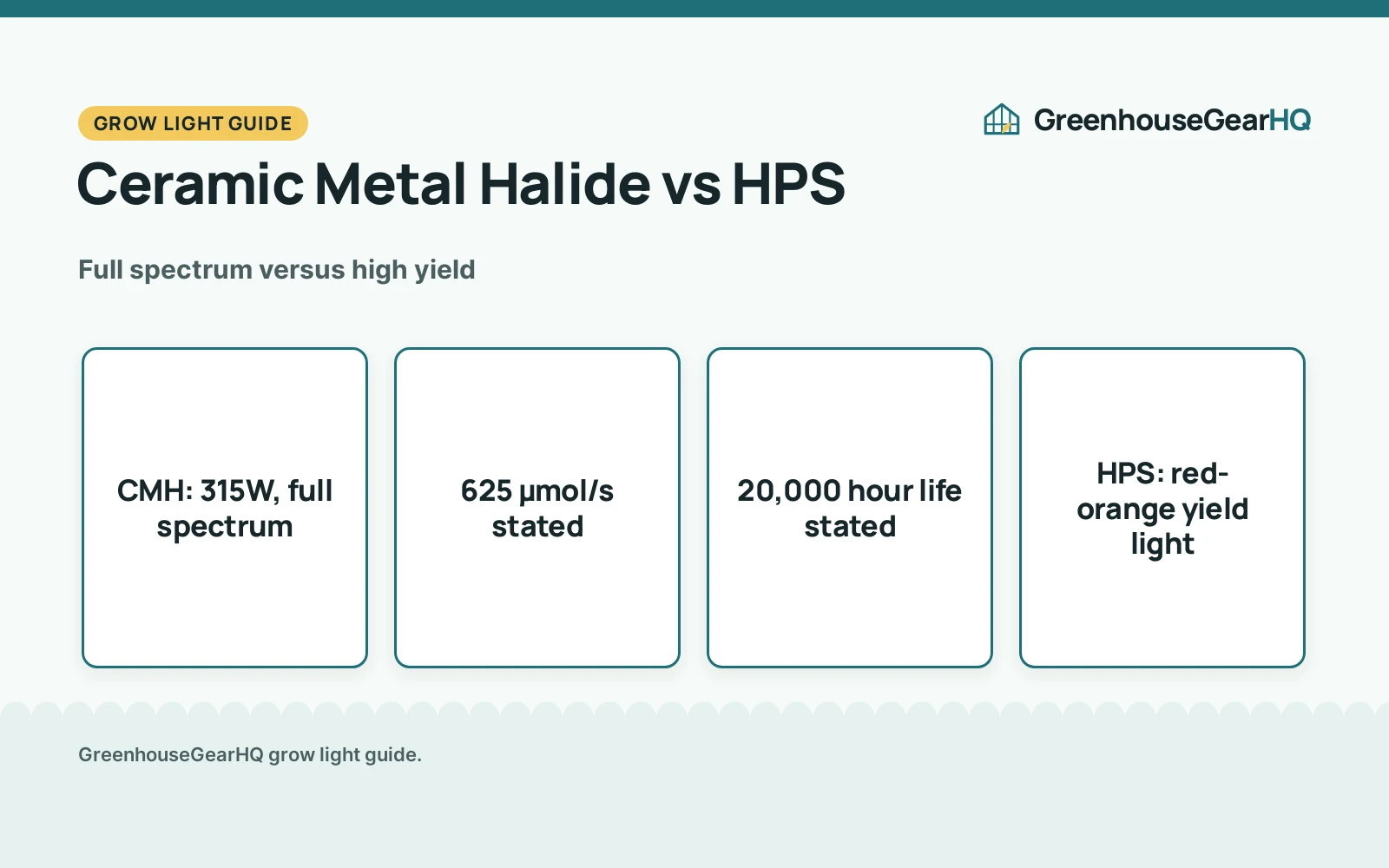
Ceramic metal halide vs HPS: the short answer is that CMH gives a fuller, sun-like spectrum in one bulb while HPS gives intense red-orange light favored for flowering yields. One trades some raw output for spectrum quality; the other trades spectrum breadth for harvest weight.
Other options worth a look
 Sunlite MH250/U/MOG M58 Metal Halide LampCheck price on Amazon
 Horticulture Ceramic Metal HalideCheck price on Amazon
 Sunlite M102/O Protected Metal Halide Lamp 150W ClearCheck price on Amazon
GreenhouseGearHQ earns a commission when you buy through links on this page, at no extra cost to you. As an Amazon Associate I earn from qualifying purchases. Affiliate disclosure.
Ceramic metal halide vs HPS: how they differ
Both are high-intensity discharge lamps, but they are built for different priorities. Ceramic metal halide (CMH) packs its arc tube in ceramic, which handles higher temperatures and produces a broader, more natural spectrum. High pressure sodium (HPS) runs a sodium vapor arc that pours out red and orange light, the spectrum flowering plants respond to most. The figures below are stated in each listing; no HPS bulb listing is included, so the HPS side is explained without figures.
Ceramic metal halide: the full-spectrum bulb
CMH suits the grower who wants one bulb for quality light. The GRUOTVSZAK listings state 315W CMH bulbs with 625 μmol/s at 3000K and 590 μmol/s at 4200K, over 20,000 hours of total life with 90% output maintenance for 10000 hours. The FLILED listings state a 4000K sun-like spectrum for vegetative stages and a 3000K spectrum with red, far red and UV enhancement for flowering, maintaining 90% of initial lumen output at 8,000 hours. The GRUOTVSZAK listing states more blue light than HPS, and both brands use a PGZX18 base. Warm-up takes about 5 minutes with at least 7 minutes of cool down, per the GRUOTVSZAK listing.
Choose CMH when you want a single bulb that covers both vegetative growth and flowering with a natural-looking spectrum, and when long life matters.
HPS: the high-yield classic
HPS suits the grower chasing maximum harvest weight. Its red-orange spectrum drives flowering and fruiting, which is why it became the standard for bloom rooms. The tradeoff is spectrum breadth: HPS light looks yellow-orange and carries little blue, so growers traditionally pair it with metal halide for the vegetative stage. The FLILED listing states its CMH bulbs decay slower than traditional HPS bulbs, which is the listing’s comparison rather than a measured result here.
Choose HPS when flowering yield is the priority and you already run the fixtures for it.
Buying advice: matching the bulb to the grow
Start with the ballast. The 315W CMH bulbs in these listings use a PGZX18 base and pair with a 315W CMH ballast; the Prism Lighting Science listing states a 315W CMH ballast with variable 120/240 volt input. The 600W and 1000W metal halide bulbs use an E39 mogul base instead, so the two families are not interchangeable. Buying the wrong base wastes the bulb.
Then weigh lifespan against output. The Bluex 100W metal halide listing states a 15,000 hour average lifespan, the CMH 315W listings state 8,000 hours of operation time, and the Vegelumax metal halide listings state 12,000 hours. A longer-lived bulb costs less per hour even if the upfront price is higher. For spectrum, the 315W CMH listings give a choice: 3000K at 625 μmol/s or 4200K at 590 μmol/s, per the listings, so pick 3000K for flowering weight and 4200K for vegetative growth. The 600W metal halide listing states 6000K and 55,000 lumens, a cooler, brighter vegetative light.
Which one should you buy?
| Bulb type | Spectrum | Life stated | Suits |
|---|---|---|---|
| Ceramic metal halide | Full spectrum, 3000K to 4200K | Over 20,000 hours | One-bulb grows, spectrum quality |
| HPS | Red-orange | Not stated here | Flowering yield |
Match the bulb to the goal. A grower who wants one bulb from seed to harvest leans CMH for its full spectrum and stated 20,000 hour life. A grower running a dedicated bloom room leans HPS for its red-heavy output. Either way, match the bulb to the fixture; see our grow lights with timer picks for complete fixtures.
FAQ for growers
Can one CMH bulb cover the whole grow?
The FLILED listings offer a 4000K CMH for vegetative stages and a 3000K CMH with red and far red enhancement for flowering, per the listings. Many growers run the 4200K through veg and switch to 3000K for bloom.
How long do CMH bulbs last?
The GRUOTVSZAK listings state over 20,000 hours of total life with 90% output maintenance for 10000 hours. The FLILED listings state 90% of initial lumen output at 8,000 hours.
Do CMH bulbs need special fixtures?
They need the right base and ballast. The CMH listings state a PGZX18 base, and the Prism Lighting Science listing states a 315W CMH ballast with variable 120/240 volt input.
Which gives more blue light?
The GRUOTVSZAK listing states its CMH bulbs give more blue light than HPS. That is the listing’s claim; no HPS spectrum figures are included here to check it against.
Keep reading
See every grow lights guide and all light and heat guides.
More picks: grow lights with timer, grow lights for basil, grow lights for microgreens.