On this page
Top picks at a glance
As an Amazon Associate I earn from qualifying purchases.
- 1
 AC Infinity MULTIFAN S7-P9.7/10View on Amazon
- 2
 VEVOR 8-Inch 807 CFM EC Inline Duct Fan with Temperature9.7/10View on Amazon
- 3
 AC Infinity AXIAL S1238DView on Amazon
- 4
 Rechargeable Circulation Desk FanView on Amazon
- 5
 6 Inch Inline Duct Fan 460 CFMView on Amazon
- 6
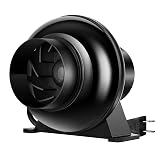 VIVOSUN D4 4" AC Motor Inline FanView on Amazon
- 7
 Dr. Prepare Tower Fan Oscillating FanView on Amazon
- 8
 AC Infinity RAXIAL S4View on Amazon
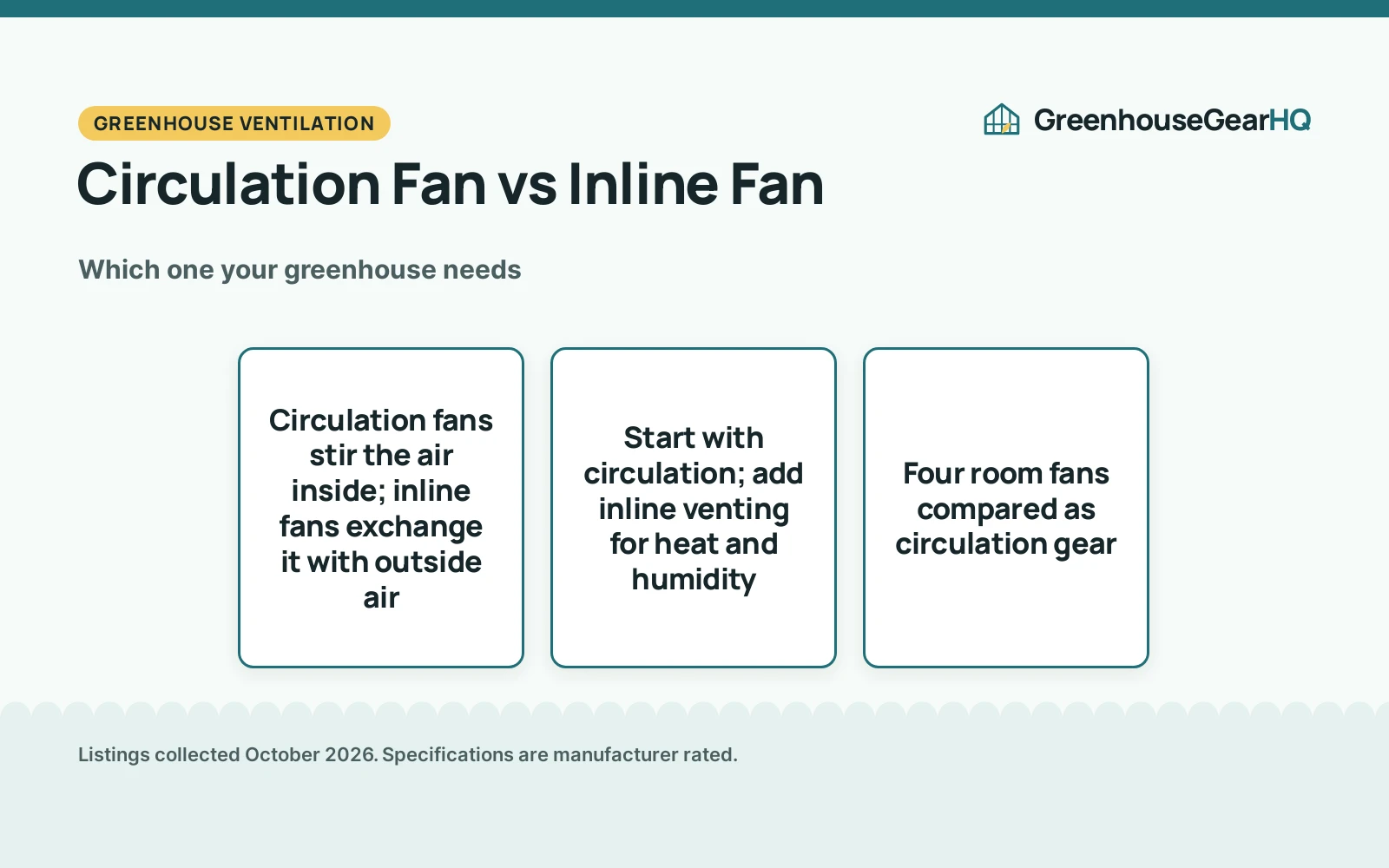
A circulation fan vs inline fan choice comes down to where the air goes. A circulation fan moves the same air around inside the greenhouse, evening out temperature and humidity around the plants. An inline fan mounts in ducting and pulls stale air out while drawing fresh air in, so it actually exchanges the air. For most small greenhouses, start with circulation; add inline venting when heat or humidity builds faster than circulation can fix.
Other options worth a look
 AC Infinity AXIAL S1238DCheck price on Amazon
 Rechargeable Circulation Desk FanCheck price on Amazon
 6 Inch Inline Duct Fan 460 CFMCheck price on Amazon
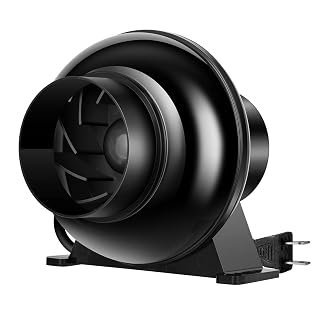 VIVOSUN D4 4" AC Motor Inline FanCheck price on Amazon
 Dr. Prepare Tower Fan Oscillating FanCheck price on Amazon
 AC Infinity RAXIAL S4Check price on Amazon
GreenhouseGearHQ earns a commission when you buy through links on this page, at no extra cost to you. As an Amazon Associate I earn from qualifying purchases. Affiliate disclosure.
Circulation fan vs inline fan: the difference
A circulation fan is a room fan: tower or pedestal, standing on the floor, blowing air across the space. It does not remove air; it stirs it. That stirring matters because still air lets heat pool at the roof and moisture settle on leaves, and moving air helps foliage dry after watering. An inline fan is a duct fan that sits inside a ventilation run and pushes or pulls air through it, so hot, humid air leaves the greenhouse and cooler air enters. One recirculates, the other ventilates.
The four fans in the data for this guide are room fans: two tower fans and two pedestal fans. None of them is an inline duct fan, so the gear section below compares them as circulation options, and the guide explains where an inline fan fits. All four list indoor use, so they suit the covered, rain-free part of a greenhouse rather than exposed positions.
When circulation is enough
Circulation is enough when the greenhouse holds its temperature reasonably but develops hot spots and still corners. A fan that reaches across the space, like the DREO pedestal with its stated 100 ft airflow reach and 120-degree oscillation, keeps air moving through the beds. Oscillation matters because a fixed fan ventilates one aisle and leaves the rest still.
Noise matters too, because a fan that runs all day should not drown out the garden. Both the DREO tower and the Levoit tower state 28 dB operation, and the DREO pedestal lists a quiet DC motor. Timers help as well: the DREO tower and pedestal list 8-hour timers and the Levoit lists a 12-hour timer, so the fan can run through the warm part of the day and shut off on its own.
When you need inline venting
Inline venting is needed when the greenhouse gets hotter than the outside air or humidity stays high even with fans running. Circulation cannot cool a greenhouse below the temperature of the air inside it; only exchanging the air can do that. If leaves stay wet through the day or temperatures climb past what the plants tolerate, a ducted inline fan pulling hot air out of the peak of the roof is the fix.
The two approaches stack rather than compete: circulation fans keep the air inside moving so no corner stagnates, while the inline fan does the actual cooling and dehumidifying. A small greenhouse can run a single oscillating fan for months of the year and only need the inline fan for the hottest weeks.
The gear: four room fans compared
Ranked by our scores, the four fans in this data set are all floor-standing room fans suited to circulation duty.
1. Levoit 36-inch tower fan. Stated 28 ft/s airflow and 28 dB, with 5 speeds, 4 modes and a temperature sensor that adjusts speed automatically. The 12-hour timer is the longest here, and the listing states a 2-year manufacturer warranty plus ETL listing. Slim 36-inch tower with remote.
2. Lasko 18-inch pedestal fan. Stated 1970 CFM airflow with 3 speeds, adjustable height from 38 to 54.5 inches, and 60-degree oscillation. ETL listed with a fused safety plug, and the listing states a 1-year limited warranty. The simplest and most powerful airflow figure of the four.
3. DREO 42-inch pedestal fan. Stated 100 ft airflow reach, 9 speeds, 4 modes, 120-degree horizontal oscillation and manual 120-degree vertical tilt. Quiet DC motor at 28 watts, remote control, 8-hour timer, and adjustable height from 37 to 42 inches. The warranty description field only shows a bare “1”, so no concrete warranty term is stated.
4. DREO 36-inch tower fan. Stated 26 ft/s airflow with 90-degree oscillation, 4 speeds, 3 modes and 28 dB operation. Includes a remote and an 8-hour timer in a slim 36-inch tower. No warranty term is stated.
In the Greenhouse
- Point the fan across the plants, not straight at them, so foliage dries without wind stress.
- Run the fan during the warm part of the day and after watering, using the timer so it shuts off.
- Keep indoor-rated fans out of direct rain and sprinkler lines; greenhouse humidity is fine, standing water is not.
- If temperatures keep climbing with the fan running, that is the signal to add inline venting rather than a second fan.
FAQ for growers
Can a tower fan work as a circulation fan in a greenhouse?
Yes for air movement: the DREO tower states 26 ft/s and the Levoit 28 ft/s, both with oscillation. But all four list indoor use, so keep them sheltered from rain and direct sprinkler spray.
How do I place a circulation fan in a small greenhouse?
Place one oscillating fan so its sweep crosses the beds, and let the oscillation do the work rather than aiming a fixed stream. The DREO pedestal states a 100 ft reach with 120-degree oscillation for whole-room coverage.
Do any of these fans mount in ducting?
No. All four are floor-standing tower or pedestal designs. No inline duct fan appears in this data set, so the gear above covers circulation duty only.
Keep reading
See every ventilation and watering guide. Also see our clip-on fan vs oscillating fan comparison and the exhaust fan for 6×8 greenhouse picks.
More picks: circulation fans for hoop houses and exhaust fans for 8×12 greenhouses.