On this page
Top picks at a glance
As an Amazon Associate I earn from qualifying purchases.
- 1
 Toolazy Ebb and Flow Fitting Kit9.6/10View on Amazon
- 2
 Botanicare Ebb and Flow Fitting Kit with 2 Extensions9.4/10View on Amazon
- 3
 THICCLY GrowLid Self-Watering Kratky Hydroponic Kit9.5/10View on Amazon
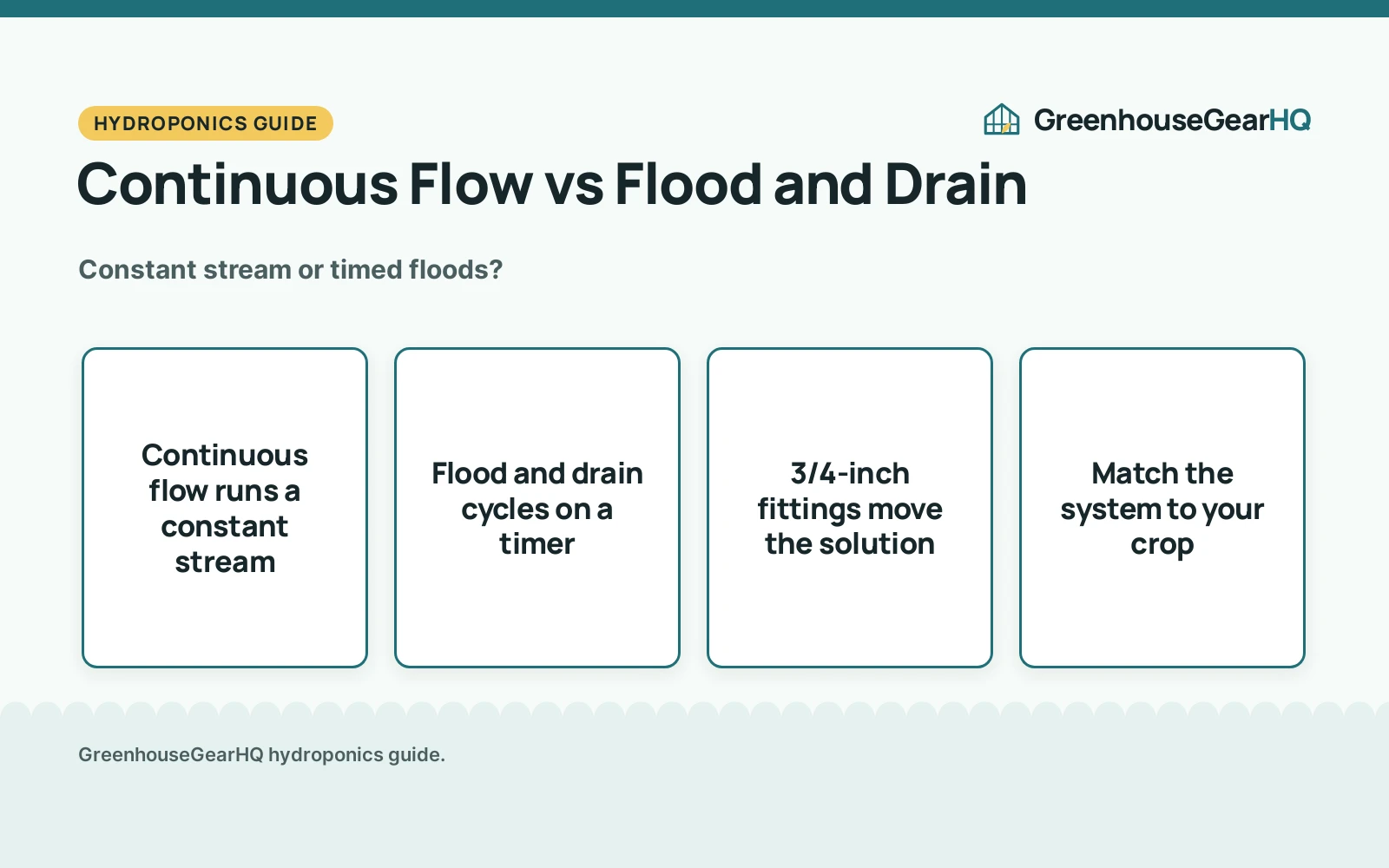
Continuous flow vs flood and drain comes down to how the nutrient solution reaches the roots: continuous flow keeps a constant stream moving past them, while flood and drain fills the tray on a timer and then lets it empty. Pick continuous flow for a simple, always-on setup with a pump running constantly, and pick flood and drain if you want the roots to breathe between waterings and to tune the flood height to the crop. Where a number appears below, it comes from a product listing we compared.
GreenhouseGearHQ earns a commission when you buy through links on this page, at no extra cost to you. As an Amazon Associate I earn from qualifying purchases. Affiliate disclosure.
Continuous flow vs flood and drain: the core difference
Continuous flow, the idea behind NFT channels, runs nutrient solution past the roots nonstop. The design is simple: a reservoir, a pump, and a channel or tray with a constant stream. Flood and drain, also called ebb and flow, works in cycles: a pump on a timer fills the grow tray to a set height, holds it briefly, then drains it back to the reservoir. Roots get a drink, then air, then a drink again.
| Aspect | Continuous flow | Flood and drain |
|---|---|---|
| Water delivery | Constant stream past the roots | Timed flood, then drain |
| Timer | Not needed; pump runs constantly | Needed to run the flood cycle |
| Fittings in our data | No dedicated fittings listed | 3/4-inch fill and drain fittings |
| Flood height | Not applicable | Set with extension fittings |
| Main risk | Pump stops, stream stops | Timer fault leaves tray dry or flooded |
How continuous flow behaves
Because the stream never stops, roots stay wet and fed at all times. That suits leafy greens and herbs that like steady moisture, and the plumbing stays simple with no timer and no flood-height tuning. The tradeoff is fragility: if the pump stops, the stream stops with it, and there is no standing water around the roots to buy time. Keep a spare pump on hand, and set the channel with a slight slope so the stream keeps moving from inlet to drain.
How flood and drain behaves
Flood and drain gives roots alternating wet and dry periods. The dry phase pulls oxygen to the roots, which many growers like for fruiting crops and larger plants. The flood height is set by the fittings: the Toolazy ebb and flow kit includes extension fittings that let you adjust the water height in the flood table to match different plant needs. The cycle runs on a timer, so a power cut or timer fault can leave the tray dry or flooded until you notice. Check the tray on a routine schedule until you trust the timing.
Fittings, sizes and kit contents
The plumbing is where the listings help. The Active Aqua fill and drain fitting comes in a 10-pack at 3/4 inch, and the maker says it is commonly used to transfer nutrient solution between the flood table and the reservoir in flood and drain systems; the listing states a 1-year warranty. The Toolazy 7-piece ebb and flow kit includes one 1/2-inch tub outlet fitting, one 3/4-inch tub outlet fitting, 2 screen fittings and 3 outlet extension fittings, made from BPA-free plastic. Screen fittings keep grow media out of the drains, and the extension fittings set the flood height. The Toolazy kit threads together with standard PVC pipe, so match the 1/2-inch and 3/4-inch sizes to your tray’s drain holes before you order.
Setting up a flood and drain tray
Assembly follows the fitting kit. Drill the holes in the grow tray or reservoir, insert the bulkhead fittings, and fasten them with the screen fittings; the Toolazy listing describes exactly this order. Connect standard PVC pipe to the threaded fittings for the fill and drain lines back to the reservoir. Thread an extension fitting onto the drain to set the flood height for the crop in the tray, since taller plants may want a higher flood line than seedlings. Fill the reservoir, run a trial cycle, and watch one full flood and drain before adding plants.
Which should you choose?
Choose continuous flow if you want the simplest plumbing: a pump running constantly, no timer, no flood-height tuning. It suits a beginner hydroponic build for leafy greens and herbs. Choose flood and drain if you want the wet-dry cycle and the control it brings: adjustable flood height with extension fittings, and trays that can hold different crops at different heights. For a side-by-side with the bucket version of recirculating systems, see our RDWC vs DWC guide, and for the timed-flood alternative in buckets, ebb and flow vs DWC hydroponics. If you are still deciding on the system type, our pump for small hydroponic system picks cover the heart of either build.
FAQ for growers
Is flood and drain the same as ebb and flow?
Yes. The Toolazy listing names its kit for ebb and flow (flood and drain) systems, and the Active Aqua listing describes fill and drain fittings for flood and drain hydroponic systems.
What fitting size do flood tables use?
The listings here use 3/4-inch fill and drain fittings, and the Toolazy kit adds a 1/2-inch tub outlet fitting. Check your tray’s drain holes before ordering.
Does flood and drain need a timer?
Yes, the flood cycle runs on a timer in the usual setup. Continuous flow skips the timer because its pump runs constantly.
Which is better for beginners?
Continuous flow has simpler plumbing with no flood-height tuning. Flood and drain needs the timer and the right fitting sizes, like the 3/4-inch fittings listed here, but gives the wet-dry cycle many growers prefer.
Keep reading
See every hydroponic system guide and all indoor growing guides.
More picks: RDWC vs DWC, ebb and flow vs DWC and pump for small hydroponic system.