On this page
Top picks at a glance
As an Amazon Associate I earn from qualifying purchases.
- 1
 LED Grow LightView on Amazon
- 2
 Smart LED PAR38 Grow LightView on Amazon
- 3
 OUTON 100W LED Grow LightView on Amazon
- 4
 Bstrip Hanging Grow Light for Indoor PlantsView on Amazon
- 5
 MARS HYDRO 100W TS600 2x2ft Dimmable LED Grow Lights forView on Amazon
- 6
 70 Watt Grow LightView on Amazon
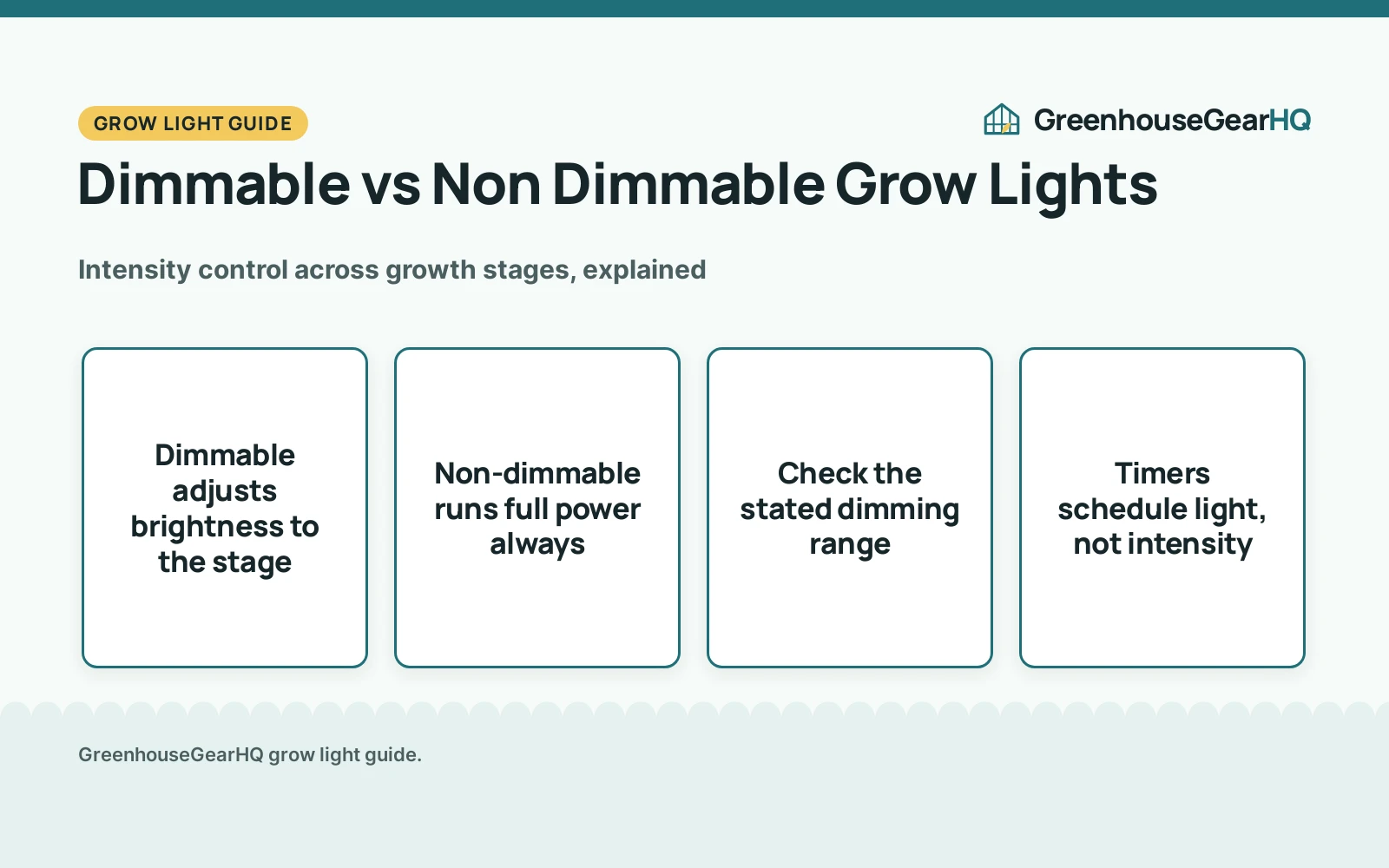
A dimmable grow light lets you turn the brightness up or down to match the growth stage; a non-dimmable light runs at full power all the time, and you control intensity by raising or lowering the fixture. Pick dimmable when one light must serve seedlings through flowering; pick non-dimmable when the setup is fixed and simplicity matters. This guide explains how each type works, what the listings state, and which suits a given grow.
Other options worth a look
 LED Grow LightCheck price on Amazon
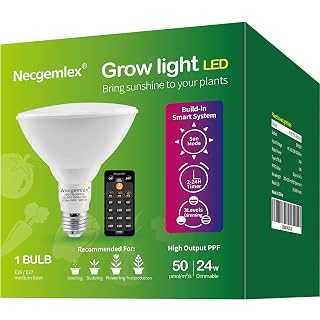 Smart LED PAR38 Grow LightCheck price on Amazon
 OUTON 100W LED Grow LightCheck price on Amazon
 Bstrip Hanging Grow Light for Indoor PlantsCheck price on Amazon
 MARS HYDRO 100W TS600 2x2ft Dimmable LED Grow Lights forCheck price on Amazon
 70 Watt Grow LightCheck price on Amazon
GreenhouseGearHQ earns a commission when you buy through links on this site, at no extra cost to you. As an Amazon Associate I earn from qualifying purchases. Affiliate disclosure.
Dimmable vs non dimmable grow lights: how they work
A dimmable grow light has a driver or control that varies its output, either in steps or smoothly. One listing describes 10 levels of brightness on an LED strip light; the SP1000 listing describes dimming from 0 to 100%; a Garpsen listing describes a 20% to 100% range; and a Barrina clip-on listing describes stepless dimming. A non-dimmable light has no such control: it runs at its rated wattage whenever it is on, so the only way to soften it is to hang it higher or move the plants. The Sylvania listing describes a 60-watt incandescent grow bulb as dimmable, which shows even old bulb technology can dim with the right circuit.
Dimming ranges and controls
Not all dimming is equal. Stepped dimming, like the 10 levels on the LED strip listing, jumps between fixed brightness points. Percentage dimming, like 0 to 100% on the SP1000 or 20% to 100% on the Garpsen, gives finer control across the range. Stepless dimming, as on the 44W Barrina clip-on, slides smoothly with no clicks. The wider the range, the more growth stages one light can cover: a 20% floor suits seedlings, while 100% suits flowering. Check whether the listing states the dimming range; several listings here simply say dimmable without giving numbers, which leaves the range unclear.
Matching light to growth stages
Seedlings want gentle light, vegetative plants want more, and flowering plants want the most. A dimmable light handles all three from one fixture: dial down for trays, dial up for bloom. The Garpsen listing pairs its 20% to 100% dimming with 3 spectral modes, and another listing pairs dimming with 3 lighting modes, so spectrum and intensity adjust together. A non-dimmable light can still work across stages if the fixture height is adjustable, the GLOWRIU listing describes a 23 to 79-inch adjustable height, but moving lights daily gets old fast. For a single shelf that does everything, dimmable wins, and the wider the stated range the fewer compromises the grower makes.
Timers, spectrums and extras
Dimming often ships with other controls. Listings here pair dimming with timers: 3, 9 and 12-hour settings on one strip light, 6, 12 and 16-hour settings on the Garpsen. Wattages in these listings run from 9W on a small A19 bulb (60W equivalent) to 120W on the SP1000, with 18W, 24W, 30W and 44W in between. The SANSI listings show the equivalence game: a 24W bulb rated 200W equivalent and a 30W bulb rated 300W equivalent. None of these extras replaces dimming; a timer without dimming still blasts seedlings at full power on schedule.
Which should you choose?
Choose dimmable when one fixture must cover multiple growth stages or when the light hangs at a fixed height: the 0 to 100% and stepless options here give the most flexibility. Choose non-dimmable when the setup never changes, a single crop at a fixed height, and the budget favors simplicity; just confirm the height is adjustable or the intensity suits the plants. For most home growers running seedlings to harvest under one light, dimmable with a stated range, like the 20% to 100% Garpsen or the 10-level strip, is the more useful buy. Whatever the choice, verify the dimming range in the listing rather than assuming it.
FAQ for growers
Do I need a dimmable grow light?
Not always. Fixed setups with one crop at one height do fine without it; multi-stage grows benefit most from dimming.
What dimming range is best?
Wider is more flexible: 0 to 100% covers everything, while 20% to 100% still handles seedlings to flowering. Listings that only say dimmable leave the range unclear.
Can I dim a non-dimmable light with a dimmer switch?
Only if the listing says the light is dimmable. Forcing a dimmer on a non-dimmable driver can cause flicker or damage; one listing here warns to use proper dimmers to prevent flickering and damage.
Do dimmable lights cost more to run?
No. A dimmed light draws less than its rated wattage; the listings here range from 9W to 120W at full power.
Keep reading
See every grow lights guide and all greenhouse climate guides.
More picks: best light meter for LED grow lights.