On this page
Top picks at a glance
As an Amazon Associate I earn from qualifying purchases.
- 1
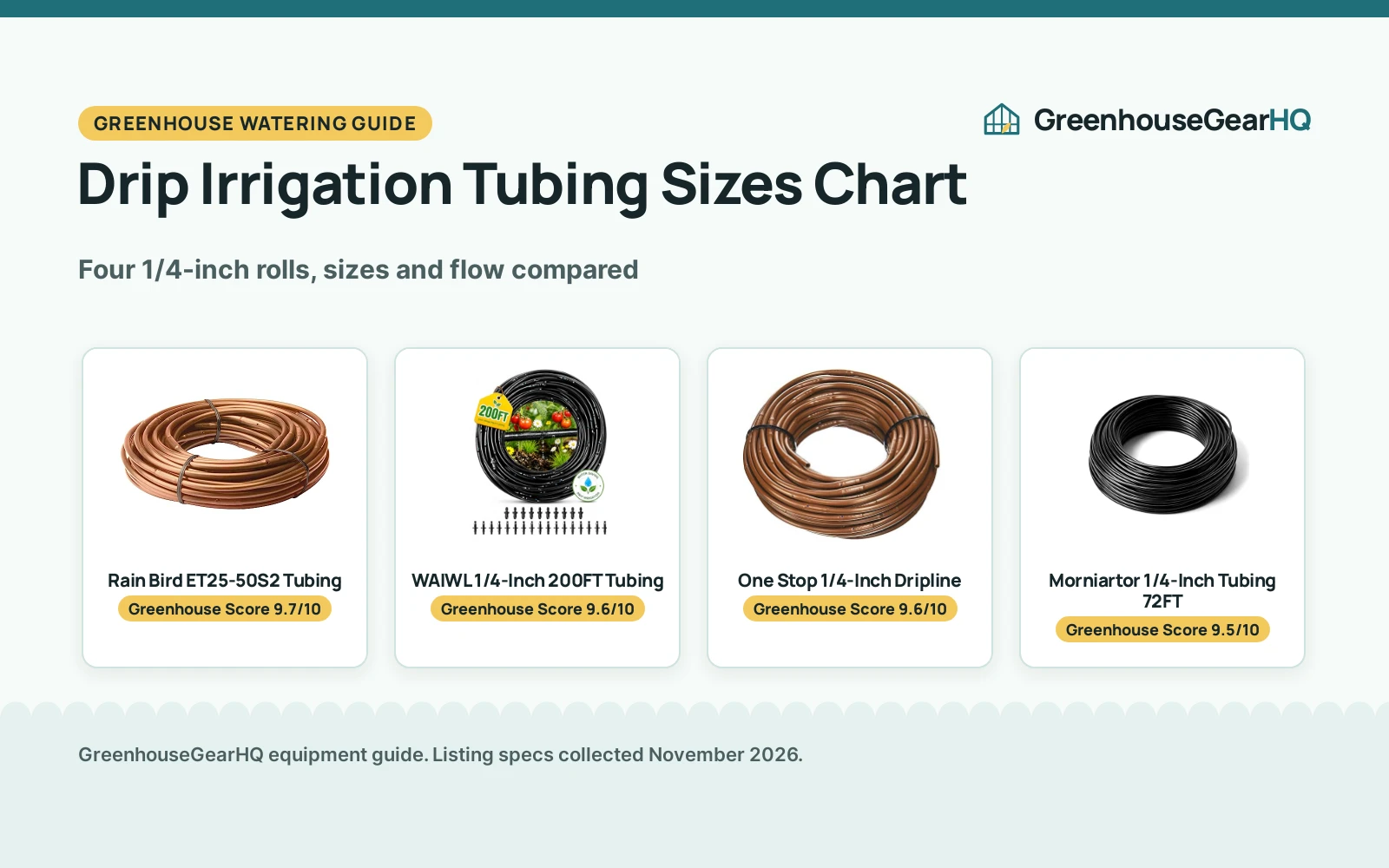
 Rain Bird ET25-50S2 Tubing9.7/10View on Amazon
- 2
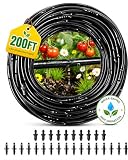 WAIWL 1/4-Inch 200FT Tubing9.6/10View on Amazon
- 3
 One Stop 1/4-Inch Dripline9.6/10View on Amazon
- 4
 Morniartor 1/4-Inch Tubing 72FT9.5/10View on Amazon
A hot July afternoon in the greenhouse is when drip irrigation tubing sizes start to matter, because the wrong size line waters unevenly and leaves the far end of the row dry. Drip irrigation tubing sizes come down to the diameter of the tube, the spacing of the emitters and the flow rate each emitter gives. This guide explains those three measures, and compares four 1/4-inch rolls by the size, spacing and flow their listings state.
GreenhouseGearHQ earns a commission when you buy through links on this page, at no extra cost to you. As an Amazon Associate I earn from qualifying purchases. Affiliate disclosure.
| # | Product | Greenhouse Score | Buy |
|---|---|---|---|
| 1 | Rain Bird ET25-50S2 Tubing | 9.7/10 | Buy on Amazon |
| 2 | WAIWL 1/4-Inch 200FT Tubing | 9.6/10 | Buy on Amazon |
| 3 | One Stop 1/4-Inch Dripline | 9.6/10 | Buy on Amazon |
| 4 | Morniartor 1/4-Inch Tubing 72FT | 9.5/10 | Buy on Amazon |

Rain Bird ET25-50S2 Tubing
A 50-foot roll of 1/4-inch emitter tubing with pressure-compensating 0.8 GPH emitters spaced 12 inches apart, for even watering along a planting row.
Pros
- Pressure-compensating emitters water evenly from the start to the end of the run
- Built-in 0.8 GPH emitters spaced 12 inches apart, with two outlet holes per emitter
- Outside diameter 0.25 inch, inside diameter 0.17 inch and wall thickness 0.04 inch are stated
Cons
- No warranty term is stated; the spec table lists only the word Warranty
- 50-foot roll is the shortest length in this guide
- No fittings are stated as included
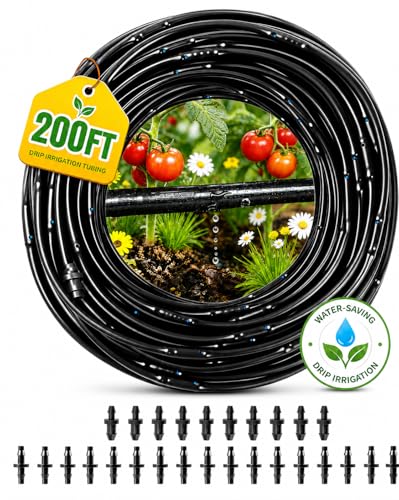
WAIWL 1/4-Inch 200FT Tubing
A 200-foot roll of 1/4-inch tubing with built-in 0.5 GPH emitters every 6 inches, for larger beds and long rows.
Pros
- 200-foot roll with built-in 0.5 GPH emitters spaced every 6 inches
- Fittings and end plugs are included
- Slow root-zone watering helps reduce runoff and waste
Cons
- No warranty term is stated
- No operating pressure is stated
- No tubing diameters or wall thickness are stated
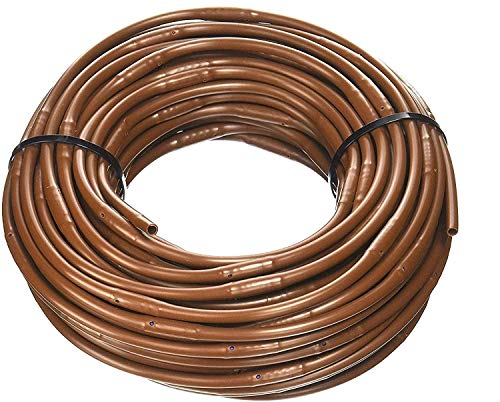
One Stop 1/4-Inch Dripline
A 100-foot roll of 1/4-inch dripline with 6-inch emitter spacing and 1/2 GPH emitters, for beds and rows that need a stated pressure range.
Pros
- 6-inch emitter spacing with 1/2 GPH flow-regulated, self-flushing emitters
- Operating pressure of 10 to 25 PSI with a minimum of 150 mesh filtration is stated
- USA made, with flexible tubing for easy installation
Cons
- No warranty term is stated
- No tubing diameters or wall thickness are stated
- 100-foot roll covers less ground than the 200-foot WAIWL roll
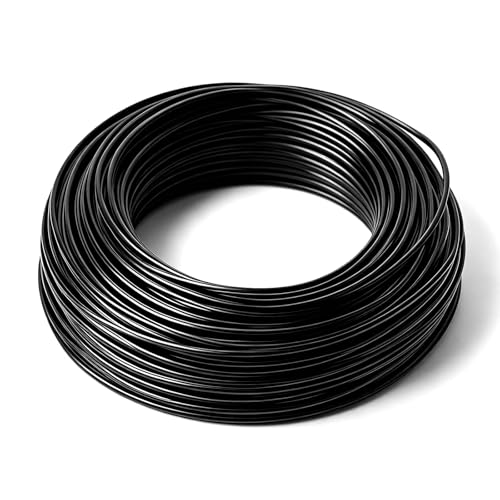
Morniartor 1/4-Inch Tubing 72FT
A 72-foot roll of plain 1/4-inch PVC supply tubing with no built-in emitters, for running water from the main line to drippers and sprayers.
Pros
- UV-resistant PVC with anti-aging and chemical corrosion resistance
- 72-foot roll with a 4mm inner diameter, for 1/2-inch main lines and micro-spray connectors
- Flexible enough to bend without cracking, for above-ground and underground installation
Cons
- No warranty term is stated
- No built-in emitters; drippers and sprayers must be added separately
- No operating pressure is stated
As an Amazon Associate I earn from qualifying purchases.
Drip irrigation tubing sizes: the short answer
Most drip setups use two sizes: a 1/2-inch main line that carries water from the source, and 1/4-inch branch lines that run to the plants. All four rolls in this guide are 1/4-inch tubing, and the Rain Bird and One Stop Outdoor listings say to attach them to 1/2-inch drip tubing with 1/4-inch barbed fittings. Within that size, the choice is emitter spacing and flow: the WAIWL and One Stop Outdoor rolls (on Amazon) list 6-inch spacing at 0.5 GPH per emitter, while the Rain Bird lists 12-inch spacing at 0.8 GPH per emitter, and the Morniartor roll lists no built-in emitters at all.
The four rolls in this guide
Diameter, spacing and flow decide which roll fits a bed, so each card below names the size, the emitter spacing and the flow rate the listing states.
How to choose the best drip irrigation tubing sizes
Match the diameter to the line
Start from the line the tubing feeds. The Rain Bird and One Stop Outdoor listings both say their 1/4-inch tubing attaches to 1/2-inch drip tubing with 1/4-inch barbed fittings, and the Morniartor listing says its 4mm inner diameter fits 1/2-inch main water supply pipes and micro-spray connectors. Check the diameters the listing states: the Rain Bird lists an outside diameter of 0.25 inch, an inside diameter of 0.17 inch and a wall thickness of 0.04 inch, while the Morniartor lists an inner diameter of 4mm and an outer diameter of approximately 7mm. The WAIWL and One Stop Outdoor listings state no diameters, so check the fitting size before you order.
Pick emitter spacing and flow for the planting
Spacing and flow decide how evenly a row waters. The table below lines up the four rolls on the two figures that matter most.
| Roll | Emitter spacing | Flow per emitter | Amazon |
|---|---|---|---|
| Rain Bird ET25-50S2 Tubing | 12 inches | 0.8 GPH | View on Amazon |
| WAIWL 1/4-Inch 200FT Tubing | 6 inches | 0.5 GPH | View on Amazon |
| One Stop 1/4-Inch Dripline | 6 inches | 1/2 GPH | View on Amazon |
| Morniartor 1/4-Inch Tubing 72FT | No built-in emitters | Not stated | View on Amazon |
Closer spacing suits dense planting and long rows, while wider spacing suits plants set further apart. The WAIWL listing says its 6-inch spacing supports even watering across vegetable rows, herb gardens and greenhouse benches, and the Rain Bird listing says its pressure-compensating emitters water plants evenly from the start to the end of the run. Our best drip irrigation systems guide compares full kits by tubing.
Check pressure and filtration
Pressure limits keep a drip line from leaking or blowing out. The Rain Bird lists an operating pressure of 8.5 to 60 psi, and the One Stop Outdoor lists 10 to 25 PSI with a minimum of 150 mesh filtration and self-flushing emitters. The WAIWL listing states no pressure, but says to warm the tubing before inserting fittings and to flush the line before sealing the end plugs. If you are weighing drip lines against soaker hose, our drip line vs soaker hose comparison walks through the difference.
Scoring notes
The Greenhouse Score weighs performance, build, value, safety and warranty. For drip tubing, safety means a stated pressure range, emitters that flush themselves clean, and filtration that keeps lines from leaking or blowing out, and each product above carries a safety score only where the listing states such features. No listing in this guide states a warranty term, so warranty adds nothing to the scores here.
FAQ for growers
What size is drip irrigation tubing?
Branch lines are commonly 1/4-inch tubing that attaches to a 1/2-inch main line with 1/4-inch barbed fittings. All four rolls in this guide are 1/4-inch tubing.
What does emitter spacing change?
Spacing sets how closely water is delivered along the row. The WAIWL and One Stop Outdoor rolls list 6-inch spacing, while the Rain Bird lists 12-inch spacing, so the closer spacing suits denser planting.
How much water does each emitter give?
The Rain Bird lists 0.8 GPH per emitter, and the WAIWL and One Stop Outdoor rolls list 0.5 GPH per emitter. The Morniartor roll lists no built-in emitters, so drippers must be added separately.
What pressure does drip tubing need?
It depends on the listing. The Rain Bird lists 8.5 to 60 psi, and the One Stop Outdoor lists 10 to 25 PSI with a minimum of 150 mesh filtration. The WAIWL and Morniartor listings state no pressure.
Keep reading
See every drip irrigation kits guide and all air and water guides.
More picks: drip irrigation systems, DIY drip irrigation systems, drip manifolds and drip irrigation kits for greenhouses.