On this page
Top picks at a glance
As an Amazon Associate I earn from qualifying purchases.
- 1
 Quick-Connect 200FT Drip Irrigation System Kit9.7/10View on Amazon
- 2
 49ft Solar Drip Irrigation System with USB Charging for 159.6/10View on Amazon
- 3
 VIVOSUN Smart Automatic Drip Irrigation Kit with A10 GrowHub9.5/10View on Amazon
- 4
 Raindrip 052020P 1/2-Inch Drip Irrigation Water Supply TubingView on Amazon
- 5
 50pcs Adjustable Drip Irrigation Emitters: Garden DrippersView on Amazon
- 6
 Raindrip R560DP Drip Watering SystemView on Amazon
- 7
 Automatic Drip Irrigation System for Indoor PlantsView on Amazon
- 8
 AC Infinity Self-Watering Fabric Pot BaseView on Amazon
- 9
 AC Infinity Self-Watering Fabric Pot Base XLView on Amazon
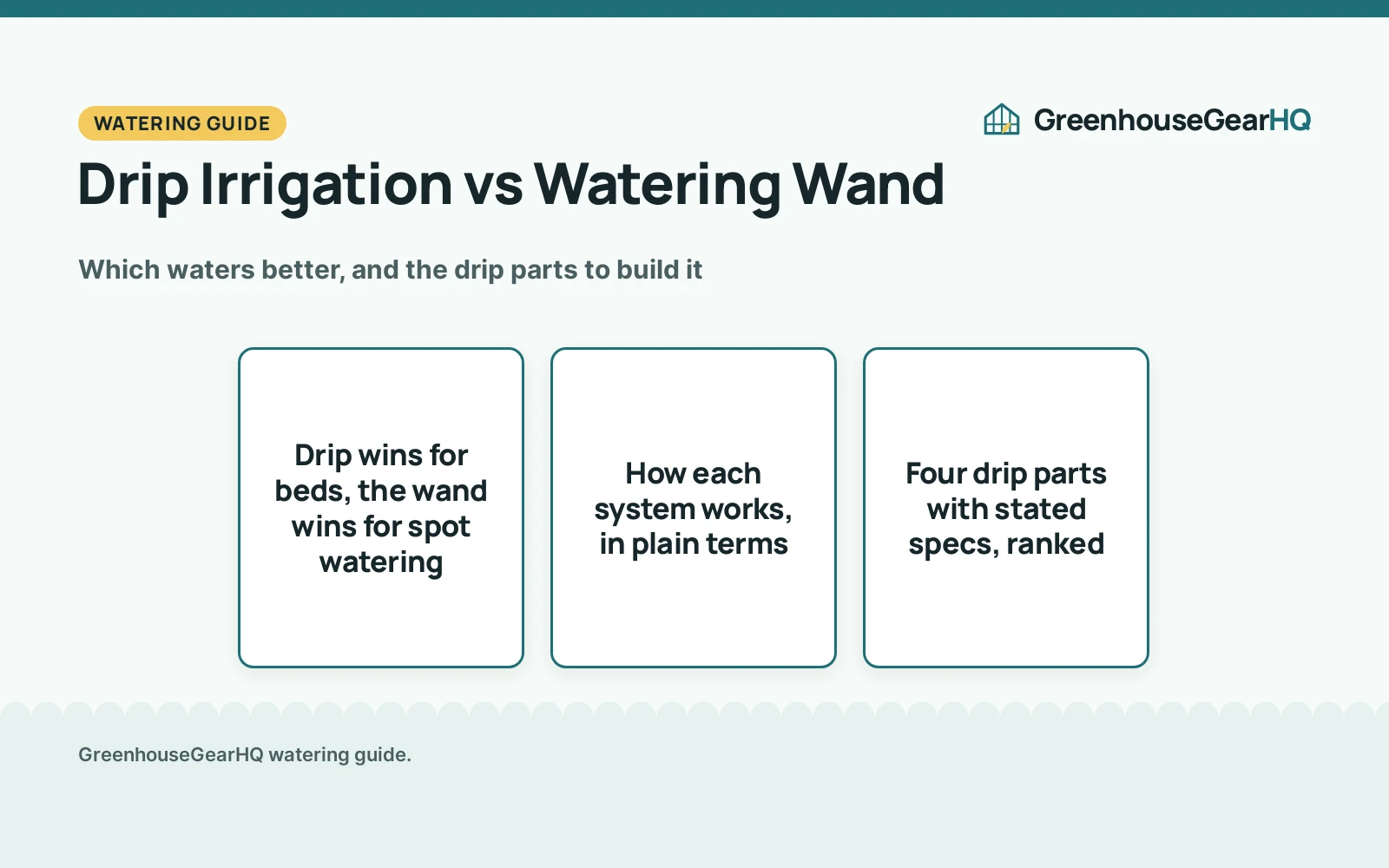
For the question of drip irrigation vs watering wand, the direct answer is this: drip irrigation waters better for beds and rows you tend all season, while a watering wand still wins for spot watering, hanging baskets and anything you water by hand once in a while. Drip runs on a timer and puts water at the roots; a wand puts you at the hose. This guide explains how each works, when each wins, and which drip parts the listings support, with every number taken from a product listing we compared.
Other options worth a look
 Raindrip 052020P 1/2-Inch Drip Irrigation Water Supply TubingCheck price on Amazon
 50pcs Adjustable Drip Irrigation Emitters: Garden DrippersCheck price on Amazon
 Raindrip R560DP Drip Watering SystemCheck price on Amazon
 Automatic Drip Irrigation System for Indoor PlantsCheck price on Amazon
 AC Infinity Self-Watering Fabric Pot BaseCheck price on Amazon
 AC Infinity Self-Watering Fabric Pot Base XLCheck price on Amazon
GreenhouseGearHQ earns a commission when you buy through links on this page, at no extra cost to you. As an Amazon Associate I earn from qualifying purchases. Affiliate disclosure.
Drip irrigation: how it works
A drip system is tubing plus emitters. A main supply line, usually half-inch tubing like the Raindrip 1/2-inch 200-foot coil, carries water through the bed; quarter-inch feeder lines branch off it, and emitters stuck into the tubing release water slowly at each plant. The listings here describe punch-in emitters, barbed connectors and stakes, and the La Farah listing states adjustable emitters with a 5-inch arrow stake, up to 18 gallons per hour flow and a 40 psi maximum.
The payoff is consistency: water goes to the root zone on a schedule instead of whenever you remember the hose. The cost is setup: you plan the lines, cut tubing, punch emitters and check for clogs. Drip suits vegetable rows, raised beds and container lines that need water every day through summer.
Watering wand: how it works
A watering wand is a long-handled sprayer on the end of a garden hose. You walk the garden and water each plant by hand, controlling where the water goes and how much each plant gets. No tubing, no emitters, no timer.
The payoff is flexibility: a wand reaches hanging baskets, spot-waters a dry corner and lets you eyeball every plant as you go. The cost is your time and your memory. A wand suits small gardens, mixed beds and anyone who enjoys the daily walk with the hose.
Drip irrigation vs watering wand: which waters better?
For plant health across a whole bed, drip waters better: slow, steady water at the roots with less wetting the leaves, and a timer that does not forget. For everything else, the wand holds its own. Many growers run both: drip on the vegetable rows and the wand for baskets, new transplants and the odd dry pot. The listings in this guide cover only the drip side; no watering wand listing was compared.
The gear: drip parts worth buying
Four drip listings, ranked by how useful each is for building a system:
1. Raindrip 1/2-inch supply tubing, 200 ft
The backbone of a small system. The listing states a 200-foot coil of half-inch poly tubing with an outside diameter of 0.620 inches and an inside diameter of 0.520 inches, built with 100% virgin outer and inner layers for UV and water exposure. Use it as the main supply line or punch emitters straight into it as a dripper line. The maker states a 1-year, 100% satisfaction guarantee.
2. Raindrip 1/4-inch supply tubing, 100 ft
The feeder line. The listing states a 100-foot coil of quarter-inch tubing with an outside diameter of 0.250 inches and an inside diameter of 0.170 inches, made for connecting to the main line with barbed fittings and running emitters to each plant. Same 1-year, 100% satisfaction guarantee from the maker.
3. La Farah adjustable drip emitters, 50-pack
The business end. The listing states 50 adjustable emitters with 5-inch arrow stakes that fit 4 to 7mm tubing, a 360-degree water flow pattern you adjust by rotating the cap, up to 18 gallons per hour and a 40 psi maximum operating pressure. The cap opens for cleaning, which matters because emitters clog.
4. Rain Bird 1/4-inch distribution tubing, T22-250S
Another quarter-inch feeder option. The listing states an outside diameter of 0.25 inches, an inside diameter of 0.17 inches, a 0.04-inch wall, UV resistance and 0 to 70 psi operating pressure, with a textured finish for faster connections. Note the listing contradicts itself on length: the spec table states 50 feet while the included-components line states a 250-foot roll, so confirm the length before ordering. See our best drip irrigation kit for patio plants picks and the best drip irrigation kit for blueberries picks for complete kits.
FAQ for growers
Is drip irrigation better than hand watering?
For beds watered daily, yes: drip delivers steady water at the roots on a schedule. A wand still suits spot watering and hanging baskets.
What size tubing does a small drip system need?
The listings here use half-inch tubing for the main line and quarter-inch for feeder lines, with the Raindrip 1/2-inch coil running 200 feet and the 1/4-inch coil running 100 feet.
Do drip emitters clog?
They can. The La Farah listing addresses this directly with an adjustable cap that opens for checking and cleaning, and states a wide water passage for clogging resistance.
Keep reading
See every drip irrigation kit guide and all ventilation and watering guides. Also see our best drip irrigation kit for patio plants.