On this page
Top picks at a glance
As an Amazon Associate I earn from qualifying purchases.
- 1
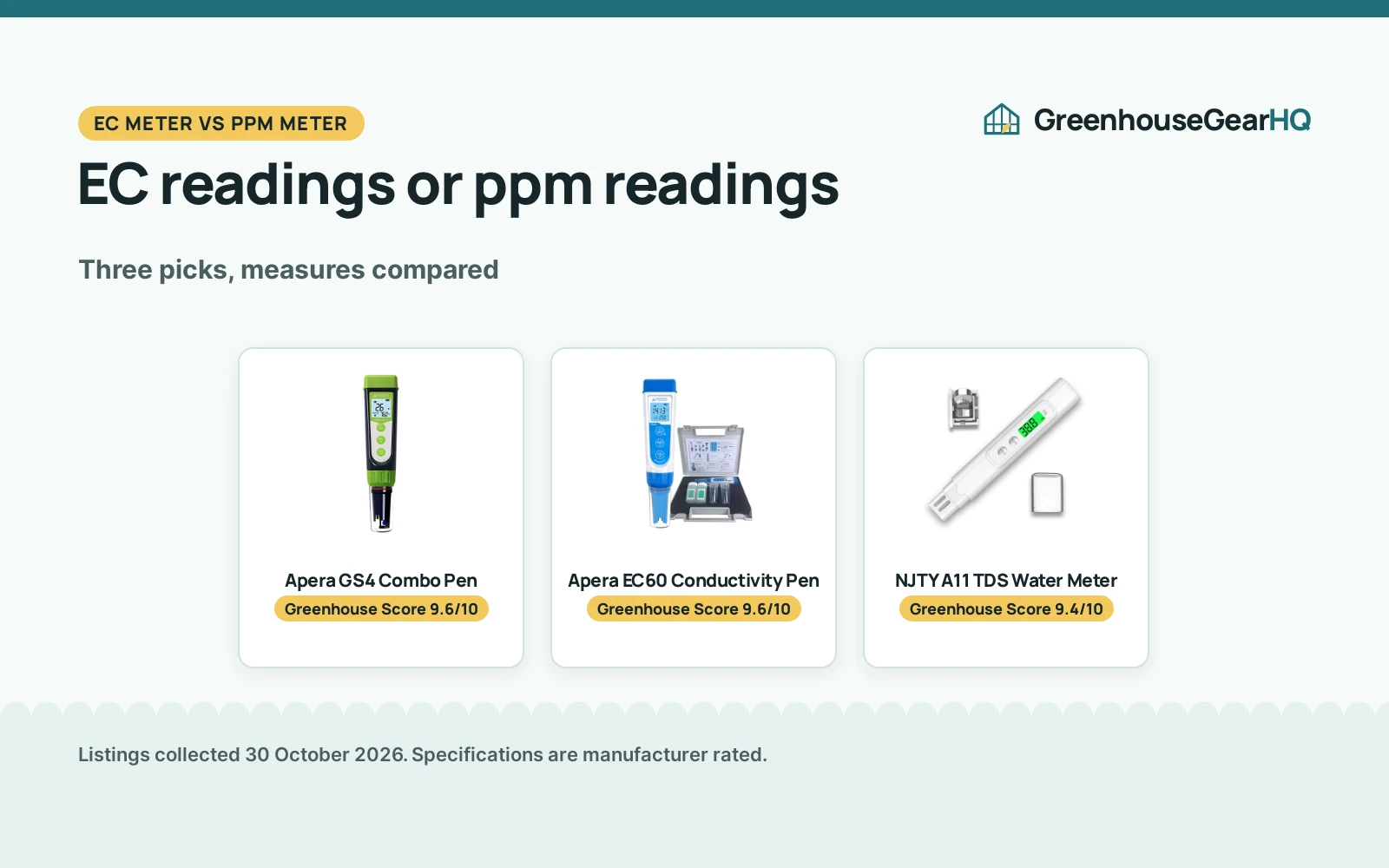
 Apera GS4 Combo Pen9.6/10View on Amazon
- 2
 Apera EC60 Conductivity Pen9.6/10View on Amazon
- 3
 NJTY A11 TDS Water Meter9.4/10View on Amazon
Late winter seed trays sit under lights while the nutrient tank waits for its first check, and the grower faces a small choice with a big effect on the feed: the ec meter vs ppm meter question. Both tools read the same tank, but they report it in different units, and this comparison puts two EC meters and one ppm meter side by side to show what separates them.
GreenhouseGearHQ earns a commission when you buy through links on this page, at no extra cost to you. As an Amazon Associate I earn from qualifying purchases. Affiliate disclosure.
Quick verdict: choose the EC side if you want a reading in conductivity units with a switch to TDS or salinity on the same pen, and you are willing to calibrate on a schedule. Choose the ppm side if you want a single TDS number at a glance, with a color-coded display and no calibration step. The Apera EC60 leads this set for its stated accuracy and waterproof build, while the NJTY A11 suits a grower who only needs a quick TDS check.
Three examples
| # | Product | Greenhouse Score | Buy |
|---|---|---|---|
| 1 | Apera GS4 Combo Pen | 9.6/10 | Buy on Amazon |
| 2 | Apera EC60 Conductivity Pen | 9.6/10 | Buy on Amazon |
| 3 | NJTY A11 TDS Water Meter | 9.4/10 | Buy on Amazon |

Apera GS4 Combo Pen
A 5-in-1 pen meter that measures pH, EC, 500ppm, 700ppm and temperature with a replaceable double-junction probe for hydroponics water.
Pros
- Measures pH, EC, 500ppm, 700ppm and temperature in one pen
- Replaceable combo probe with a double-junction pH sensor and titanium EC sensor
- 2-point calibration within a minute on an HD backlit screen
- Electrode condition indicator and calibration reminder for maintenance
Cons
- No waterproof claim in the listing
- Probe warranty runs 1 year, shorter than the instrument term
- No stated accuracy figure
- No stated battery type

Apera EC60 Conductivity Pen
A waterproof pocket conductivity meter that measures EC, TDS and salinity with a replaceable platinum black sensor and a complete calibration kit.
Pros
- ±1% F.S accuracy with a replaceable platinum black sensor
- One-tap switch between EC, TDS and salinity with a customizable TDS factor
- Auto calibration with buffer recognition and auto temperature compensation
- Complete kit with calibration solutions, bottles, AAA batteries, lanyard and carrying case
Cons
- No pH measurement, unlike the combo pen in this comparison
- Electrode warranty runs six months, shorter than the instrument term
- No stated EC measurement range in the listing
- No stated probe replacement price

NJTY A11 TDS Water Meter
A pocket TDS meter that reads 0-9990 ppm with a color-coded display, HOLD function and 1-minute auto shutoff for tap water, pools and hydroponics.
Pros
- Wide 0-9990 ppm range with a factory-calibrated probe, no manual calibration
- Color-coded display: green below 50 ppm, red at 50 ppm or above
- HOLD function locks a stable reading, auto shutoff after 1 minute
- Compact pocket size powered by 2 LR44 batteries
Cons
- Measures TDS only, no EC, pH or temperature reading
- 30-day warranty is the least cover in this comparison
- TDS does not identify specific contaminants, as the listing notes
- Liquids over 104°F must be avoided, per the listing
As an Amazon Associate I earn from qualifying purchases.
Other options worth a look
 GIDIGI Digital pH Tester for WaterCheck price on Amazon
 Truncheon Nutrient Meter for HydroponicsCheck price on Amazon
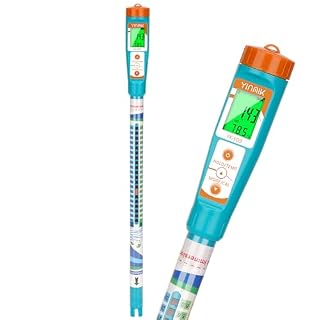 YINMIK PPM MeterCheck price on Amazon
 Apera Instruments PC60-Z Bluetooth Multi-ParameterCheck price on Amazon
 YINMIK pH EC Meter for Water HydroponicsCheck price on Amazon
 Soil EC MeterCheck price on Amazon
Ec meter vs ppm meter: side by side
| Meter | Greenhouse Score | Measures | Probe | Calibration | Warranty | Amazon |
|---|---|---|---|---|---|---|
| Apera EC60 Conductivity Pen | 9.6/10 | EC, TDS, salinity | Replaceable platinum black | Auto, buffer recognition | Two-year, six-month electrode | View on Amazon |
| Apera GS4 Combo Pen | 9.6/10 | pH, EC, 500ppm, 700ppm, temperature | Replaceable double-junction | 2-point within a minute | 2-year instrument, 1-year probe | View on Amazon |
| NJTY A11 TDS Water Meter | 9.4/10 | TDS 0-9990 ppm | Factory-calibrated probe | Factory calibrated, none manual | 30-day | View on Amazon |
Each figure is the brand’s own rating, taken from its product page on 30 October 2026.
What each side measures
The EC side reports electrical conductivity, the figure growers use to judge nutrient strength in the tank. The Apera EC60 lists EC, TDS and salinity on one pen, with a one-tap switch between them, so it covers both unit families. The Apera GS4 goes further: its listing states pH, EC, 500ppm and 700ppm plus temperature, so one pen reports both conductivity and two ppm scales. The ppm side is narrower by design. The NJTY A11 lists TDS only, across 0-9990 ppm, with no EC, pH or temperature reading. Its listing also states plainly that TDS measures total dissolved solids and does not identify specific contaminants, so a ppm number alone never names what is in the water.
That split decides the purchase more than any single feature. A grower who follows a feed chart written in EC wants the EC60 or the GS4, since both report conductivity directly. A grower who follows a chart written in ppm can use the GS4 scales or the NJTY reading, but only the NJTY keeps the job to one number on a color-coded screen.
Probes and accuracy
The two Apera pens both list replaceable probes, which matters when a probe wears out. The EC60 lists a replaceable platinum black sensor and states an accuracy of ±1% F.S, the only accuracy figure stated in this set. The GS4 lists a replaceable combo probe with a double-junction pH sensor and a titanium EC sensor, but its listing states no accuracy figure, so the two Apera pens cannot be ranked on accuracy from the listings alone. The NJTY A11 lists a factory-calibrated high-sensitivity probe and states no accuracy figure either, and it asks for no manual calibration at all.
Calibration and displays
Calibration is where the two sides trade effort for control. The GS4 listing describes a grower-friendly workflow that finishes 2-point calibration within a minute on an HD backlit screen, plus an electrode condition indicator and a calibration reminder function. The EC60 listing describes auto calibration with auto buffer recognition, auto temperature compensation, a dual display of temperature and EC, and a large LCD with 3 backlit colors for its modes. The NJTY listing skips calibration entirely: the pen arrives factory-calibrated, and the grower only presses power, immerses the probe between the immersion marks, stirs gently and presses HOLD once the reading steadies. It shuts off after 1 minute of inactivity to save battery.
Displays follow the same split. The Apera pens show numbers the grower must interpret against a chart, while the NJTY display adds color: green for TDS below 50 ppm and red at 50 ppm or above, for instant feedback on the reading.
Kits and warranties
What comes in the box differs as much as the readings. The EC60 listing describes a complete kit with ready-to-use calibration solutions, calibration bottles, AAA batteries and a lanyard, all in a premium portable carrying case. The GS4 listing details the pen and its replaceable probe but states no carrying case or calibration solutions. The NJTY listing is the simplest: a compact pen powered by 2 LR44 batteries, with care instructions to dry the probe after each check and to avoid liquids over 104°F.
Warranty terms follow the same order. The GS4 listing states a manufacturer limited warranty of 2-year for the instrument and 1-year for the probe. The EC60 listing states a two-year limited warranty for the instrument and a six-month limited warranty for the electrode. The NJTY listing states a 30-day warranty with expert support, the briefest term in this set.
Which should you choose?
Choose an EC meter if you follow a feed chart in conductivity units, or you want one pen that also reads pH and ppm scales, as the GS4 does. The EC60 suits a grower who wants a stated accuracy figure, a waterproof pocket pen and a full calibration kit. Compare more pH options in our best pH meter for greenhouse picks, and keep the calibration step simple with a pH calibration solution.
Choose a ppm meter if you only need a quick TDS number before a feed or a water change, and you want no calibration routine. The NJTY A11 suits that job with its wide range, color-coded display and HOLD function. If the reading ever needs a second opinion, a pen from the EC side can confirm it in conductivity units.
If the tank sits inside a larger hydroponic setup, our durable hydroponic system picks cover the rest of the rig.
In the Greenhouse
- Dip the NJTY probe between the immersion marks, stir gently, and press HOLD once the reading steadies.
- Dry the NJTY probe after each check and avoid liquids over 104°F, per the listing.
- Keep the EC60 kit together in its carrying case, with the calibration solutions, bottles and lanyard.
- Watch the GS4 electrode condition indicator and calibration reminder to plan maintenance.
Scoring notes
| Product | Greenhouse Score | Perf. /35 | Build /25 | Value /25 | Safety /10 | Warranty /5 |
|---|---|---|---|---|---|---|
| Apera GS4 Combo Pen | 9.6 | 33 | 22 | 21 | 0 | 4 |
| Apera EC60 Conductivity Pen | 9.6 | 32 | 21 | 21 | 5 | 0 |
| NJTY A11 TDS Water Meter | 9.4 | 26 | 19 | 20 | 0 | 1 |
We rescale the weighted total onto a range that ends at 9.2 and 9.8; nothing in the conversion can reorder two picks.
The Greenhouse Score weighs performance, build, value, safety and warranty, as explained on our How we pick page. For water meters, safety reflects a stated waterproof build; only the EC60 states one, so only it earns safety points. All three listings state a warranty term, from the 30-day term on the NJTY to the two-year instrument terms on the Apera pens.
FAQ for growers
Should I buy an EC meter or a ppm meter for hydroponics?
It depends on the chart you follow. The EC60 and GS4 report conductivity, and the GS4 also reports 500ppm and 700ppm, while the NJTY reports TDS only across 0-9990 ppm.
Can one pen read both EC and ppm?
Yes, on this set. The GS4 lists EC plus 500ppm and 700ppm, and the EC60 switches between EC, TDS and salinity with one tap.
Do ppm meters need calibration?
The NJTY arrives factory-calibrated and asks for no manual calibration. The Apera pens do ask for it: the EC60 uses auto calibration with buffer recognition, and the GS4 finishes 2-point calibration within a minute.
What does the color-coded display tell you?
On the NJTY, green means TDS below 50 ppm and red means 50 ppm or above. The listing notes that TDS measures total dissolved solids and does not identify specific contaminants.
Keep reading
See every indoor growing guide.
More picks: pH meters for greenhouses, pH calibration solutions, durable hydroponic systems and thermometers for hydroponics.