On this page
Top picks at a glance
As an Amazon Associate I earn from qualifying purchases.
- 1
 iLIVING 18 Inch Wall Mounted Shutter Exhaust Fan with9.8/10View on Amazon
- 2
 VIVOSUN AeroWave E6 Gen2 Grow Tent Clip Fan9.8/10View on Amazon
- 3
 Amico 20 in Shutter Exhaust Fan with Thermostat9.8/10View on Amazon
- 4
 Comfort Zone Twin Window Fan with Reversible Airflow ControlView on Amazon
- 5
 VEVOR Air Mover Blower Fan 12 InchView on Amazon
- 6
 VEVOR 10'' Exhaust FanView on Amazon
- 7
 iLivingView on Amazon
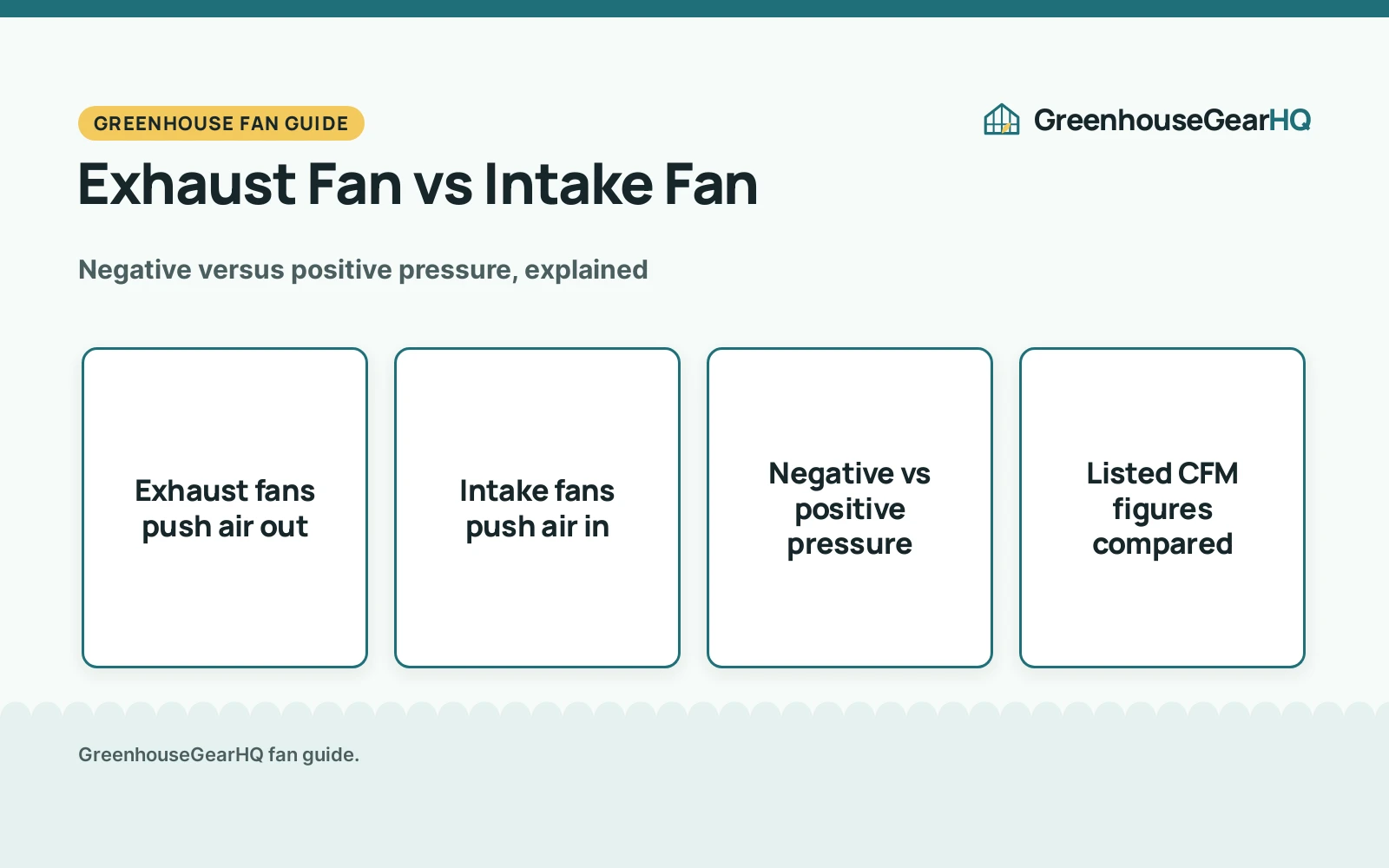
On a still afternoon, a greenhouse fills with warm, damp air that has nowhere to go, which is when growers compare an exhaust fan vs intake fan. The short answer: an exhaust fan pushes inside air out, creating negative pressure that pulls fresh air in through vents; an intake fan pushes outside air in, creating positive pressure that forces inside air out through vents. One pulls, the other pushes.
Other options worth a look
 Comfort Zone Twin Window Fan with Reversible Airflow ControlCheck price on Amazon
 VEVOR Air Mover Blower Fan 12 InchCheck price on Amazon
 VEVOR 10'' Exhaust FanCheck price on Amazon
 iLivingCheck price on Amazon
GreenhouseGearHQ earns a commission when you buy through links on this page, at no extra cost to you. As an Amazon Associate I earn from qualifying purchases. Affiliate disclosure.
Exhaust fan vs intake fan: what each one does
An exhaust fan sits at the outlet and moves inside air to the outside. Because it removes air, the house goes slightly negative, and replacement air is drawn in through vents or louvers on the far side. An intake fan sits at the inlet and pushes outside air into the house, making the inside slightly positive so stale air is forced out through vents. The listings in this guide are mostly exhaust fans, with two reversible models that do both jobs; figures below name the brand only where a figure is cited.
Exhaust fans: pushing air out
Exhaust listings state their CFM plainly. The Panasonic WhisperFit lets you select 50, 80 or 110 CFM at 0.8 sones and 15 watts with Energy Star and UL marks; the Broan ChromaComfort lists 110 CFM at 1.5 sones for rooms up to 110 square feet with a 3 year Limited warranty; the Gopper lists 120 CFM at 1.0 sones for spaces up to 100 square feet with a 1 year warranty. Smaller bath models list 50 CFM: the Broan 688ES for rooms up to 45 square feet at 2.0 sones, and the Holdly at 1.0 sones and 24 watts. At the other end, the VEVOR portable blower lists 3198 CFM at 585 watts with a 16.4 ft flexible duct, 79 dB, ETL certification and an IP44 waterproof rating.
Use an exhaust fan where heat, humidity or odors build up and must leave the house. Negative pressure does the rest of the work: every cubic foot pushed out pulls a cubic foot in through the vents. Our greenhouse exhaust fans with thermostat roundup compares more exhaust models.
Intake fans: pushing air in
Dedicated intake listings are rare in the data; instead, the Comfort Zone twin window fans are reversible and cover both sides. The CZ319WT lists reversible airflow, intake or exhaust, at 272 CFM with 2 speeds, 45.9 watts, 53.3 dB, ETL and UL marks and a 1 Year Warranty Against Manufacturer Defects. Its sibling, the CZ319WT2, lists 3 speeds, a removable bug screen, ETL certification and the same 1 year warranty.
An intake setup suits houses where the grower wants to control what comes in: filtered or cooled air pushed in at one end, stale air forced out the other. Positive pressure also keeps unfiltered air from sneaking in through cracks. For moving air inside the house rather than exchanging it, see our greenhouse fans with thermostat picks.
Which one should you buy?
| Fan type | Air direction | Room pressure | Suits |
|---|---|---|---|
| Exhaust fan | Inside air out | Negative: pulls air in through vents | Heat, humidity and odor removal |
| Intake fan | Outside air in | Positive: pushes air out through vents | Controlled incoming air |
Most greenhouses start with exhaust: it directly removes the heat and humidity, and the listings above run from 50 to 3198 CFM to size it. Add intake when you want to decide what replaces that air, or use a reversible model like the Comfort Zone twins, which list both intake and exhaust at 272 CFM. Either way, the far side needs a clear vent path, or neither pressure strategy moves air well.
FAQ for growers
Can one fan do both jobs?
Some can. The Comfort Zone CZ319WT and CZ319WT2 list reversible airflow, so each works as an intake or an exhaust fan at 272 CFM. Dedicated bath and blower listings are exhaust only.
How much air do exhaust fans move?
The bath listings here range from 50 CFM on the Broan 688ES and the Holdly to 110 CFM on the Panasonic and the Broan ChromaComfort and 120 CFM on the Gopper. The VEVOR portable blower lists 3198 CFM with a 16.4 ft duct.
What is negative versus positive pressure?
Negative pressure comes from an exhaust fan: it pushes inside air out, and fresh air is pulled in through vents. Positive pressure comes from an intake fan: it pushes outside air in, and stale air is forced out through vents.
How quiet are these fans?
The Panasonic lists 0.8 sones, the Gopper and the Holdly list 1.0 sones, and the Broan ChromaComfort lists 1.5 sones. The Comfort Zone twins list 53.3 dB, and the VEVOR blower lists 79 dB.
Keep reading
See every greenhouse fans guide and all air and water guides.
More picks: greenhouse exhaust fans with thermostat, greenhouse fans with thermostat.