On this page
Top picks at a glance
As an Amazon Associate I earn from qualifying purchases.
- 1
 Tankless 800 mL/h humidifier for 1000 sq ft9.7/10View on Amazon
- 2
 Electric ULV Portable Fogger Sprayer Machine 4.5LView on Amazon
- 3
 Concrobium Mold Control FoggerView on Amazon
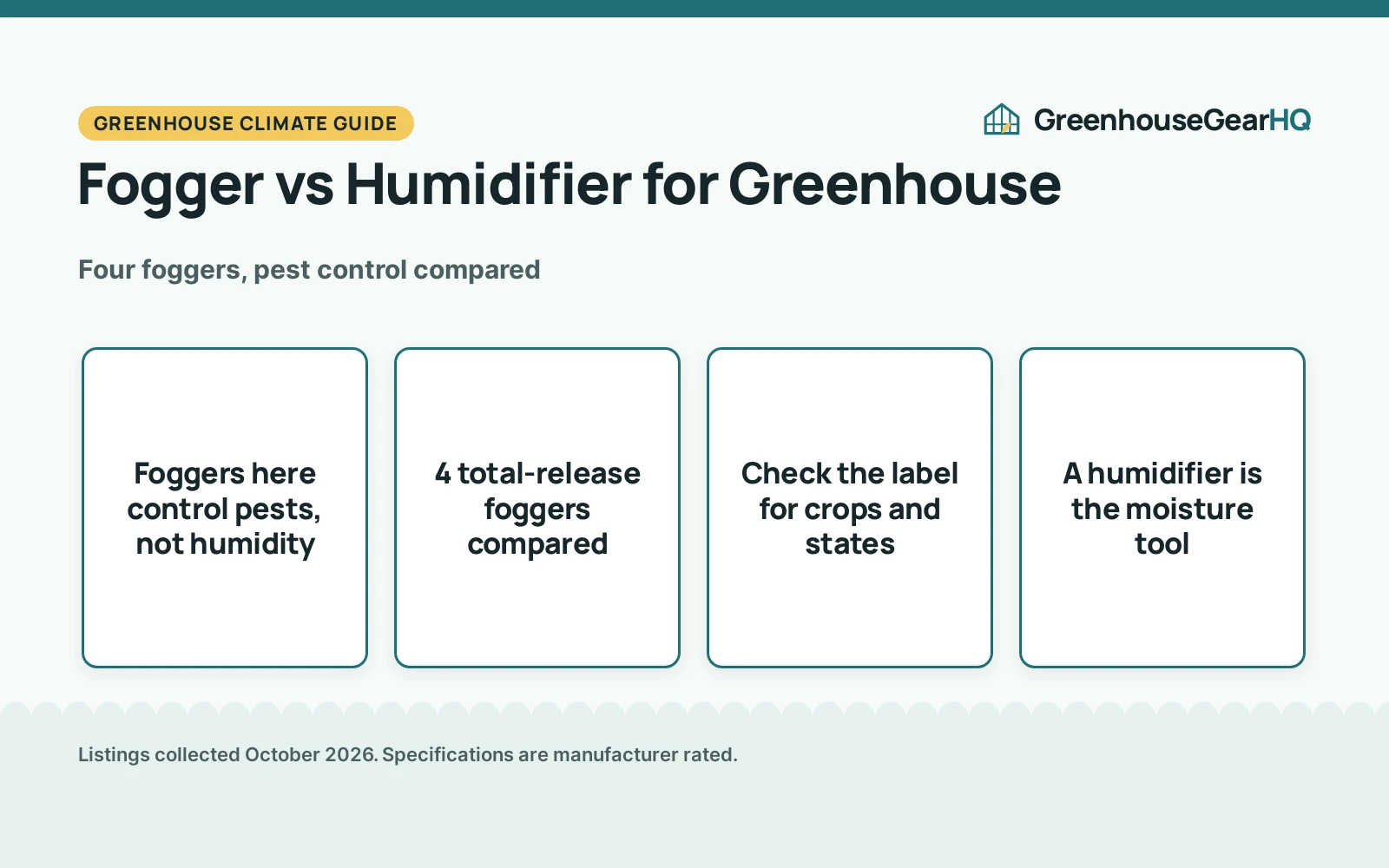
On a hot afternoon in the greenhouse, leaves can look dry and pests can hide under them, and a grower searching for fogger vs humidifier for greenhouse may mean different tools. In the listings compared here, a fogger is a total-release insecticide fogger for pest control, not a device that adds moisture to the air, while a humidifier is the tool that raises humidity. None of the listings here is a humidifier, so this guide compares the fogger side in full and states plainly where a humidifier would fit instead.
Other options worth a look
 Electric ULV Portable Fogger Sprayer Machine 4.5LCheck price on Amazon
 Concrobium Mold Control FoggerCheck price on Amazon
GreenhouseGearHQ earns a commission when you buy through links on this page, at no extra cost to you. As an Amazon Associate I earn from qualifying purchases. Affiliate disclosure.
Fogger vs humidifier for greenhouse: what each one does
A fogger, as the listings use the word, releases fine insecticide particles through the air to reach pests on and under leaves. A humidifier, by contrast, puts moisture into the air to raise humidity for plants that need damp air. Each tool answers a different problem: pests for the fogger, dry air for the humidifier. Buying a fogger when the problem is dry air will not raise humidity, and buying a humidifier when the problem is pests will not control them.
The gear section: 4 foggers, ranked
The 4 listings below are all total-release insecticide foggers, ranked by breadth of labeled pests and crops and by clarity of the listing.
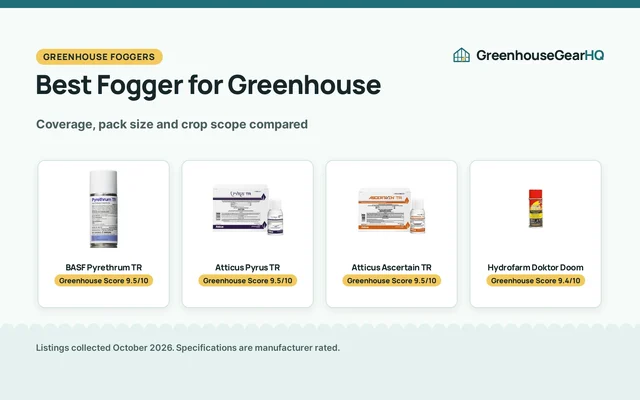
First, the Atticus Pyrus TR, sold as 12 cans of 2 oz. Its bullets state 4% pyrethrin plus 16% piperonyl butoxide, for aphids, beetles, gnats, mites, thrips, whiteflies and more, on flowers, ornamentals and vegetables including leafy, legume and fruiting types, plus herbs. Each container treats greenhouse spaces up to 3,000 sq ft, per the listing. One caution: its spec table also lists chlorfenapyr 4.5% as an active ingredient, which does not match the bullets, so the bullets are the safer guide. It is not available for sale in Alaska, Puerto Rico, or Vermont.
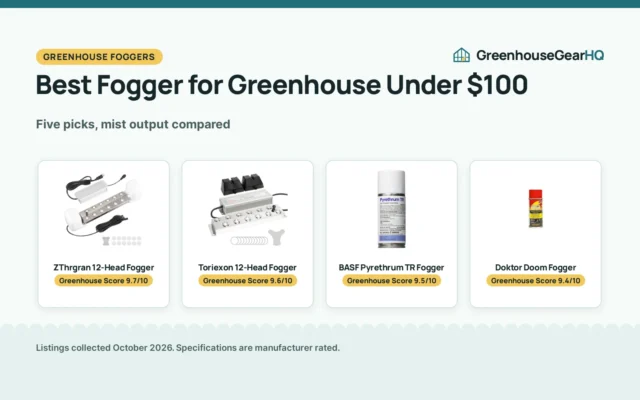
Second, the Doktor Doom Total Release Fogger, 3 oz. Its bullets state natural pyrethrin that breaks down within hours with no long-lasting residuals, for fungus gnats, spider mites, aphids, whiteflies, scale, mealy bugs and thrips, in greenhouses and indoor gardening spaces, including fruit and vegetable areas. No coverage figure is stated for this listing.
Third, the BASF Pyrethrum TR, 2 fluid ounces. Its title states 6000 sq ft of coverage and botanical insecticide for ornamental crops and growing crops in commercial greenhouses, for aphids, fungus gnats, mites and whiteflies. One caution: its spec table lists chlorfenapyr 4.5% as the active ingredient, which does not match the pyrethrum in the title and bullets, so the title and bullets are the safer guide.
Fourth, the Atticus Piston TR, a 2 oz can. Its bullets state 4.5% chlorfenapyr for fast 72-hour control of adult fungus gnats, mites and thrips, labeled for fruiting vegetables such as peppers and tomatoes, plus flowering plants and ornamentals. Each container treats greenhouse spaces up to 3,000 sq ft, per the listing. It is not available for sale in Alaska or Hawaii.
| Fogger | Active ingredient as listed in bullets | Container | Coverage as listed |
|---|---|---|---|
| Atticus Pyrus TR | 4% pyrethrin, 16% piperonyl butoxide | 12 cans of 2 oz | Up to 3,000 sq ft per container |
| Doktor Doom Total Release Fogger | Natural pyrethrin | 3 oz | Not stated |
| BASF Pyrethrum TR | Pyrethrum per title and bullets | 2 fluid ounces | 6000 sq ft |
| Atticus Piston TR | 4.5% chlorfenapyr | 2 oz can | Up to 3,000 sq ft per container |
How to choose a fogger vs humidifier for greenhouse
Start from the problem, not the device name
If leaves show pests, a fogger from the listings above matches the problem, and the label for the crop in question decides which one. If the air feels dry and no pests are present, a humidifier matches the problem instead; see humidifiers for microgreens and plant humidifiers with heaters for that side. Do not buy a pest fogger to raise humidity: none of the listings here describes adding moisture.
Check the label for crops, states and ventilation
Each fogger here is labeled for some crops and not others, and some list states where they are not sold. Read the product label for the complete crop listing, the states, and the ventilation directions, and check with the local extension office where the label leaves a question open.
Compare coverage and container counts on the label
Coverage figures differ by listing: the BASF listing states 6000 sq ft, while each Atticus container treats up to 3,000 sq ft, and the Doktor Doom listing states no coverage figure. Container counts differ too: Pyrus TR comes as 12 cans of 2 oz, while Piston TR comes as a 2 oz can.
What this guide does not cover
This guide gives no dosing or mixing instructions for any fogger here. Follow the product label for use directions, and check with the local extension office for timing and crop questions. It also does not review humidifiers in full; the humidifier links above point to guides that do.
FAQ for growers
Does a fogger add humidity to a greenhouse?
No, not the foggers listed here. They release insecticide particles for pest control, and none of the listings describes adding moisture to the air.
Which fogger covers the largest area per container?
The BASF listing states 6000 sq ft of coverage, while each Atticus container treats up to 3,000 sq ft. The Doktor Doom listing states no coverage figure.
Do these foggers work on edible crops?
Some do, for the crops on their own labels: Doktor Doom is described for fruit and vegetable areas, and Pyrus TR is labeled for vegetables including leafy, legume and fruiting types. Always check the product label for the complete crop listing.
Are these foggers sold in every state?
No. Pyrus TR is not available for sale in Alaska, Puerto Rico, or Vermont, and Piston TR is not available in Alaska or Hawaii, per their listings.
Keep reading
See every Light and Heat guide and all greenhouse climate guides.
More picks: misting systems with pumps, greenhouse fans for large greenhouses, copper vs plastic misting tubing.