On this page
Top picks at a glance
As an Amazon Associate I earn from qualifying purchases.
- 1
 Quictent 20x10x6.6 FT Tunnel Greenhouse with Dual Hinged Doors9.8/10View on Amazon
- 2
 GIANTEX Wood Cold Frame with Flip-Top RoofView on Amazon
- 3
 6 x 6 FT Polycarbonate Greenhouse with Roof VentView on Amazon
- 4
 Happygrill Portable Wood Mini Greenhouse w/TransparentView on Amazon
- 5
 6x8 FT Polycarbonate Walk-in Greenhouse with Roof Vent &View on Amazon
- 6
 AMERLIFE 10x18 FT Polycarbonate Greenhouse with 4 Roof VentsView on Amazon
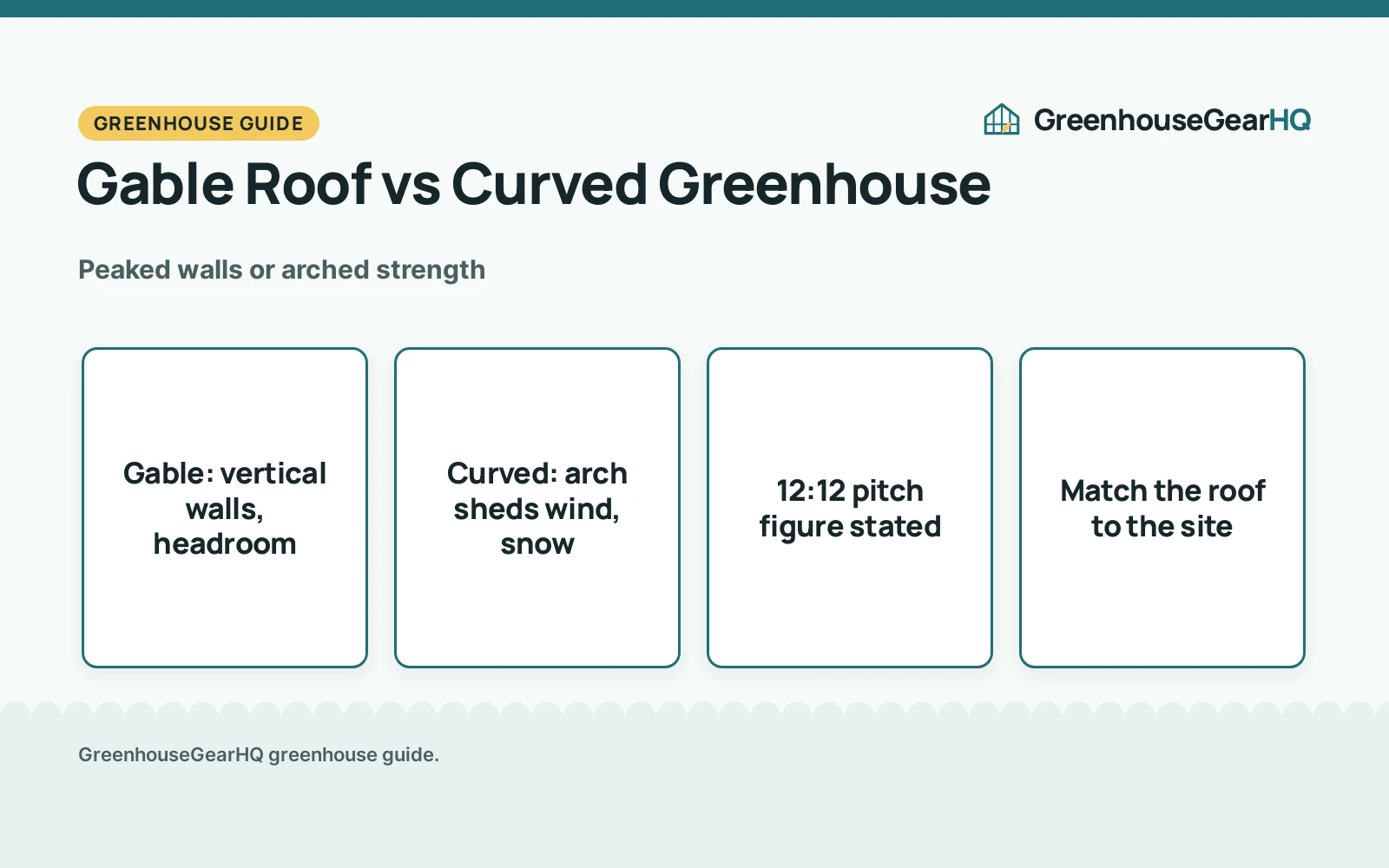
Gable roof vs curved greenhouse: the short answer is that a gable roof gives you vertical walls and headroom with a classic peaked look, while a curved greenhouse sheds wind and snow with an aerodynamic arch. One trades some wind resistance for usable space; the other trades headroom for toughness. The reference listings include gable hardware but no greenhouse kits, so the comparison is explained with one cited figure and general knowledge otherwise.
Other options worth a look
 GIANTEX Wood Cold Frame with Flip-Top RoofCheck price on Amazon
 6 x 6 FT Polycarbonate Greenhouse with Roof VentCheck price on Amazon
 Happygrill Portable Wood Mini Greenhouse w/TransparentCheck price on Amazon
 6x8 FT Polycarbonate Walk-in Greenhouse with Roof Vent &Check price on Amazon
 AMERLIFE 10x18 FT Polycarbonate Greenhouse with 4 Roof VentsCheck price on Amazon
GreenhouseGearHQ earns a commission when you buy through links on this page, at no extra cost to you. As an Amazon Associate I earn from qualifying purchases. Affiliate disclosure.
Gable roof vs curved greenhouse: how they differ
The roof shape decides three things: how much of the floor area you can actually use, how the structure handles weather, and how easy it is to ventilate. A gable roof is two sloped planes meeting at a ridge, like a house. A curved greenhouse is a continuous arch from ground to ground, like a tunnel.
Gable roof: walls, headroom and a classic look
Gable suits the grower who wants every square foot. Vertical walls mean benches and tall plants fit right up to the edges, and the peak gives headroom for hanging baskets or a tall door. Roof vents sit naturally along the ridge, where hot air collects. Snow slides off a pitched roof; the VEVOR listing for gable truss connector plates states a 12:12 pitch, a typical steep gable angle. The tradeoff is wind: flat wall planes and a ridge catch more wind than an arch.
Choose gable when usable space and headroom matter most, when you want ridge ventilation, and when the site is reasonably sheltered from wind.
Curved: arch strength against wind and snow
Curved suits the grower on an exposed site. The arch distributes wind and snow loads along its curve instead of concentrating them on a ridge, and snow tends to slide off the smooth shape. Fewer joints mean fewer places for leaks and less framing to assemble. The tradeoffs are headroom at the edges, where the arch curves down, and ventilation: ridge vents do not fit an arch, so curved houses rely on side vents, louvers or end-wall fans.
Choose curved when wind or heavy snow is the main threat, when you want the simplest frame, and when you can live with lower edges.
How to size and spec your choice
Start with the footprint. The reference listings show gable-roof outdoor structures at 10′ x 12′, 12′ x 14′ and 12′ x 16′ footprints (Raysfung, Domi and Aoxun listings), a useful range for planning a backyard grow. Larger footprints give more growing room but need more glazing and framing, so match the size to the site and the number of plants you plan to keep.
Then check the pitch and the extras. Steeper gable pitches shed snow and rain better: the VEVOR gable plate listing states a 12:12 pitch, and the Ekena Millwork gable pediment listing states 60 inches wide by 25 inches tall with a 10/12 pitch. Extras in the listings show what gable structures can carry: the Aoxun 12′ x 14′ listing includes a 19.7-foot power outlet run for lights and fans. If the structure will hold lights, heaters or automated vents, confirm the frame and the power run before buying.
Finally, plan ventilation around the roof shape. Gable peaks take ridge vents where hot air collects; the listings show gable-roof structures with galvanized steel roofs (Aoxun, Kozyard and Raysfung listings), which pair well with ridge or gable-end vents. Curved houses need side or end-wall ventilation instead, so budget for louvers or an exhaust fan.
Which one should you buy?
| Roof type | Shape | Strengths | Suits |
|---|---|---|---|
| Gable roof | Peaked with vertical walls | Headroom, usable edges, ridge vents | Space and ventilation priority |
| Curved | Continuous arch | Wind and snow shedding, simple frame | Exposed, harsh-weather sites |
Match the roof to the site. A sheltered backyard grow leans gable for its space and classic looks; see our budget greenhouses for kit examples. An exposed, windy or snowy site leans curved for its arch strength. Browse every walk-in greenhouse guide for more.
FAQ for growers
Which handles snow better?
Curved, in general: the arch sheds snow along its smooth curve. A gable roof also sheds snow when the pitch is steep; the VEVOR gable plate listing states a 12:12 pitch, a typical steep angle. Shallow gable pitches hold snow and need checking.
Which gives more usable space?
Gable. Vertical walls keep the full floor area usable right to the edges, while a curved house loses headroom where the arch comes down.
Which is easier to ventilate?
Gable: ridge vents sit naturally at the peak where hot air collects. Curved houses use side vents, louvers or end-wall exhaust fans instead.
Which is cheaper to build?
Curved frames usually use fewer parts and simpler joints, which keeps kit prices down. Gable kits cost more in framing but give more usable space for the footprint. No prices are stated in the listings.
Keep reading
See every walk-in greenhouse guide and all greenhouse guides.
More picks: budget greenhouses, greenhouse plastic for cold climates, greenhouse fans.