On this page
Top picks at a glance
As an Amazon Associate I earn from qualifying purchases.
- 1
 TIDEWE Rubber Work Boots9.6/10View on Amazon
- 2
 CKWLXQY Women's Deck Boots9.5/10View on Amazon
- 3
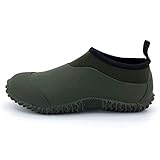 SYLPHID Garden Shoes9.4/10View on Amazon
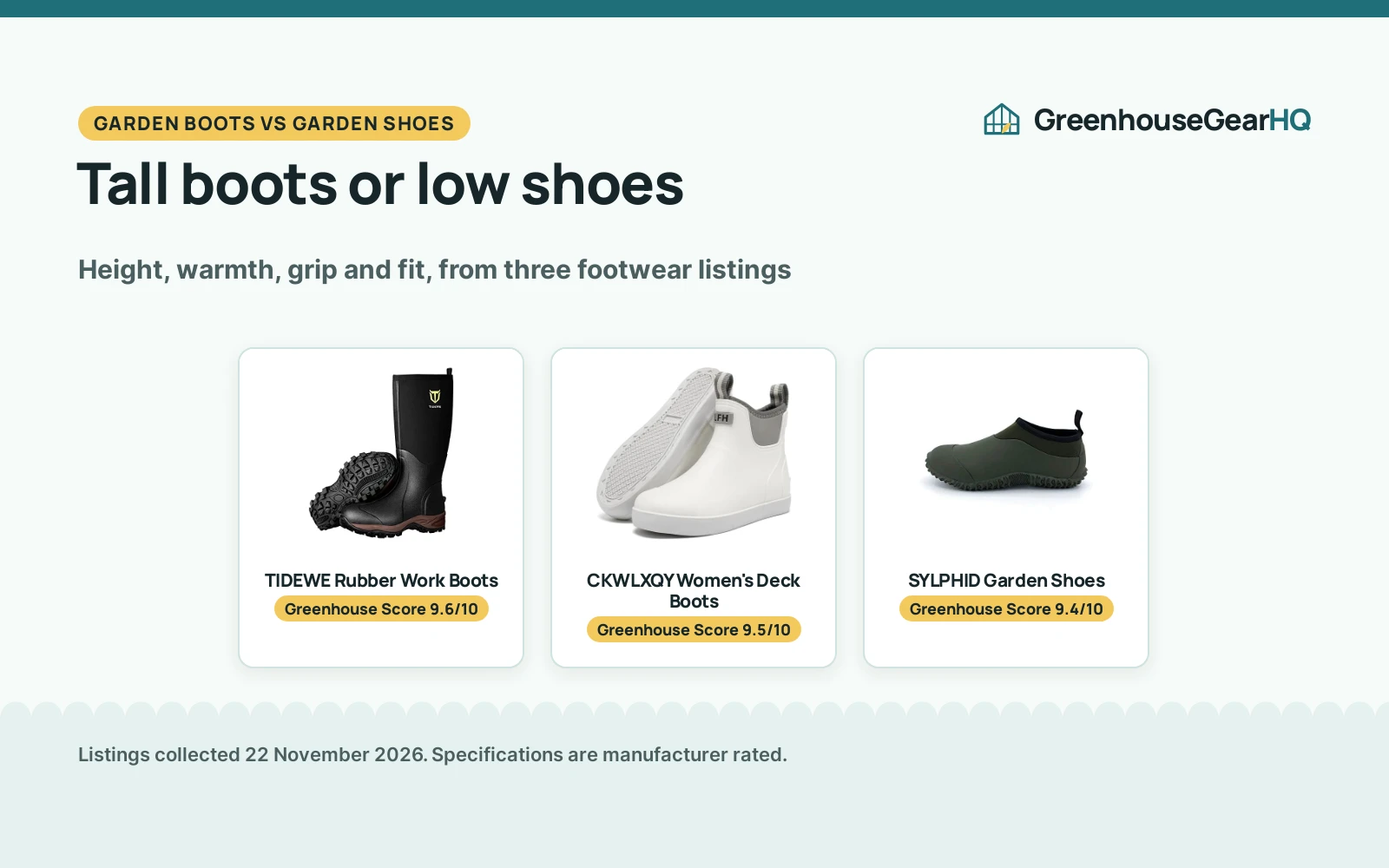
A wet spring morning leaves the greenhouse paths slick and the beds soft underfoot, and the footwear choice comes down to garden boots vs garden shoes. Boots cover more of the leg and keep mud off, while shoes stay light and slip off easily at the door. This guide compares the two on height, warmth, grip and fit.
GreenhouseGearHQ earns a commission when you buy through links on this page, at no extra cost to you. As an Amazon Associate I earn from qualifying purchases. Affiliate disclosure.
Quick verdict: choose garden boots for deep mud, standing water and cold mornings, where height and insulation matter. The TIDEWE example pairs 6mm neoprene with a comfort rating from -4°F to 50°F, and the CKWLXQY example is an ankle boot with a non-slip outsole. Choose garden shoes for quick trips and warm days, where a low shoe matters more than leg coverage. The SYLPHID example is a low waterproof neoprene shoe with a rubber sole.
Three examples
| # | Product | Greenhouse Score | Buy |
|---|---|---|---|
| 1 | TIDEWE Rubber Work Boots | 9.6/10 | Buy on Amazon |
| 2 | CKWLXQY Women's Deck Boots | 9.5/10 | Buy on Amazon |
| 3 | SYLPHID Garden Shoes | 9.4/10 | Buy on Amazon |
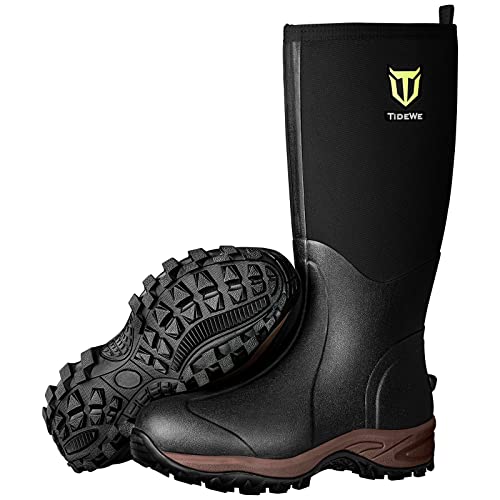
TIDEWE Rubber Work Boots
A rubber work boot with 6mm neoprene, insulation rated from -4°F to 50°F, a reinforced toe and a heel spur.
Pros
- 6mm neoprene with insulation rated from -4°F to 50°F
- 100% waterproof CR Flex-Foam that flexes with the foot
- Reinforced toe for extra protection
- Heel spur makes the boots easy to take off
Cons
- No warranty term is stated
- Comfort rated only to 50°F, so warm days sit outside its range
- No traction or slip-resistance detail is stated
- Size 11 is the size given in this listing

CKWLXQY Women's Deck Boots
A women's ankle-height deck boot with waterproof rubber, a non-slip outsole, pull tabs and a soft insole.
Pros
- Fully waterproof ankle boot for rain, mud and wet decks
- Non-slip outsole with a tread pattern
- Pull tabs and a flexible ankle opening
- Soft, supportive insole with a breathable inner design
Cons
- No warranty term is stated
- No temperature or insulation rating is stated
- Ankle height leaves the calf exposed in deep mud or standing water
- Size 8 is the size given in this listing

SYLPHID Garden Shoes
A low, waterproof neoprene garden shoe with a rubber sole and a lower profile for stability.
Pros
- 100% waterproof from top to bottom
- Low, lightweight shoe that slips off easily
- Neoprene rubber that will not crack when it stretches
- Rubber sole with a lower profile for stability
Cons
- No weight is stated
- No insulation or temperature rating is stated
- Low cut leaves the ankle exposed to mud and splashes
- Women 12 and Men 10.5 are the only sizes given in this listing
As an Amazon Associate I earn from qualifying purchases.
Other options worth a look
 Fubotao Women's Mid Calf Rain Boots Waterproof Fashion GardenCheck price on Amazon
 HISEA Women's Short Rain Boots Waterproof Ankle Chelsea BootsCheck price on Amazon
 Asgard Women's Mid Calf Rain Boots Short Rubber BootsCheck price on Amazon
 Asgard Women's Mid Calf Rain Boots Waterproof Garden Slip onCheck price on Amazon
 Women's Rain BootsCheck price on Amazon
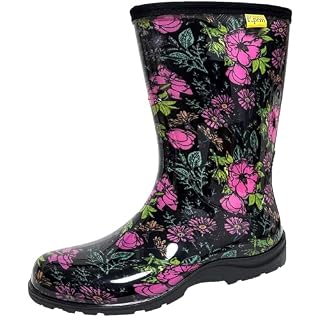 Kprm Women's Rain Boots Waterproof Mid Calf Rubber GardenCheck price on Amazon
Garden boots vs garden shoes: side by side
| Footwear | Greenhouse Score | Style | Material | Comfort range | Weight | Amazon |
|---|---|---|---|---|---|---|
| TIDEWE Rubber Work Boots | 9.6/10 | Tall rain boot | 6mm neoprene, CR Flex-Foam | -4°F to 50°F | 0.9 pounds | View on Amazon |
| CKWLXQY Women’s Deck Boots | 9.5/10 | Ankle deck boot | Rubber | Not stated | 1.84 pounds | |
| SYLPHID Garden Shoes | 9.4/10 | Low garden shoe | Neoprene rubber | Not stated | Not stated | View on Amazon |
Size and build specs are the manufacturer’s ratings as published on each listing, gathered 22 November 2026.
Height and coverage
Height is the first real divide. The TIDEWE example is a rubber work boot built on 6mm neoprene, with a reinforced toe and a heel spur for taking it off. The CKWLXQY example is an ankle-height deck boot with a flexible ankle opening and reinforced pull tabs. The SYLPHID example is lower still, a garden shoe with a lower profile that the maker describes as easy to slip off. Boots shield more of the leg from mud, and shoes trade that coverage for a lower cut.
Warmth and weather
Only one listing states a temperature range. The TIDEWE example lists a comfort rating from -4°F to 50°F, with heat-retaining insulation that the maker says returns up to 90% of body warmth, and 100% waterproof CR Flex-Foam that flexes with the foot. Warm days sit outside the 50°F top of its range. The other two listings state waterproofing but no temperature figure: the CKWLXQY example is fully waterproof with a breathable inner design, and the SYLPHID example is 100% waterproof top to bottom in neoprene rubber. Neither states an insulation figure, so warmth cannot be compared across all three.
Grip and stability
The CKWLXQY example lists a non-slip outsole with a tread pattern, described as giving traction on wet and slippery surfaces. The SYLPHID example lists a rubber sole with a lower profile that the maker links to stability on uneven terrain. The TIDEWE example states no traction or tread detail, so its grip cannot be scored against the other two.
Fit and getting them on and off
Fit is a stated concern in every listing. The TIDEWE example warns buyers to mind the size chart before buying, and lists size 11 in this listing. The CKWLXQY example lists size 8, with a flexible ankle opening and pull tabs for quick on and off. The SYLPHID example lists Women size 12 and Men size 10.5, and says to select by foot length.
Which should you choose?
Choose garden boots if the work means deep mud, standing water or cold mornings, and leg coverage matters more than a fast change at the door. Compare more tall options in the best garden boots roundup.
Choose garden shoes if the work is a quick trip to the beds, light weeding or a warm day, and a low shoe that slips off at the door suits the routine. Clogs sit between the two sides, and the garden clogs vs garden boots comparison covers them.
In the Greenhouse
- Check the TIDEWE size chart before ordering, since the maker warns buyers to mind it and this listing gives size 11.
- Keep the TIDEWE boots for cold mornings, since the maker rates them from -4°F to 50°F.
Scoring notes
| Product | Greenhouse Score | Perf. /35 | Build /25 | Value /25 | Safety /10 | Warranty /5 |
|---|---|---|---|---|---|---|
| TIDEWE Rubber Work Boots | 9.6 | 29 | 21 | 21 | 5 | 0 |
| CKWLXQY Women’s Deck Boots | 9.5 | 28 | 20 | 20 | 5 | 0 |
| SYLPHID Garden Shoes | 9.4 | 27 | 19 | 20 | 3 | 0 |
Greenhouse Scores use 9.2 as the lowest value and 9.8 as the highest, with weighted points placed between them in proportion. More points always earns more score.
The Greenhouse Score weighs performance, build, value, safety and warranty, as explained on the How we pick page. For footwear, safety reflects a stated reinforced toe, a slip-resistant outsole or a stability detail. The TIDEWE earns safety points for its reinforced toe, the CKWLXQY for its non-slip outsole, and the SYLPHID for its low, stable rubber sole. No listing states a warranty term, so no product earns warranty points. The SYLPHID example states no weight, so it cannot be compared with the TIDEWE at 0.9 pounds or the CKWLXQY at 1.84 pounds.
FAQ for growers
Are garden boots or garden shoes better for muddy beds?
Boots cover more of the leg: the TIDEWE example is a rubber work boot built on 6mm neoprene and the CKWLXQY example is ankle-height, so boots suit deep mud and standing water.
Can garden shoes handle wet mornings?
Yes, if the shoe is waterproof. The SYLPHID example is 100% waterproof top to bottom, with a rubber sole and a lower profile for stability on uneven terrain.
Do garden boots keep feet warm in cold weather?
The TIDEWE example is the only listing here with a stated temperature range, a comfort rating from -4°F to 50°F with heat-retaining insulation.
Which sizes are listed?
The TIDEWE example lists size 11, the CKWLXQY example lists size 8, and the SYLPHID example lists Women size 12 and Men size 10.5, with a note to select by foot length.
Keep reading
See every gardening footwear and apparel guide and all garden tools guides.
More picks: garden boots, garden clogs, garden tools and cleaning garden tools.