On this page
Top picks at a glance
As an Amazon Associate I earn from qualifying purchases.
- 1
 Abbott Collection 27-Carolyn Bell Shaped Glass Cloche9.6/10View on Amazon
- 2
 Garutom 10x33 Foot 1.1 oz Floating Row Cover Frost Cloth9.7/10View on Amazon
- 3
 Garden Cold Frame Greenhouse ClocheView on Amazon
- 4
 HTG Supply Garden Cloche Plant Protector BellView on Amazon
- 5
 Garden Cloche Plant Protector BellView on Amazon
- 6
 Garden Raised Bed and Cold Frame Greenhouse ClocheView on Amazon
- 7
 12Pcs garden cloche for plantsView on Amazon
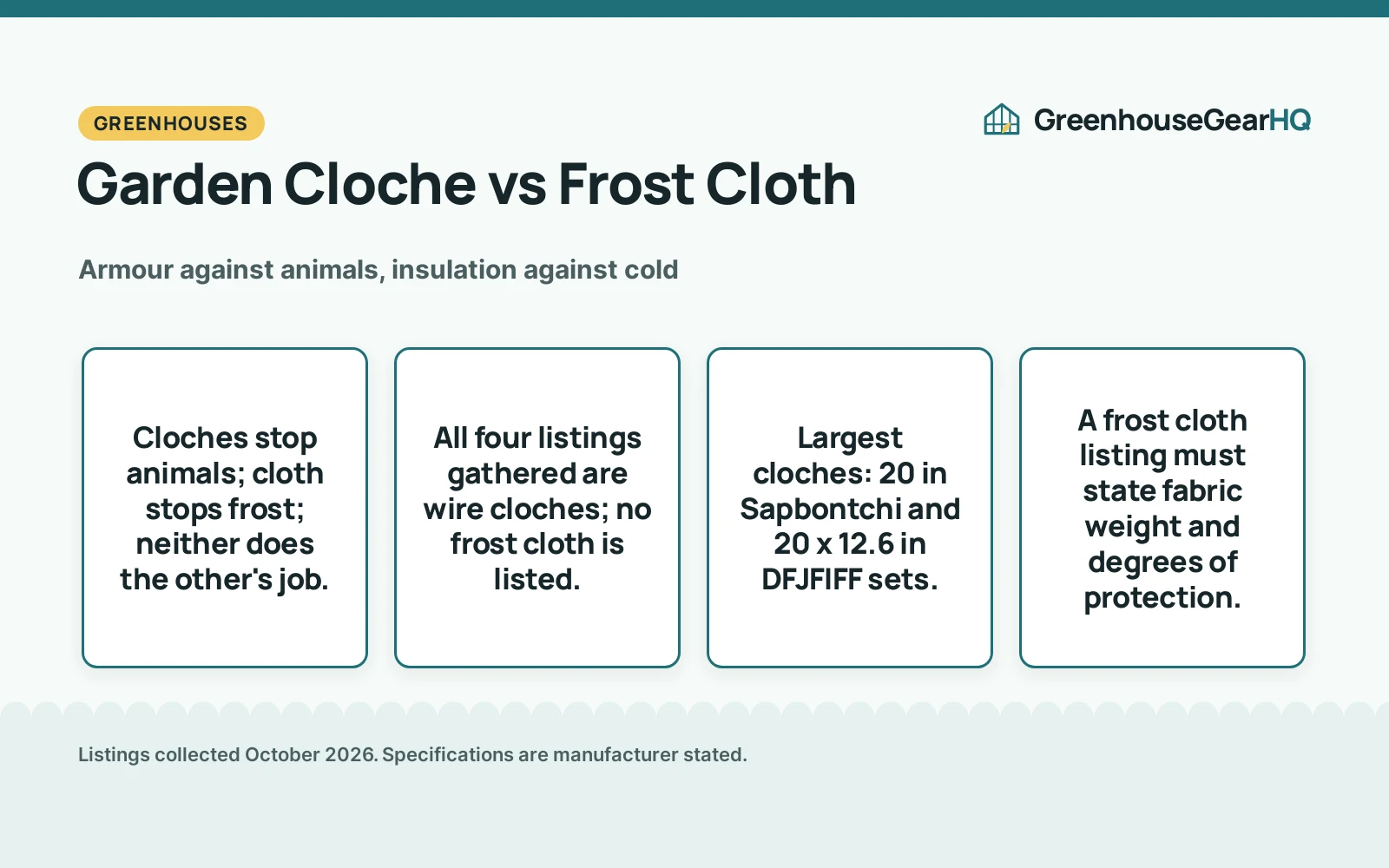
Garden cloche vs frost cloth is a choice between two different emergencies, and the first thing a buyer should know about this comparison is that only one side of it is on the shelf. A cloche is a rigid cage over a single plant, armour against teeth and beaks. A frost cloth is a soft fabric over a whole bed, insulation against cold air. Every listing gathered for this guide is a chicken wire cloche; not one is a frost cloth, a fleece or a fabric row cover. So the guide does two honest things: it compares the four cloches in prose, on size and design, and it states what a frost cloth listing must tell you, so the fabric side of the decision can be judged the day one is offered.
Other options worth a look
 Garden Cold Frame Greenhouse ClocheCheck price on Amazon
 HTG Supply Garden Cloche Plant Protector BellCheck price on Amazon
 Garden Cloche Plant Protector BellCheck price on Amazon
 Garden Raised Bed and Cold Frame Greenhouse ClocheCheck price on Amazon
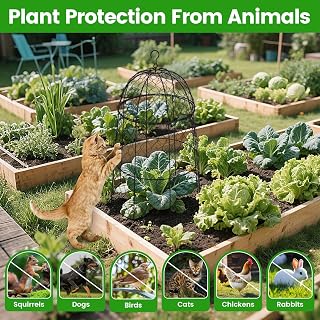 12Pcs garden cloche for plantsCheck price on Amazon
GreenhouseGearHQ earns a commission when you buy through links on this page, at no extra cost to you. As an Amazon Associate I earn from qualifying purchases. Affiliate disclosure.
The short answer: garden cloche vs frost cloth
Choose the cloche when the threat has legs: rabbits, squirrels, chickens, deer at the fence line, cats in the pots. Choose frost cloth when the threat is the weather itself, a clear cold night that will blacken basil and split lettuce hearts by morning. The protections do not overlap: wire stops no frost worth the name, since cold air moves through mesh freely, and fabric stops no rabbit, since teeth go through cloth in a night. Serious beds run both in sequence, cloth over the row in the cold weeks, cloches over the young plants when the cloth comes off and the animals return.
The cloches, compared
| Cloche | Size | Count | Design note |
|---|---|---|---|
| Sapbontchi Extra Large | 20 in H x 12 in D | Set of 6 | 24 anchors; spec table says set of 10, the title says 6 |
| DFJFIFF Large | 20 x 12.6 in | 10 pack | Split design, anti-rust coated metal |
| EXJEXJ with Cover | 11.8 x 12.6 in | 5 pack | Removable metal top cover, stakes and ties |
| Doksving Seedling | 6.8 x 7.4 in | 20 pack | PVC coated wire, 60 fixing pins, labels |
Size sorts the four first. Two are genuinely large: the Sapbontchi at 20 inches high by 12 across, a set of 6 with 24 anchors, and the DFJFIFF at 20 by 12.6 inches in a 10 pack whose split design opens for tending and whose anti-rust coated wire is the heaviest build here, at 14.47 pounds the pack. Either roofs a young shrub, a pepper plant or a ripening squash with room to spare. The EXJEXJ set, 5 cages at 11.8 by 12.6 inches, adds the cleverest detail, a removable metal top cover that closes the roof against birds dropping in from above and lifts off as the plant grows through. The Doksving 20 pack is a different tool at 6.8 by 7.4 inches: seedling guards, PVC coated, with 60 fixing pins and plant labels in the box, armour for the first fortnight of a plant’s life rather than its season.
On stated figures the DFJFIFF is the season-long choice, count, coating and size together; the Sapbontchi matches its height at a lower count and carries a listing contradiction worth knowing, a specification field reading set of 10 against a title and description of 6. The EXJEXJ is the bird-heavy garden’s pick, and the Doksving owns the seedling stage outright. All four are chicken wire in metal with coatings, all pass air and sunlight freely as their listings say, and none claims any frost protection, which is exactly the point of the next section.
What a frost cloth listing needs to state
Since no fabric cover is listed here, judge any frost cloth you meet elsewhere by the figures its listing must publish. It should state a fabric weight, since grams per square metre is what insulation is; a temperature protection claim in degrees, the honest ones modest; its dimensions and whether it is sold as cut sheets or a roll; whether it passes water and light, so it can stay on through a cold week rather than a single night; and its fixing method, hoops, pins or weights, since a cloth lying on leaves in a frost can damage what it touches. A listing silent on weight and degrees is selling a sheet, not a rating. The wider season extension shelf is in the cold frames guides, where the rigid middle ground between cage and cloth lives.
How each earns its place on a bed
Work the calendar and the two tools stop competing. Early spring: frost cloth earns the bed, tented over hoops at night, off or vented by day, while seedlings harden under it. Late spring: the cloth retires and the cloches arrive, seedling guards first, then the large cages as transplants go out and every rabbit in the parish learns the address. Summer: cloches alone, over the crops animals queue for, strawberries colouring, melons swelling, young shrubs behind the deer line. Autumn: the cloth returns for the last cold nights while the cages guard the brassicas into winter. A gardener who owns both spends less on either, since each is spared the work it does badly.
In the Greenhouse
Under glass the same division holds in miniature. Cloches guard the bench against the greenhouse cat and the mouse that winters inside, and their wire is no use at all on the January night the heater fails, when a fabric layer over the bench is the difference between a collection and a compost heap. Keep a folded cloth on the potting shelf for that night, labelled and dry, and let the cages do the daily work they were built for.
FAQ for growers
Does a garden cloche protect against frost?
No. The four cloches here are chicken wire, and their listings promise animal protection, not insulation; cold air passes through mesh freely. Frost is the frost cloth’s job.
Why is there no frost cloth in the comparison?
Because none was listed. Every product gathered is a wire cloche, so the guide compares those honestly and states what a frost cloth listing must publish instead of inventing one.
Which cloche suits seedlings?
The Doksving 20 pack, at 6.8 by 7.4 inches with fixing pins and labels included. The larger cages suit established plants and shrubs.
Can I use both on the same bed?
Yes, in sequence: cloth over the bed in the cold weeks, cloches over individual plants once the cloth comes off and animal pressure returns. Many beds run both across one season.
Keep reading
See every greenhouse guide.
More from the greenhouse: browse cold frames.