On this page
Top picks at a glance
As an Amazon Associate I earn from qualifying purchases.
- 1
 GOLOPET Seedling Heat Mat with Thermostat Pack of 29.6/10View on Amazon
- 2
 Enhon Chicken Coop Heater9.7/10View on Amazon
- 3
 Digital Heat Mat Thermostat Controller for Seed GerminationView on Amazon
- 4
 VIVOSUN Digital Heat Mat Thermostat ControllerView on Amazon
- 5
 Hydrofarm MTMDU Seedling Heat MatView on Amazon
- 6
 2 Pack Seedling Heat Mat for Seed Starting Plants GerminationView on Amazon
- 7
 iPower Seedling Heat Mat for Plants with Dual DigitalView on Amazon
- 8
 Seedling Heat Mat 11 in x 22 inView on Amazon
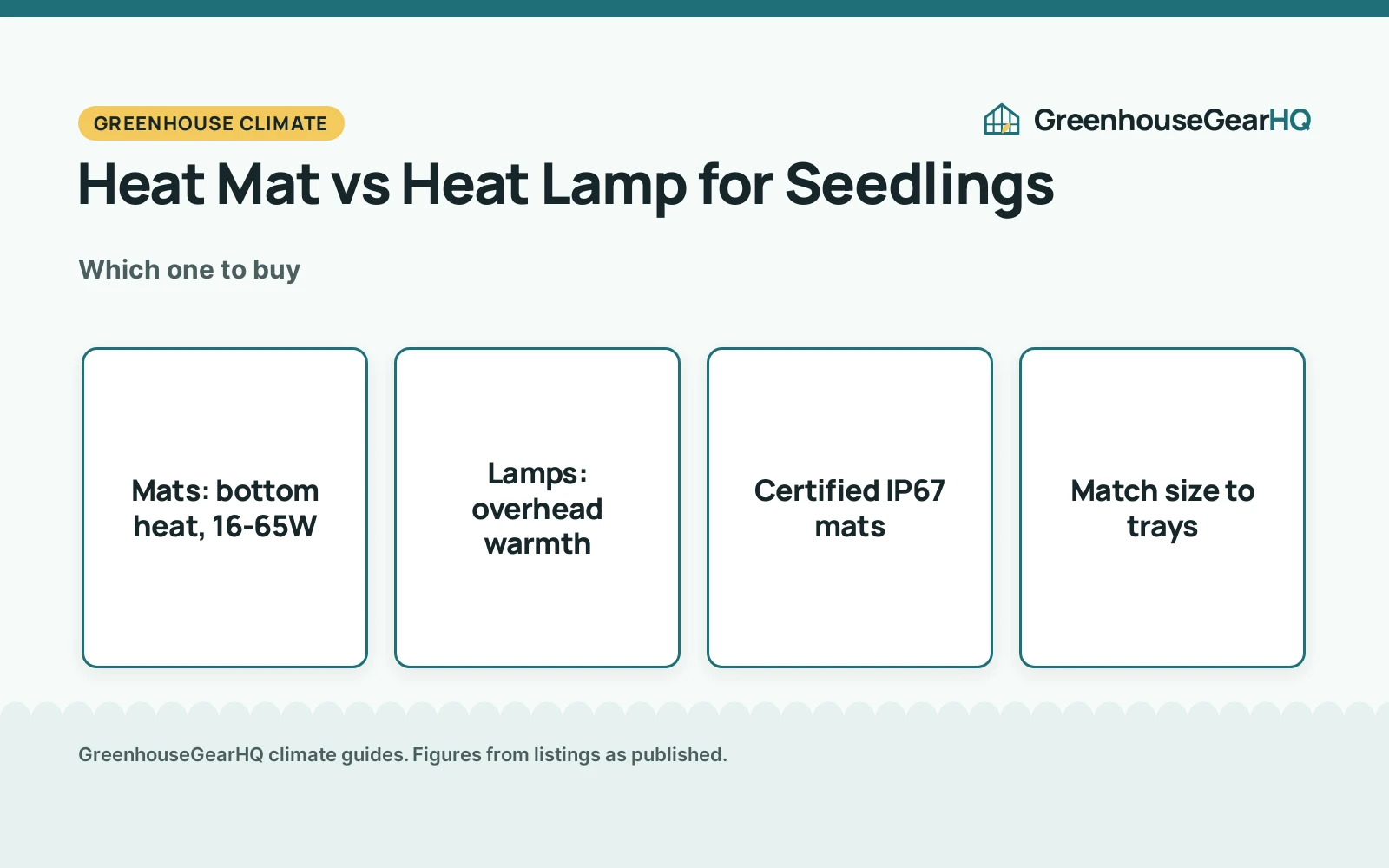
This heat mat vs heat lamp for seedlings guide answers the question directly: a heat mat is the safer and simpler choice for starting seedlings, because it warms the root zone from below. A heat lamp can add overhead warmth, but it dries the soil surface and is harder to control. For most seed starting, choose a heat mat and use a lamp or grow light only for light after sprouting.
Other options worth a look
 Digital Heat Mat Thermostat Controller for Seed GerminationCheck price on Amazon
 VIVOSUN Digital Heat Mat Thermostat ControllerCheck price on Amazon
 Hydrofarm MTMDU Seedling Heat MatCheck price on Amazon
 2 Pack Seedling Heat Mat for Seed Starting Plants GerminationCheck price on Amazon
 iPower Seedling Heat Mat for Plants with Dual DigitalCheck price on Amazon
 Seedling Heat Mat 11 in x 22 inCheck price on Amazon
GreenhouseGearHQ earns a commission when you buy through links on this page, at no extra cost to you. As an Amazon Associate I earn from qualifying purchases. Affiliate disclosure.
heat mat vs heat lamp for seedlings: how they differ
Where the heat goes
A heat mat delivers bottom heat to the root zone. The AC Infinity SUNCORE A1 example measures 3 by 20 inches, lists a heating range of 80 to 87 degrees Fahrenheit and states it warms up to 20 degrees Fahrenheit above ambient temperature. The Luxbird 4-pack example measures 10 by 20.75 inches, uses 20 watts and states it maintains a 68 to 86 degree Fahrenheit range. A heat lamp delivers overhead warmth from above, which warms the air and the soil surface but can dry the top of the soil faster than bottom heat can compensate.
Temperature control
Heat mats offer precise control. The AC Infinity SUNCORE H3 example is 10 by 20.75 inches with a digital heat controller that displays real-time mat temperature. The AC Infinity SUNCORE A3X2 example is a two-pack of 10 by 20.75 inch mats with an adjustable dial for heat output. The REPTI MATE example is 8 by 12 inches with a built-in digital thermostat holding 32 to 122 degrees Fahrenheit. A heat lamp offers no such thermostat; its output changes with distance, so you adjust height instead of a dial.
Power and efficiency
Heat mats draw little power. The Luxbird example states 20 watts per mat with a 5.9-foot cord, and the REPTI MATE example states 16 watts. The SUNCORE A1 example lists 65 watts in its spec table. A heat lamp draws far more power per unit of area warmed, and much of it goes into the air above the trays rather than the soil. For running costs, the heat mat wins on stated figures.
Safety
Heat mats are built for soil contact. The AC Infinity listings state UL and MET certification with IP-67 rated quad-layer PVC, and the Luxbird example states UL and MET certification with an IP67 waterproof surface. The SUNCORE H3 listing states the controller carries no risk of scorching. A heat lamp hangs above the trays, so there is a burn risk to leaves and a fire risk if it falls or sits too close to flammable material. Never leave a heat lamp unattended over seedlings.
Light vs heat
Seedlings need light after sprouting, and that is where a lamp belongs. The Homiton 4-pack example includes 8 LED grow lights per tray with 5 adjustable brightness settings and 4 timing settings for different lighting durations, plus a 10 by 20.75 inch heat mat. The kit heats the soil with the mat and lights the seedlings with the LEDs. That is the pattern to copy: mat for heat, lamp or LEDs for light.
Coverage and sizing
Heat mats come in sizes that match trays. The Luxbird example is 10 by 20.75 inches, fitting standard 1020 trays. The AC Infinity SUNCORE H5 example is 20 by 20.75 inches and the H7 example is 48 by 20.75 inches. A heat lamp covers a cone of area that is hard to match to a tray grid, so rows at the edges get less warmth. For uniform germination, sized mats beat a single overhead source.
Who should pick which
Pick a heat mat if
Pick a heat mat for starting seeds indoors or in a greenhouse: it warms the root zone, uses 16 to 65 watts per the listed examples, and comes with dial or digital control. The Homiton example states its mat provides 90 to 100 degrees Fahrenheit for speeding germination. For germination gear, see our seedling heat mats guides.
Pick a heat lamp if
Pick a heat lamp only when you need overhead warmth in a cold space and cannot heat from below, such as a large unheated bench. Use it as a supplement, not the main heat source, and pair it with a heat mat for the root zone. Keep it high, watch for drying and never leave it unattended.
Before you buy
- Match mat size to your trays: 10 by 20.75 inches fits standard 1020 trays.
- Pick a mat with a thermostat or digital controller for precision.
- Use a lamp for light after sprouting, not as the main heat source.
- Check the listed temperature range against your seeds.
FAQ for growers
Can I use both a heat mat and a heat lamp?
Yes: the mat warms the root zone and the lamp provides overhead light and warmth, but the mat is the safer main heat source.
What temperature range do the listed mats state?
The Luxbird example states 68 to 86 degrees Fahrenheit, the SUNCORE A1 states 80 to 87 degrees Fahrenheit, and the Homiton example states 90 to 100 degrees Fahrenheit.
Do heat mats use much power?
No. Listed examples state 16 to 65 watts per mat.
Are the listed mats certified?
The AC Infinity and Luxbird listings state UL and MET certification with IP67 rated surfaces.
Keep reading
See every seedling heat mat guide and all greenhouse climate guides.