On this page
Top picks at a glance
As an Amazon Associate I earn from qualifying purchases.
- 1
 KING BIRD 15x6.6x6.6FT Walk-In Tunnel Hoop House with9.8/10View on Amazon
- 2
 EAGLE PEAK 8x8 Pop Up Greenhouse9.8/10View on Amazon
- 3
 EAGLE PEAK 8x6 Easy Setup Pop Up Greenhouse9.6/10View on Amazon
- 4
 Mini Greenhouse Tunnel Greenhouses for OutdoorsView on Amazon
- 5
 Grezone Walk-in Greenhouse Upgraded Green House with DualView on Amazon
- 6
 8X14FT Green House with ThermometersView on Amazon
- 7Grezone Walk-in Greenhouse Upgraded Green House with ZipperedView on Amazon
- 8
 Mini Greenhouse for IndoorView on Amazon
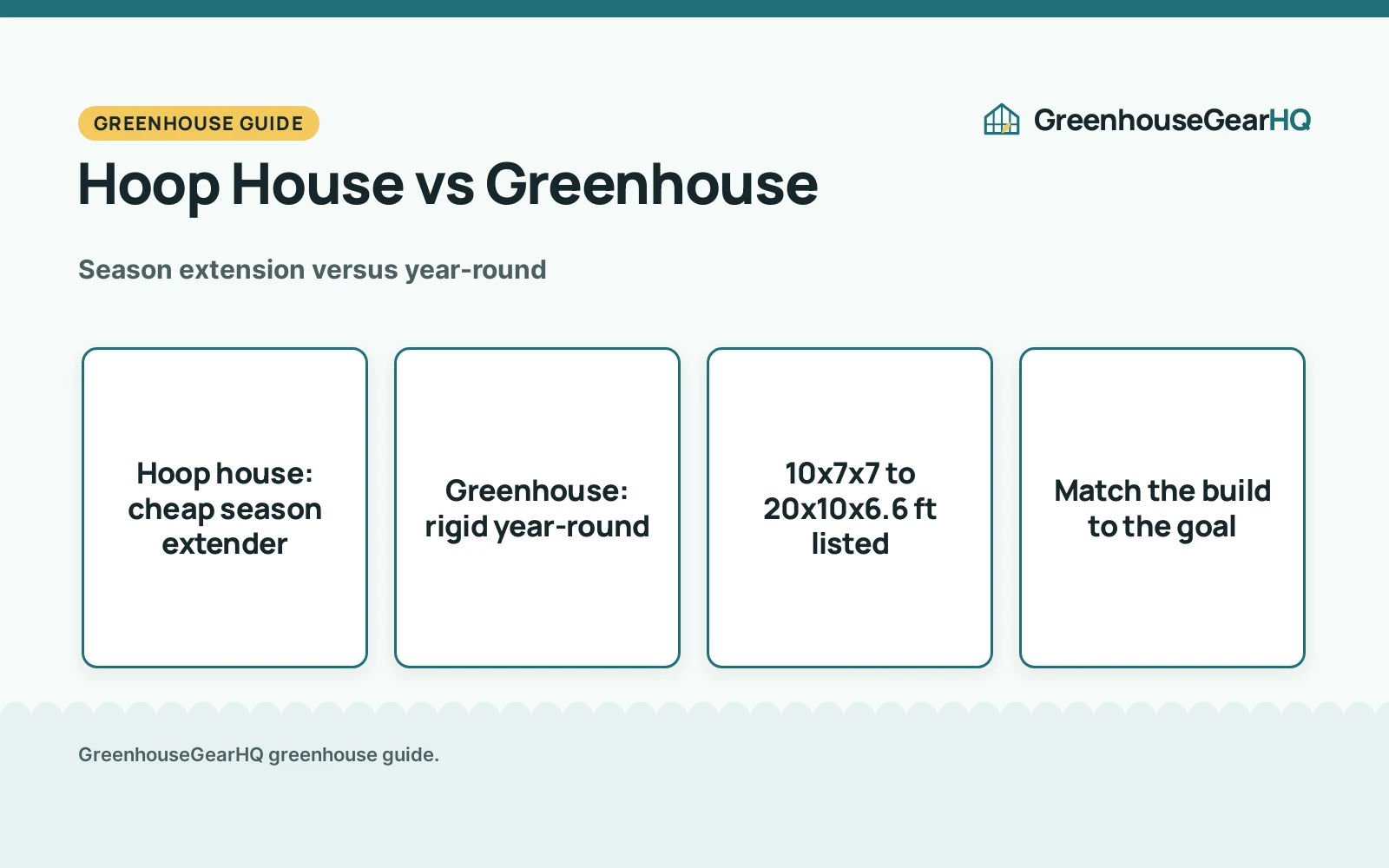
A hoop house is a simple curved frame covered in film, built for cheap season extension; a greenhouse is a rigid structure with glazing, built for year-round growing. Pick a hoop house to stretch the season for little money; pick a greenhouse to grow through winter and to last for years. This guide compares the two, with concrete figures from the listings.
Other options worth a look
 Mini Greenhouse Tunnel Greenhouses for OutdoorsCheck price on Amazon
 Grezone Walk-in Greenhouse Upgraded Green House with DualCheck price on Amazon
 8X14FT Green House with ThermometersCheck price on Amazon
- Grezone Walk-in Greenhouse Upgraded Green House with ZipperedCheck price on Amazon
 Mini Greenhouse for IndoorCheck price on Amazon
GreenhouseGearHQ earns a commission when you buy through links on this site, at no extra cost to you. As an Amazon Associate I earn from qualifying purchases. Affiliate disclosure.
Hoop house vs greenhouse: how they differ
The difference is the frame. A hoop house is bent hoops stuck in the ground or in a raised bed, covered with film: no foundation, no rigid walls, often no door. A greenhouse has a rigid frame, solid glazing, vents and doors. The listings here show both sides: hoop kits like the MAXPACE DIY 8-foot grow tunnel for raised beds, 2.8 feet wide and up, sold in 50-piece sets; 60-piece garden hoop sets for raised beds; 12 sets of 7-foot greenhouse row-cover hoops with 2.4-inch metal connect pipes and 3.4-inch clips; and rigid houses like the KING BIRD 20 by 10 by 6.6-foot premium house, the 15 by 7 by 7-foot and 10 by 7 by 7-foot models with 0.7mm galvanized steel, and the VEVOR 11.3 by 6.4 by 6.3-foot walk-in tunnel with a galvanized steel frame.
Hoop house: the cheap season extender
Hoop houses win on price and speed. A set of hoops and a roll of film turn a raised bed into a protected row in an afternoon: the listings show 8-foot hoops for wide beds, 7-foot row-cover sets with metal connectors, and hoops 17 inches long spanning 3.5 feet wide and 3.0 feet tall. They push spring earlier and fall later, shielding crops from frost and wind. The trade: film tears, hoops bend in snow, and there is no heat, no ventilation and no standing room. A hoop house is a tool for the bed, not a building.
Greenhouse: the rigid year-round house
Greenhouses win on durability and control. Rigid frames carry snow, vents and doors regulate heat, and glazing lasts years instead of seasons. The KING BIRD listings show the range: 10 by 7 by 7 feet for beginners, 15 by 7 by 7 feet for larger plots, and 20 by 10 by 6.6 feet for serious growers, with 0.7mm galvanized steel. The VEVOR 11.3 by 6.4 by 6.3-foot walk-in tunnel shows the middle ground: a tunnel shape with a galvanized steel frame. The trade: higher cost, a level site, assembly time and, for winter growing, a heat source.
Buying advice: match the build to the goal
Start from the goal. For protecting one raised bed through a cold snap, the 60-piece garden hoop sets and 7-foot row-cover kits are the right spend: 2.8 to 3.5 feet wide covers a standard bed, and the 2.4-inch connectors and 3.4-inch clips hold the film. For a first real greenhouse, the 10 by 7 by 7-foot KING BIRD is listed as ideal for beginners; the 15-foot model suits larger plots. For a permanent installation, the 20 by 10 by 6.6-foot house gives the most room, and a 20 by 10 by 7-foot replacement frame listing shows that covers wear out while frames get reused.
Check the frame spec. The KING BIRD listings state 0.7mm galvanized steel with supporting structure, versus 0.6mm on other models, which is the kind of concrete difference to compare. For hoops, flexibility is the point: they bend into the bed and come out in spring. Anchor any film-covered structure against wind; film is a sail.
Which should you choose?
Choose a hoop house when the goal is season extension on a budget: spring and fall protection for raised beds at the cost of a hoop kit and film. Choose a greenhouse when the goal is year-round growing or a permanent structure: rigid frames, vents and doors earn their price in control and durability. Many growers own both: hoops for the beds, a greenhouse for the tender crops.
FAQ for growers
Can a hoop house survive winter?
Film hoops handle frost and wind but bend under heavy snow; rigid greenhouses with 0.7mm steel frames handle it better.
What size hoop fits a raised bed?
The listings show hoops 2.8 to 3.5 feet wide and 3.0 feet tall, covering a standard bed.
Is a greenhouse worth the extra cost?
For year-round growing yes: vents, doors and rigid glazing give control a film hoop cannot.
Do greenhouse covers wear out?
Yes; a 20 by 10 by 7-foot replacement frame listing shows covers are replaced while frames are reused.
Keep reading
See every greenhouses guide and all greenhouse climate guides.
More picks: walk-in greenhouse, polycarbonate greenhouse.