On this page
Top picks at a glance
As an Amazon Associate I earn from qualifying purchases.
- 1
 ZYCZGXL Drip Irrigation Sprinkler Kit9.7/10View on Amazon
- 2
 YLYMNHCY Drip Irrigation System9.7/10View on Amazon
- 3
 Landtouch 120FT Drip Irrigation System9.7/10View on Amazon
On a hot afternoon, the far corners of a greenhouse dry out while the beds near the door stay damp, and that uneven wetting is why so many growers ask how many iridium sprinklers for greenhouse watering they need. The honest answer is that the count depends on the coverage each sprinkler states and the floor area that needs water, so there is no count that fits every greenhouse. This guide explains how to work out the count for a particular house, step by step, using the figures on the sprinkler listing and a tape measure on the floor.
GreenhouseGearHQ earns a commission when you buy through links on this page, at no extra cost to you. As an Amazon Associate I earn from qualifying purchases. Affiliate disclosure.
What decides the count: how many iridium sprinklers for greenhouse
The count comes down to the floor area that needs water, the coverage each sprinkler states, the water supply behind the line, and the way beds and paths are laid out. Floor area is the starting point, because a long narrow house needs a different layout from a square house, even when the floor space is similar. Coverage is the figure the sprinkler maker states on the listing, and it is the only coverage figure worth using. Water supply matters because a line can only feed the heads its flow allows, so a weak supply means fewer heads per line or a separate line. Beds and paths matter because water aimed at a path is water wasted, and beds tucked behind a potting bench can sit in a dry shadow.
- Floor area: the beds, the paths between them and any potting bench that blocks spray.
- Stated coverage: the area each sprinkler is listed to cover, read from the listing.
- Water supply: the flow the line can feed, checked against the listing.
- Layout: where beds sit, where paths run, and where spray would hit glass or a wall.
How to work out the count, step by step
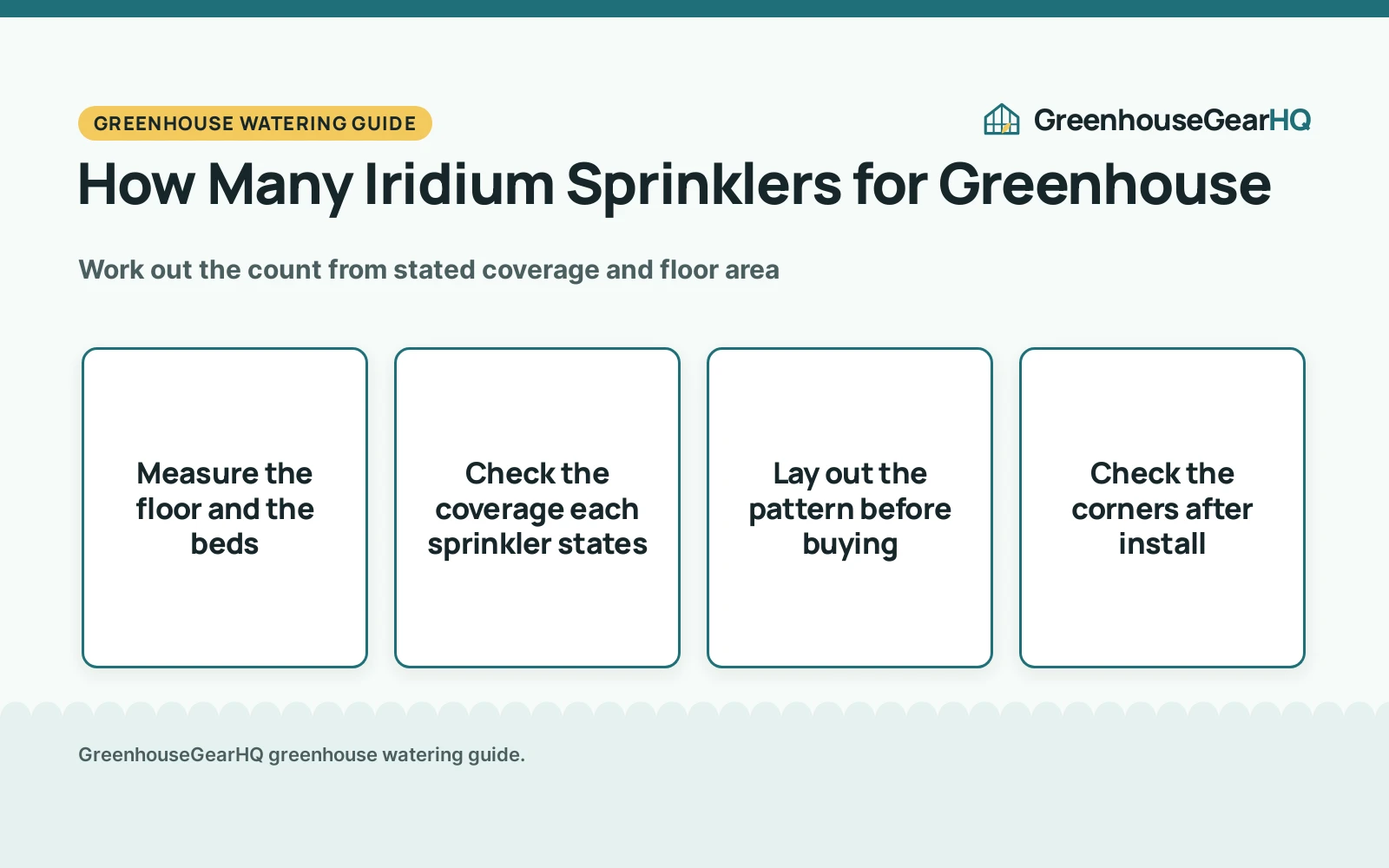
Measure the floor and the beds
Start with a tape measure and a sketch of the floor. Mark the beds, the paths, the door and the potting bench, and note which beds hold thirsty crops and which hold plants that prefer drier soil. The sketch is the map for the rest of the job, and it shows at a glance where spray can reach and where a bench or a tall crop blocks it. Measure the beds rather than the whole house, because paths need no water, and a count based on the whole floor would put heads where no plant grows.
Check the coverage each sprinkler states
Read the sprinkler listing for the coverage it states, and use that figure and no other. Listings state coverage as an area or as a spray distance, so read the listing carefully and keep its wording in mind when planning. Also read the listing for the flow it asks for, because a sprinkler that asks for more flow than the line gives will throw a short pattern and leave dry rings. When the listing states no coverage, treat the sprinkler as unproven for planning and look for a listing that states it.
Lay out the pattern before buying
Draw the sprinkler positions on the sketch, spacing them so the spray patterns overlap a little at the edges. Overlap matters because the edge of a spray pattern is always lighter than the middle, and a gap between patterns leaves a dry stripe down the bed. Aim the spray at the beds and away from the paths, the door and the glass, and keep heads clear of the potting bench and any tall crop that would block the spray. When the sketch shows a corner or a bed end with no coverage, move a head or add a head to the plan rather than hoping the gap closes on its own.
| Part of the plan | What to check | What it changes |
|---|---|---|
| Floor sketch | Beds, paths, door and bench marked | Where spray belongs and where it does not |
| Stated coverage | Coverage figure on the listing | How much ground each head can serve |
| Water supply | Flow the line can feed | How many heads run on a line |
| Overlap | Spray patterns meet at the edges | Dry stripes between heads |
Run the system and check the corners
After the heads are in place, run the system and walk the house while it waters. Look for dry corners, dry stripes and puddles, and feel the soil at the bed ends, where coverage is thinnest. When a corner stays dry, move a head, raise it, or add a head to the plan. When a path stays wet, aim the head away from it or swap the head for a pattern that suits a narrower bed. A short run after install saves a season of uneven watering, and the sketch from the planning stage makes the fix easy to find.
Sprinklers or drip lines
Sprinklers wet the leaves as well as the soil, which suits seed trays and leafy crops that like humidity, while drip lines wet the soil alone and keep leaves dry. In a greenhouse, wet leaves stay damp longer than they do outdoors, so crops that suffer in damp air often do better on drip lines. Drip kits also lose less water to paths and glass, and they run well on a modest supply. When the house holds a mix of crops, a common layout is sprinklers over the seedling benches and drip lines along the beds, with a water timer on each line so the zones can run on their own schedules. The drip irrigation kit for raised beds guide and the water timer picks cover the parts for that layout.
What this guide does not cover
This guide gives no fixed count, because the count comes from the coverage on the listing and the floor in front of the reader, and those differ from house to house. It gives no pressure or flow figures either, because those come from the water supply and the sprinkler manual. For figures that fit a particular house, check the sprinkler manual and the local extension office, which can advise on watering schedules for the area. This guide also does not cover fertilizer or pest products; follow the product label.
FAQ for growers
What shows that a greenhouse needs more sprinklers?
Watch the corners and the bed ends. When the soil there stays dry while the middle of the bed is damp, the pattern has a gap, and the fix is to move a head, raise it, or add a head to the plan.
Should sprinkler patterns overlap in a greenhouse?
Yes. The edge of a spray pattern is lighter than the middle, so patterns that meet at the edges water evenly, while patterns with a gap between them leave a dry stripe down the bed.
Do sprinklers or drip lines suit a greenhouse better?
It depends on the crop. Sprinklers suit seed trays and leafy crops that like humidity, while drip lines suit crops that prefer dry leaves and water at the roots. Many houses use sprinklers over the benches and drip lines along the beds.
Can sprinklers be added to a greenhouse later?
Yes. Plan the layout with spare capacity on the line, and leave room on the sketch for extra heads where the beds may grow. A head added later should match the pattern and flow of the heads already in place, so check the listing before buying.
Keep reading
See every greenhouse ventilation and watering guide and all drip irrigation kits guides.
More picks: browse automatic water timers, misting systems for greenhouses and water timers.