On this page
Top picks at a glance
As an Amazon Associate I earn from qualifying purchases.
- 1
 JESLED Waterproof T8 Grow Lights9.7/10View on Amazon
- 2
 APILAB Solar Shed Light with Pull String9.5/10View on Amazon
- 3
 FECiDA Flat Panel Grow Light for Large Indoor Plant Shelves9.5/10View on Amazon
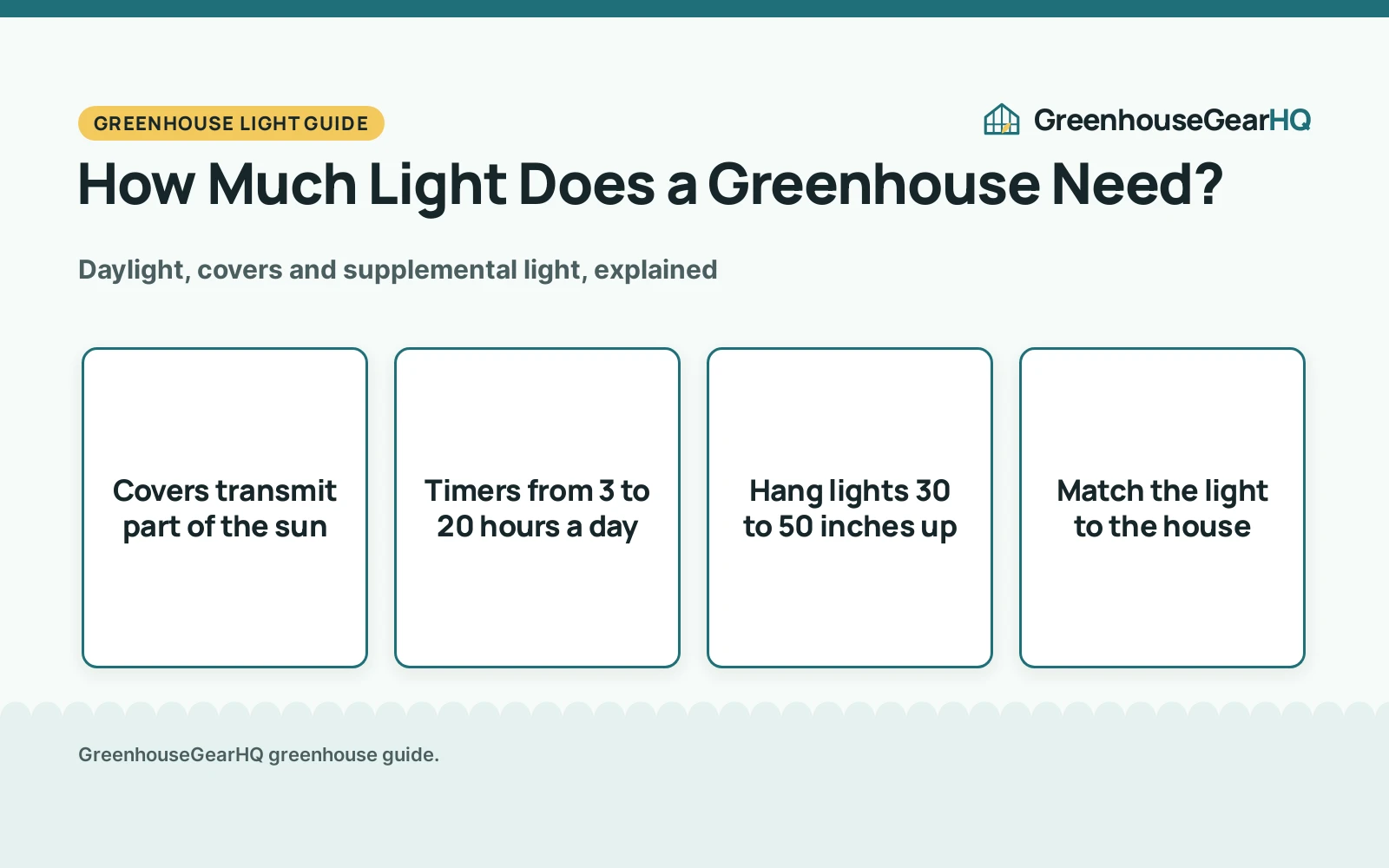
A greenhouse in late winter can look bright inside and still leave seedlings stretching toward the roof. How much light does a greenhouse need? Enough daylight that plants grow stocky instead of leggy, and where the cover or the season cuts that short, electric light on a timer to fill the gap. The listings we compared give concrete figures for the second part: timer settings from 3 to 20 hours a day, hanging heights of 30 to 50 inches, and a stated cover transmission of 85% for one PE mini greenhouse.
Other options worth a look
 Bstrip Indoor Greenhouse with Grow LightCheck price on Amazon
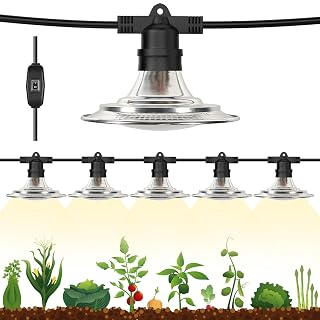 Outdoor LED Grow Lights for Greenhouse 6-Light WaterproofCheck price on Amazon
 Indoor Greenhouse with Grow LightCheck price on Amazon
 Bamworld 3-Tier Metal Mini Greenhouse with Grow Lights PlantCheck price on Amazon
 6 Pack Polycarbonate Greenhouse PanelsCheck price on Amazon
 14 Pack Polycarbonate Greenhouse PanelsCheck price on Amazon
GreenhouseGearHQ earns a commission when you buy through links on this page, at no extra cost to you. As an Amazon Associate I earn from qualifying purchases. Affiliate disclosure.
Where the daylight goes
Glass and plastic both take a cut of the sun before it reaches the bench. Bamworld lists 85% light transmission for the PE cover on its 2-tier mini greenhouse, so even a clear cover leaves some daylight outside the walls. Dirt, condensation and an aging cover take more, and the low winter sun shortens the day from the other end. When plants lean hard toward one side or stretch thin between leaves, the house is telling you the daylight is not enough.
Orientation and clutter matter as much as the cover. Keep the ridge clear of stored pots, wash the glazing when dust builds up, and remember that a shaded corner that suits ferns in July will starve tomatoes in February. This guide covers how much light the house needs, not which cover to buy; the cover guides in the related links below compare materials.
How much light does a greenhouse need when days are short
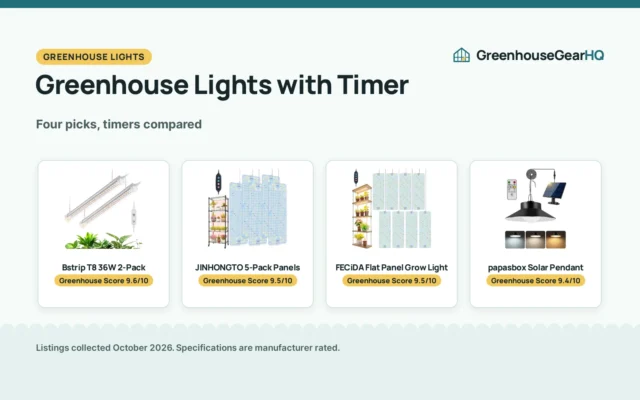
When the natural day runs short, growers add electric light on a timer so the plants get a steady schedule without anyone flipping a switch. The listings we compared agree on the tool but not the hours: RWNTAO lists 3, 9 and 12 hour settings with automatic on and off each day, Bstrip lists 3, 6 and 12 hours, Bamworld lists 3, 9 and 12 hours, Loscarol lists 3, 5 and 8 hours, and FECiDA lists 4, 8, 12, 16 and 20 hour modes. Pick the timer that fits the crop, not the longest setting on the dial.
Brightness control matters as much as the clock. RWNTAO lists 10 dimmable levels, Bstrip lists 7 levels from 15% to 100%, Bamworld lists 9 intensity levels, and Loscarol lists 30%, 60% and 100% brightness. Seedlings and cuttings want less light than fruiting plants, so a dimmable light you can turn down beats a bright one you have to raise out of reach.
Picking a supplemental light
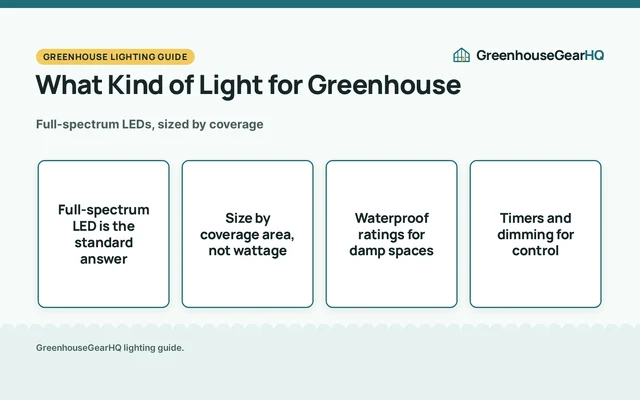
Match the light form to the house. String lights drape over benches: Espird lists a 6-light string at 150 watts that links end to end, and Danshinro lists a 21 FT string of six 25W bulbs at 1980 lumens. T8 strips suit long benches: JESLED lists two 4FT strips at 96W total and 9600 lumens with a 5000K daylight color, linkable end to end. Shelf growers use panels and bars: FECiDA lists a 6-pack of flat panels at 12W each with daisy-chain wiring, and RWNTAO lists 13 inch 4-head strips at 10 watts and 3500K.
Spectrum figures come straight from the listings. Bstrip lists 400 to 780nm, Espird lists 380 to 780nm with 460nm blue and 660nm red called out, Loscarol lists 390 to 780nm, and FECiDA lists 3000K, 5000K and 660nm. Color temperatures run from 3500K on the RWNTAO strips (on Amazon) to 5000K on the Espird and JESLED lights (on Amazon) and 6500K on the APILAB solar light (on Amazon). None of this tells you which spectrum grows the best tomato; it tells you the makers all aim at the same daylight band, so buy for form, timer and brightness instead of chasing nanometers.
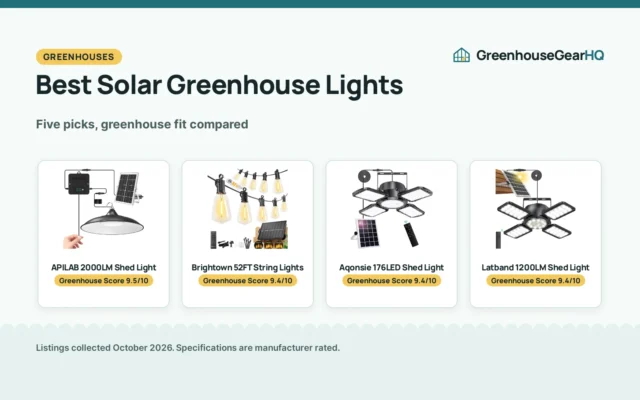
Solar lights have their place and their limit. APILAB lists a 2000 lumen 6500K solar pendant that charges in 6 to 8 hours of direct sun with a 6000mAh battery, and Loscarol lists a solar grow light with 50 LEDs at 1000 lumens, also USB-C rechargeable for cloudy stretches. Both suit a small corner or a shed, not a whole production house. For a full bench of plants, see our best grow lights for a greenhouse roundup.
Where to hang it
Height decides how much bench one light covers. Espird recommends 30 to 50 inches above the plants for its string lights, which is the only stated hanging figure in the listings we compared. Hang lower for intensity on a small area, higher for even coverage across a wide bench, and adjust as the plants grow.
Link lights instead of adding outlets. JESLED strips link end to end, FECiDA panels (on Amazon) daisy-chain in series or parallel, and Espird says one switch can run up to 120 lights at once. One timer and one switch for the whole bench beats a row of individual plugs, and it keeps the cord count down where water drips.
What this guide does not cover
We do not give light hours for specific crops, because they depend on the plant, the light and the room. The timer ranges above show what the listings offer; your seed packet and the light manual give the figures for your crop, and your local extension office can advise on timing for your area. We also do not rate individual lights here; the roundups linked below compare them head to head.
FAQ for growers
Do I need grow lights if my greenhouse gets full sun?
Not always. Watch the plants: stocky growth means the daylight is enough, while stretching and leaning mean it is not. When the days shorten, the listings we compared offer timer settings from 3 to 20 hours a day to fill the gap.
How long should supplemental lights run each day?
The listings offer 3 to 20 hours depending on the model: RWNTAO and Bamworld list up to 12 hours, FECiDA lists up to 20 hours. Set the timer to the crop’s needs and let the automatic on and off keep the schedule steady.
How high should I hang a grow light?
Espird recommends 30 to 50 inches above the plants for its string lights, the only stated hanging height in the listings we compared. Raise the light for wider coverage, lower it for more intensity on a small area.
Can a solar light run a greenhouse?
For a small space, yes. APILAB lists a 2000 lumen 6500K solar pendant that charges in 6 to 8 hours of direct sun, and Loscarol lists a solar light with 50 LEDs at 1000 lumens. Neither replaces wired lights across a whole house.
What light spectrum do plants use?
The listings state full-spectrum ranges of 380 to 780nm from Espird, 400 to 780nm from Bstrip and 390 to 780nm from Loscarol, with color temperatures of 3500K, 5000K and 6500K across the models. All of them aim at the daylight band, so choose by form, timer and brightness.
Keep reading
See every walk-in greenhouse guide and all greenhouses guides. Also see our best grow lights for a greenhouse. Also see our best grow light for a 2×2 tent. Also see our 600W vs 1000W grow light.
More picks: full spectrum LED grow lights and grow lights for a plant shelf.