On this page
Top picks at a glance
As an Amazon Associate I earn from qualifying purchases.
- 1
 AC Infinity Humidity Dome 6x12 Propagation Kit9.7/10View on Amazon
- 2
 10 EachView on Amazon
- 3
 MIXC Nursery Pots with Humidity DomeView on Amazon
- 4
 7 Inch Clone DomeView on Amazon
- 5
 Propagator Tray with Vented DomeView on Amazon
- 6
 winemana 36 Set Nursery Pots with Humidity DomeView on Amazon
- 7
 AC Infinity Heavy-Duty Humidity Dome with Full Spectrum LEDView on Amazon
The first seed trays of the season sit on the windowsill, and the room is cool. Humidity dome vs heated propagator is the question every seed starter asks: one traps moisture, the other adds warmth. Both help seeds, but they do different jobs, and the four products in this guide show the difference.
Other options worth a look
 10 EachCheck price on Amazon
 MIXC Nursery Pots with Humidity DomeCheck price on Amazon
 7 Inch Clone DomeCheck price on Amazon
 Propagator Tray with Vented DomeCheck price on Amazon
 winemana 36 Set Nursery Pots with Humidity DomeCheck price on Amazon
 AC Infinity Heavy-Duty Humidity Dome with Full Spectrum LEDCheck price on Amazon
GreenhouseGearHQ earns a commission when you buy through links on this page, at no extra cost to you. As an Amazon Associate I earn from qualifying purchases. Affiliate disclosure.
Humidity dome vs heated propagator: the honest answer
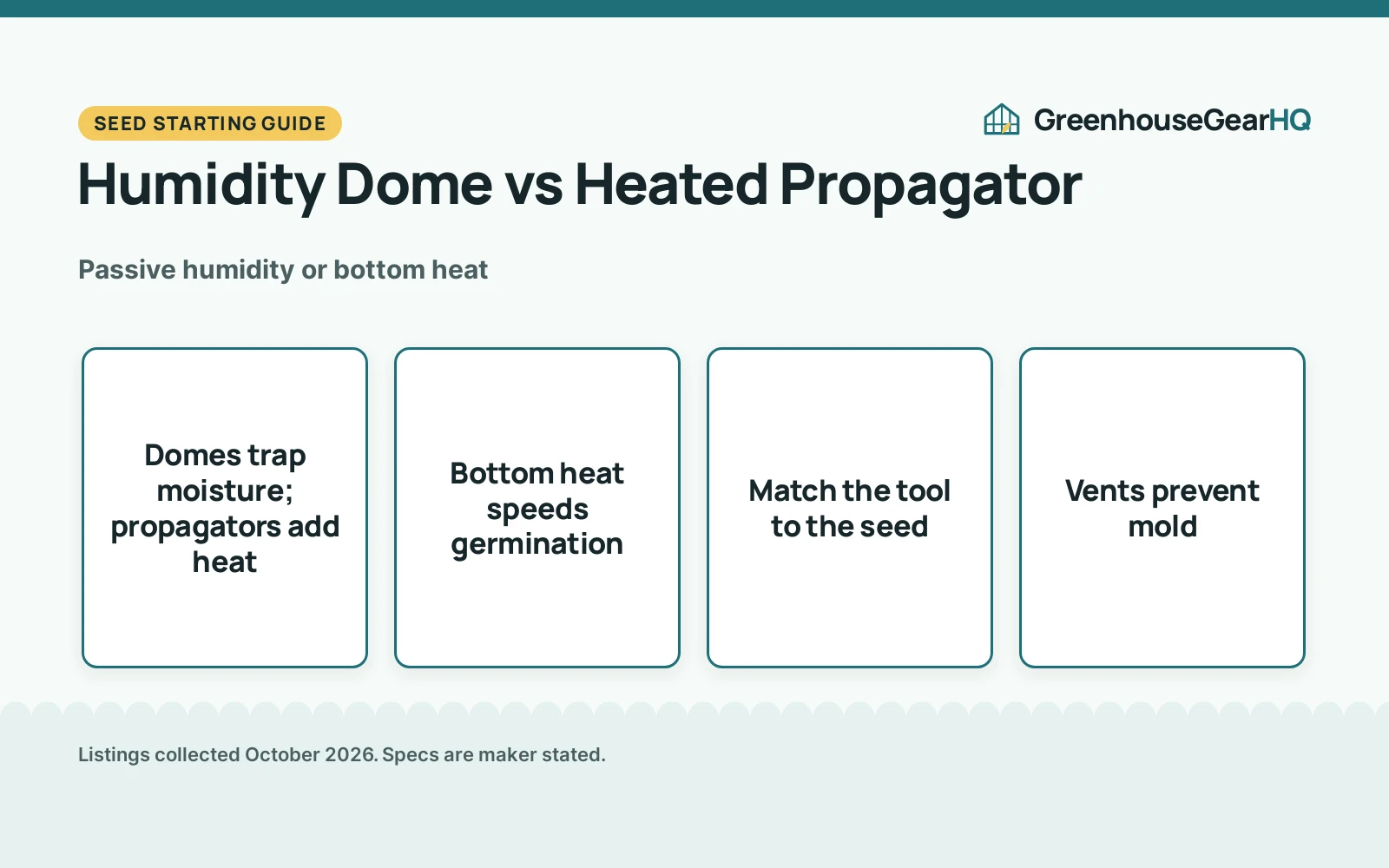
A humidity dome traps moisture around the seedlings: it is a clear lid that keeps the air damp so seeds do not dry out between waterings. A heated propagator warms the soil from below with integrated bottom heating. If your room is warm but dry, buy the dome. If your room is cool, buy the heat. If it is both cool and dry, use both: heat below, dome above.
The four products in this guide split three to one. Three are pot-and-dome sets in different sizes; one is a heated seed starter tray with a grow light. None of the listings claims to do both jobs, so match the tool to the problem you actually have.
What a humidity dome does
The dome’s job is moisture. The 30-pack of 3 in clear nursery pots comes with 30 transparent humidity domes and drainage holes in each pot, reusable and washable. The RooTrimmer 15-pack pairs 6 in clear pots with domes that have adjustable ventilation holes for airflow and moisture control. The RooTrimmer 25-set uses 4 in soft pots that squeeze for easy transplant, with ventilated domes.
Vents are the feature that separates good domes from mold factories. Both RooTrimmer sets list ventilated or adjustable ventilation holes, which let you bleed off excess moisture on warm days and close up on cool ones. Without vents, a dome in full sun cooks the seedlings it was meant to protect.
Pot size decides what you can start. The EBaokuup 30-pack uses 3 in pots, 6.1 in tall, with labels included and drainage holes in each pot, per the listing. The RooTrimmer 15-pack steps up to 6 in pots for larger starts, while the 25-set uses 4 in soft pots that squeeze for easy transplant. All three dome sets are listed as reusable and washable.
What a heated propagator does
The Sondiko is the only heated option here: a seed starter tray with integrated bottom heating, a grow light and a temperature display. The listing says to set 68 to 86 degrees Fahrenheit for seeds and 104 for potted plants, and that the tray heats slightly above the target then self-adjusts to stabilize.
Bottom heat is for germination, not growing on. Peppers, tomatoes and eggplants sprout faster and more evenly on warmth than on a cool windowsill. The Sondiko’s all-in-one design means no separate heat mat to buy, and it does include a dome after all: the included components list a humidity dome and tray, and the dome carries 8 adjustable vents, per the listing.
The Sondiko is the most fully specified pick here. The tray holds 40 cells at 1.57 by 1.37 inches each, with dual full-spectrum LED grow lights offering 5 brightness levels and 3 timer settings (3, 6 or 12 hours), per the listing. The heater spans 15 to 40 degrees Celsius (59 to 104 Fahrenheit), the tray is UV-resistant ABS plastic, and the removable base tray doubles as a water reservoir, per the listing. Drainage holes are included to prevent overwatering.
Which one for your seeds
Start with the room. A cool basement or unheated greenhouse wants the heated propagator first: no amount of humidity fixes cold soil. A warm, dry house wants the dome first: seeds dry out under furnace air. A cool, dry room wants both, and the Sondiko plus any of the dome sets covers it.
Size the dome set to your trays. The 30-pack of 3 in pots suits starting many varieties; the 15-pack of 6 in pots suits fewer, larger starts; the 25-set of 4 in soft pots suits herbs and succulents. Browse our humidity domes for more, and see heat mat vs heated propagator if you already own a mat.
FAQ for growers
Can I use both a dome and a heated propagator?
Yes: heat below, dome above. That is the standard setup for cool, dry rooms.
Which is better for peppers?
Bottom heat. Peppers want warmth to germinate, per the Sondiko’s 68 to 86 degree range.
Do humidity domes need vents?
Yes. Both RooTrimmer sets list ventilated or adjustable ventilation holes to control moisture.
What temperature should seeds get?
68 to 86 degrees Fahrenheit, per the Sondiko listing; 104 for potted plants.
Does the Sondiko include a dome?
Yes. The included components list a humidity dome and tray, and the dome has 8 adjustable vents, per the listing.
Keep reading
See every humidity domes guide. Also see our seed starting guides.
More guides: humidity dome vs seed tray with lid, hygrometers for humidity domes and tabletop greenhouses with humidity domes.