On this page
Top picks at a glance
As an Amazon Associate I earn from qualifying purchases.
- 1
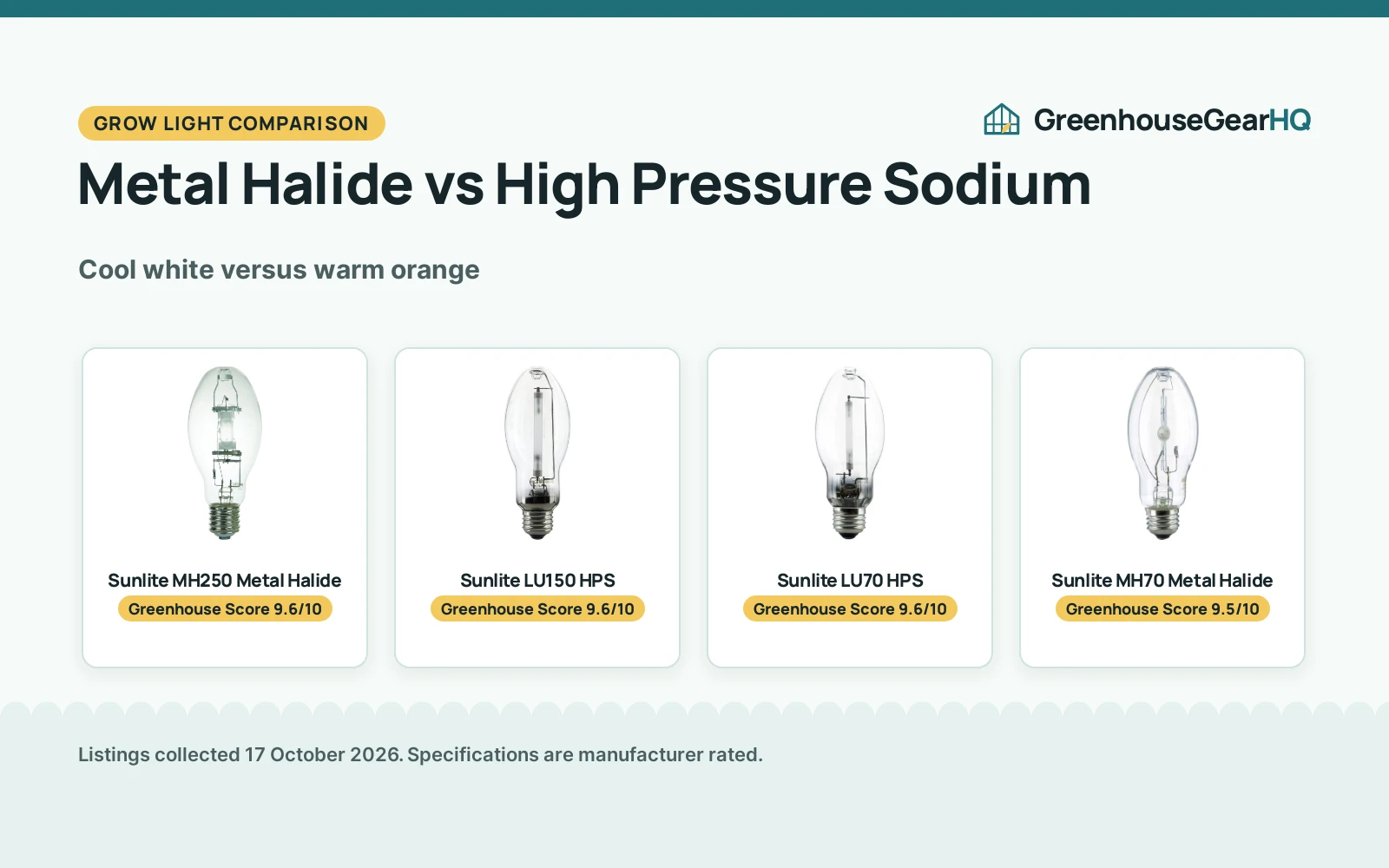
 Sunlite MH250 Metal Halide9.6/10View on Amazon
- 2
 Sunlite LU150 HPS9.6/10View on Amazon
- 3
 Sunlite LU70 HPS9.6/10View on Amazon
- 4
 Sunlite MH70 Metal Halide9.5/10View on Amazon
Pick metal halide for vegetative growth and high pressure sodium for flowering. The MH examples here run 4000K cool white; the HPS examples run 2100K warm orange. Many growers use both: MH while plants grow leaves, HPS when they bloom.
GreenhouseGearHQ earns a commission when you buy through links on this site, at no extra cost to you. As an Amazon Associate I earn from qualifying purchases. Affiliate disclosure.
The 4 examples
| # | Product | Greenhouse Score | Buy |
|---|---|---|---|
| 1 | Sunlite MH250 Metal Halide | 9.6/10 | Buy on Amazon |
| 2 | Sunlite LU150 HPS | 9.6/10 | Buy on Amazon |
| 3 | Sunlite LU70 HPS | 9.6/10 | Buy on Amazon |
| 4 | Sunlite MH70 Metal Halide | 9.5/10 | Buy on Amazon |

Sunlite MH250 Metal Halide
A 250W MH lamp with 21,000 lumens, for vegetative growth; skip it for flowering light.
Pros
- 250W with 21,000 lumens.
- 4000K cool white for vegetative growth.
- E39 mogul base.
- Pulse-start ballast compatibility.
Cons
- No warranty stated.
- 250W draws more power.
- Needs MH ballast.
- Not for flowering emphasis.

Sunlite LU150 HPS
A 150W HPS bulb with 15,000 lumens, for flowering; skip it for vegetative light.
Pros
- 150W with 15,000 lumens.
- 2100K warm light for flowering.
- Medium base fits common fixtures.
- Lower wattage than the 250W MH.
Cons
- No warranty stated.
- Warm spectrum; not for vegetative.
- Needs HPS ballast.
- ED17 shape; check fixture fit.

Sunlite LU70 HPS
A 70W HPS bulb with 6,000 lumens, for small flowering spaces; skip it for high output.
Pros
- 70W with 6,000 lumens.
- 2100K warm light for flowering.
- Medium base.
- Low wattage for small spaces.
Cons
- No warranty stated.
- Lower output than the 150W.
- Warm spectrum only.
- Needs HPS ballast.

Sunlite MH70 Metal Halide
A 70W MH lamp with 5,600 lumens, for small vegetative spaces; skip it for high output.
Pros
- 70W with 5,600 lumens.
- 4000K cool white for vegetative growth.
- Medium base.
- Pulse start.
Cons
- No warranty stated.
- Lowest output here.
- Needs MH ballast.
- Not for flowering emphasis.
As an Amazon Associate I earn from qualifying purchases.
Other options worth a look
 Sunlite M102/O Protected Metal Halide Lamp 150W ClearCheck price on Amazon
 Sunlite MH250/U/MOG M58 Metal Halide LampCheck price on Amazon
 Horticulture Ceramic Metal HalideCheck price on Amazon
Metal halide vs high pressure sodium: side by side
| Example | GHQ Score | Type | Wattage | Color temp | Lumens | Amazon |
|---|---|---|---|---|---|---|
| Sunlite MH250 Metal Halide | 9.6/10 | Metal halide | 250W | 4000K | 21,000 | View on Amazon |
| Sunlite LU150 HPS | 9.6/10 | High pressure sodium | 150W | 2100K | 15,000 | View on Amazon |
| Sunlite LU70 HPS | 9.6/10 | High pressure sodium | 70W | 2100K | 6,000 | View on Amazon |
| Sunlite MH70 Metal Halide | 9.5/10 | Metal halide | 70W | 4000K | 5,600 | View on Amazon |
We reproduce the maker’s listed specs without adjustment (collected 17 October 2026).
The metal halide side: cool white for growth
Both MH examples run 4000K, a cool white rich in blue. The Sunlite MH250 example is a 250W lamp with an E39 mogul base and 21,000 lumens, the brightest example here. The Sunlite MH70 example is a 70W pulse-start lamp with a medium base and 5,600 lumens. Neither listing states a warranty or lifespan, so the comparison rests on the stated lumens and color temperature. MH suits the vegetative stage, where blue-heavy light keeps plants compact.
The high pressure sodium side: warm orange for bloom
Both HPS examples run 2100K, a warm orange rich in red. The Sunlite LU150 example is a 150W bulb with a medium base and 15,000 lumens; the Sunlite LU70 example is a 70W bulb with a medium base and 6,000 lumens. Like the MH side, no warranty or lifespan is stated. HPS suits flowering, where red-heavy light drives bloom. The listings leave efficiency comparisons unclear, since neither side states lumens per watt directly.
Which should you choose?
Choose metal halide when the plants are growing leaves and stems: the 4000K examples here give the cool white that stage wants, at 5,600 or 21,000 lumens. Choose high pressure sodium when the plants are flowering: the 2100K examples here give the warm orange that stage wants, at 6,000 or 15,000 lumens. Choose both, on a schedule, when the grow runs seed to harvest under one roof. Match the base to the fixture: E39 mogul for the 250W MH, medium base for the other three.
Scoring notes
| Product | Greenhouse Score | Perf. /35 | Build /25 | Value /25 | Safety /10 | Warranty /5 |
|---|---|---|---|---|---|---|
| Sunlite MH250 Metal Halide | 9.6 | 30 | 21 | 20 | 9 | 0 |
| Sunlite LU150 HPS | 9.6 | 30 | 21 | 20 | 8 | 0 |
| Sunlite LU70 HPS | 9.6 | 28 | 20 | 20 | 8 | 0 |
| Sunlite MH70 Metal Halide | 9.5 | 28 | 20 | 20 | 7 | 0 |
Every score falls within 9.2 and 9.8, and a pick moves toward the top end only by earning more weighted points.
The GHQ Score weighs performance, build, value, safety and warranty. The 250W MH leads on raw output at 21,000 lumens; the 150W HPS follows at 15,000. The two 70W examples trail on output but suit small spaces. No listing states a warranty, so warranty scores are zero across the board. How we pick explains the weights.
FAQ for growers
Can I use MH and HPS in the same fixture?
Only if the ballast supports both. The listings here describe separate MH and HPS lamps with different bases and ballast needs; check the ballast before swapping.
Which is better for seedlings?
Metal halide: the 4000K examples here give cool white light that keeps seedlings compact. HPS runs warm and suits flowering instead.
How many lumens do I need?
The examples here range from 5,600 to 21,000 lumens. Match the lumens to the grow area; the listings state output, not coverage.
Do these bulbs include a ballast?
No. The listings describe lamps only; each needs the matching MH or HPS ballast and fixture.
Keep reading
See every grow lights guide and all greenhouse climate guides.
More picks: grow lights with timer, light meter for LED grow lights.