On this page
Top picks at a glance
As an Amazon Associate I earn from qualifying purchases.
- 1
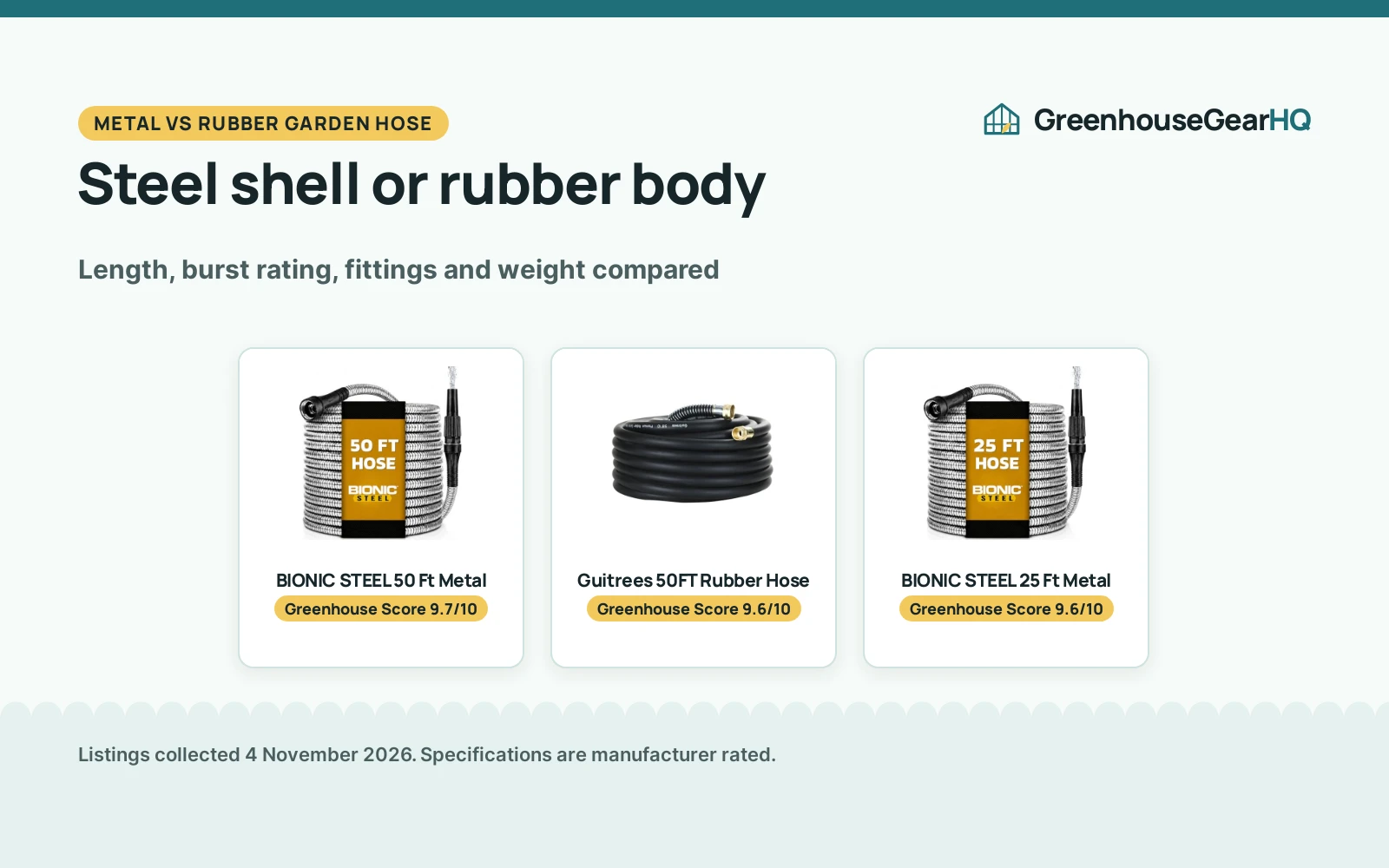
 BIONIC STEEL 50 Ft Metal9.7/10View on Amazon
- 2
 Guitrees 50FT Rubber Hose9.6/10View on Amazon
- 3
 BIONIC STEEL 25 Ft Metal9.6/10View on Amazon
On a hot July afternoon, when beds need water and a hose that kinks at every corner slows the job, the metal vs rubber garden hose choice comes down to shell material and handling. A steel shell promises a puncture-resistant body that coils small, while a rubber body promises flexible, all-season handling with brass fittings. This comparison uses the listings as concrete examples, with a short verdict on who should pick which side.
GreenhouseGearHQ earns a commission when you buy through links on this page, at no extra cost to you. As an Amazon Associate I earn from qualifying purchases. Affiliate disclosure.
Quick verdict: choose metal if you want a 304 stainless steel shell, a memoryless body that resists kinks and a light listed weight for dragging and coiling. Choose rubber if you want a 50FT body with five-layered braiding, solid brass fittings and stated hot and cold water use. The rubber listing leaves its working pressure unclear, so check that figure before a high-pressure job.
Our picks for the greenhouse
| # | Product | Greenhouse Score | Buy |
|---|---|---|---|
| 1 | BIONIC STEEL 50 Ft Metal | 9.7/10 | Buy on Amazon |
| 2 | Guitrees 50FT Rubber Hose | 9.6/10 | Buy on Amazon |
| 3 | BIONIC STEEL 25 Ft Metal | 9.6/10 | Buy on Amazon |

BIONIC STEEL 50 Ft Metal
A 50 Ft metal garden hose in 304 stainless steel with a 5/8 in interior, a 500 PSI burst rating and a sprayer nozzle.
Pros
- 304 stainless steel shell that the maker says resists rust, cracks and rot
- Memoryless design that lays flat and resists kinks around corners and trees
- Listed at 3.0 Pounds, easy to drag across the yard, coil up and carry
- 500 PSI burst rating with a 5/8 in interior for a steady stream
Cons
- No warranty term is stated
- No working pressure figure is stated, only a 500 PSI burst rating
- No freezing temperature figure is stated, only an all-weather description

Guitrees 50FT Rubber Hose
A 50FT rubber garden hose with five-layered braiding, solid brass 3/4 in GHT fittings and stated hot and cold water use.
Pros
- Five-layered braiding that the maker links to durability and bending resilience
- Solid brass 3/4 in GHT fittings for heavy-duty tasks
- Stated for hot and cold water, with flexibility even in -40° conditions
- 1000psi Burst rating in the title for high-pressure gardening and construction use
Cons
- No warranty term is stated
- No item weight is stated
- No kink figure or bend radius is stated

BIONIC STEEL 25 Ft Metal
A 25 Ft metal garden hose in 304 stainless steel with a 5/8 in interior, a 500 PSI burst rating and a sprayer nozzle.
Pros
- 304 stainless steel shell that the maker says resists rust, cracks and rot
- Memoryless design that lays flat and resists kinks around corners and trees
- Listed at 3.0 pounds, easy to drag across the yard, coil up and carry
- 500 PSI burst rating with a 5/8 in interior for a steady stream
Cons
- No warranty term is stated
- No working pressure figure is stated, only a 500 PSI burst rating
- Shorter reach than the 50 Ft metal listing in this comparison
As an Amazon Associate I earn from qualifying purchases.
Other options worth a look
 BIONIC STEEL 75 Ft Garden Hose 304 Stainless SteelCheck price on Amazon
 UNCO- Metal Garden HoseCheck price on Amazon
 Lefree 100ft Metal Garden Hose with Upgraded Leak‑ProofCheck price on Amazon
 Beitopamz Metal Garden Hose 75 ftCheck price on Amazon
 Kebose Garden Hose 50FTCheck price on Amazon
 AnyEasy Stainless Steel Garden Hose 75ft Heavy Duty MetalCheck price on Amazon
Metal vs rubber garden hose: side by side
| Garden Hose | Greenhouse Score | Length | Interior | Burst rating | Fittings | Amazon |
|---|---|---|---|---|---|---|
| BIONIC STEEL 50 Ft Metal | 9.7/10 | 50 Ft | 5/8 in | 500 PSI | Aluminum crush-resistant fittings | View on Amazon |
| Guitrees 50FT Rubber Hose | 9.6/10 | 50FT | 5/8 | 1000psi Burst | Solid brass 3/4 in GHT fittings | View on Amazon |
| BIONIC STEEL 25 Ft Metal | 9.6/10 | 25 Ft | 5/8 in | 500 PSI | Aluminum crush-resistant fittings | View on Amazon |
We reproduce the maker’s listed specs without adjustment (collected 4 November 2026).
Material and shell
The metal listings share a shell story. BIONIC STEEL describes commercial-grade 304 stainless steel that resists rust, cracks and rot, with an interlocking housing that resists punctures, dog bites, thorns and dragging over gravel or concrete. That shell is the metal side argument in plain terms: a hard outer body for rough yards and pet owners, plus aluminum crush-resistant fittings and a stabilizer collar.
The rubber listing tells a different shell story. Guitrees describes five-layered braiding for durability and resilience to bending, with solid brass 3/4 in GHT fittings. Braiding gives a rubber body its strength without a hard shell, and brass fittings give the ends a sturdy connection. The listings do not state a shell thickness for either side, so compare shell claims by the maker descriptions, not by a shared measurement.
Length and handling
Length separates the metal listings from each other more than it separates the sides. The BIONIC STEEL listings offer 50 Ft and 25 Ft, while the Guitrees rubber listing offers 50FT. A grower who waters beds far from the tap will notice that gap in daily use, while a grower with a compact plot may prefer the shorter metal coil.
Handling claims also differ. The metal listings describe a memoryless design that lays flat, resists kinks and coils small on a reel or hook, with a listed weight of 3.0 Pounds on the longer hose and 3.0 pounds on the shorter hose. The rubber listing describes kink-resistant technology and all-season flexibility, but states no item weight, so weight cannot be compared across the sides from the listings alone.
Pressure and fittings
Pressure figures need careful reading here. Both metal listings state a 500 PSI burst rating with a 5/8 in interior, and neither states a working pressure figure. The rubber listing states a 1000psi Burst rating in its title, but its working pressure is unclear: the title states 300psi working, while the bullets state working pressures up to 200psi and bursts above 1000psi.
Fittings are clearer. The metal listings use aluminum crush-resistant fittings with a built-in on/off valve for flow control at the hose. The rubber listing uses solid brass 3/4 in GHT fittings. Neither side states a fitting warranty or a leak figure, so judge fittings by material and the valve detail, not by a durability number the listings do not give.
Listing gaps to check
Every listing in this comparison leaves a warranty term unstated, so warranty cannot separate the sides. The metal listings state no working pressure figure and no freezing temperature figure, only an all-weather description covering sun, heat and freezing conditions. The rubber listing states no item weight and no kink figure.
Two smaller gaps deserve a note. The shorter metal listing spells its spec table color Sliver, while the longer metal listing spells it Silver, so treat that color entry as unclear. The rubber listing dimension table lists a long inch figure alongside a 50FT size, so use the stated 50FT size and the 5/8 size for planning, not the dimension table alone.
How to choose the best metal vs rubber garden hose
Match the shell to the yard
Pick a steel shell for a yard with gravel paths, thorns or pets, where the BIONIC STEEL listings describe puncture resistance as a central benefit. Pick a rubber body for a yard where flexible handling and brass fittings matter more than a hard shell, as the Guitrees listing describes. Compare more metal options in our best metal flexible garden hose picks before settling on a shell.
Match length to the watering run
Measure the run from tap to the farthest bed in plain terms, then match it to a listed length: 50 Ft or 25 Ft on the metal side, 50FT on the rubber side. A hose that falls short forces a move of the tap or a second connection, while a hose with spare length adds coiling and dragging on every watering round. Length is the simplest figure to verify, so let it narrow the choice before shell material does.
Check pressure figures before buying
Read burst rating and working pressure as separate figures. The metal listings give a burst rating only, and the rubber listing gives conflicting working pressure figures, so ask the seller for a settled working pressure figure if a sprayer or washer needs it. A nozzle change can also alter handling at the hose end, so see our best garden hose nozzle picks for end fittings that suit greenhouse watering.
Which should you choose?
Choose a metal garden hose if you want a 304 stainless steel shell, a memoryless body that resists kinks, aluminum fittings with an on/off valve and a light listed weight. The 50 Ft listing suits longer runs, while the 25 Ft listing suits compact runs close to the tap.
Choose a rubber garden hose if you want a 50FT rubber body with five-layered braiding, solid brass fittings and stated hot and cold water use for garden, agriculture and construction jobs. Confirm the working pressure figure first, since the title and bullets disagree on it.
In the Greenhouse
- Coil the metal hose into a tight loop on a reel or hook after watering, as the maker describes for small storage.
- Use the rubber hose for hot and cold water jobs, and note its stated flexibility even in -40° conditions for cold-season use.
- Check the listed length against the run from tap to beds before ordering, since the metal listings offer 50 Ft and 25 Ft and the rubber listing offers 50FT.
- Control flow at the hose with the metal listings built-in on/off valve, and confirm the rubber listing working pressure with the seller before a high-pressure job.
Scoring notes
| Product | Greenhouse Score | Perf. /35 | Build /25 | Value /25 | Safety /10 | Warranty /5 |
|---|---|---|---|---|---|---|
| BIONIC STEEL 50 Ft Metal | 9.7 | 30 | 22 | 21 | n/a | 0 |
| Guitrees 50FT Rubber Hose | 9.6 | 29 | 21 | 21 | n/a | 0 |
| BIONIC STEEL 25 Ft Metal | 9.6 | 28 | 22 | 20 | n/a | 0 |
Every score falls within 9.2 and 9.8, and a pick moves toward the top end only by earning more weighted points. If there is no power source and no stated safety feature, the safety criterion is left off and 90 points remain.
The Greenhouse Score weighs performance, build, value, safety and warranty, as explained on our How we pick page. For garden hoses, safety reflects stated safety-relevant features such as a puncture-resistant shell or sturdy fittings, and no listing earns safety points here because none states a matching certification. None of the listings states a warranty term, so none earns warranty points. The longer metal hose ranks ahead on reach and its full set of stated shell and flow details, while the rubber hose ranks ahead of the shorter metal hose on its brass fittings and hot and cold water range.
FAQ for growers
Is a metal garden hose better than a rubber garden hose?
It depends on the yard. The metal listings describe a 304 stainless steel shell that resists punctures, while the rubber listing describes five-layered braiding with solid brass fittings and hot and cold water use.
Which hose length suits a greenhouse watering run?
Match the listed length to the run from tap to beds. The metal listings offer 50 Ft and 25 Ft, and the rubber listing offers 50FT, so a longer run favors a 50 Ft or 50FT listing.
Does the Guitrees hose handle hot and cold water?
Yes, the listing states hot and cold water use, with flexibility even in -40° conditions and five-layered braiding for durability.
What should be checked about the rubber hose working pressure?
Confirm it with the seller. The title states 300psi working, while the bullets state working pressures up to 200psi, so the working pressure figure is unsettled in the listing.
Keep reading
See every Air and Water guide and all greenhouse guides.
More picks: metal flexible garden hoses, garden hose nozzles, rubber vs plastic garden hose and garden sprinkler hose 50 Ft.