On this page
Top picks at a glance
As an Amazon Associate I earn from qualifying purchases.
- 1
 iLiving 30-Inch Commercial Pedestal Fan9.7/10View on Amazon
- 2
 hYwecy Rechargeable Circulation Desk Fan with 360-Degree9.4/10View on Amazon
- 3
 Amazon Basics 16" Pedestal Fan with Remote9.5/10View on Amazon
- 4
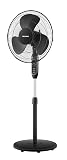 PELONIS 16" Adjustable Oscillating Pedestal Fan with RemoteView on Amazon
- 5
 DREO Fan for BedroomView on Amazon
- 6
 DREO Smart Pedestal Fan for BedroomView on Amazon
- 7
 DREO Smart Fan for Bedroom with RGB LightView on Amazon
- 8
 EZ-CHILL 16" Oscillating Pedestal Fan with Folding BaseView on Amazon
- 9
 Levoit Standing Fan for BedroomView on Amazon
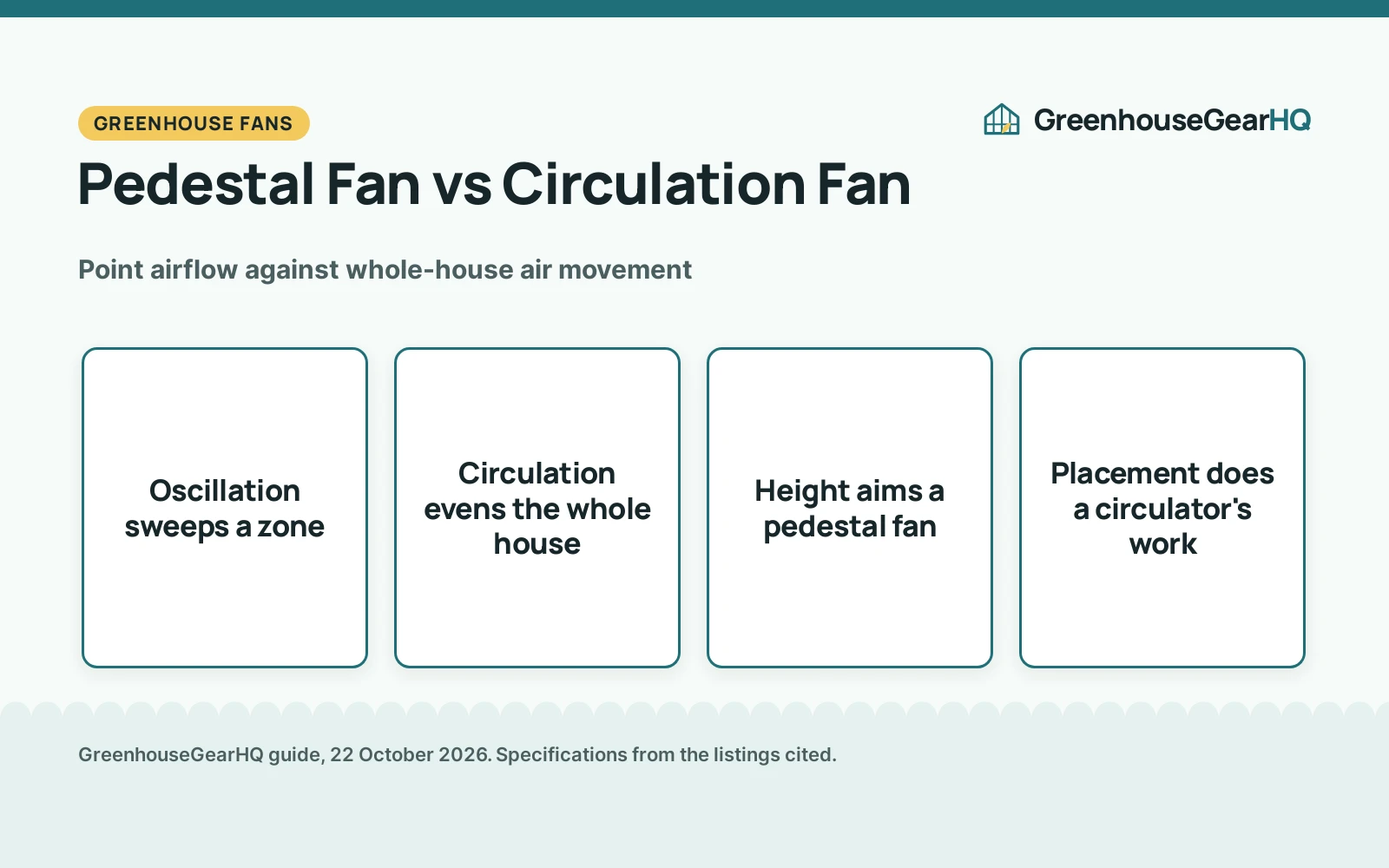
Pedestal fan vs circulation fan: which one does a greenhouse need? Choose the circulation fan for the crop: continuous, gentle air movement through the whole house that keeps leaves stirring, evens out temperature layers and dries foliage. Choose the pedestal fan for a place: a strong, adjustable blast of air aimed at a work bench, a hot corner or a row you are trying to cool right now. Most houses end up wanting circulation everywhere and a pedestal where people work.
Other options worth a look
 PELONIS 16" Adjustable Oscillating Pedestal Fan with RemoteCheck price on Amazon
 DREO Fan for BedroomCheck price on Amazon
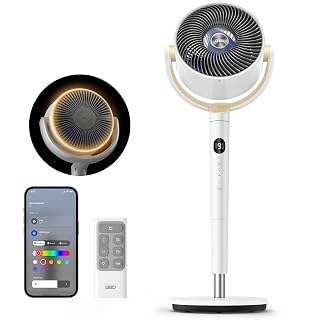 DREO Smart Pedestal Fan for BedroomCheck price on Amazon
 DREO Smart Fan for Bedroom with RGB LightCheck price on Amazon
 EZ-CHILL 16" Oscillating Pedestal Fan with Folding BaseCheck price on Amazon
 Levoit Standing Fan for BedroomCheck price on Amazon
GreenhouseGearHQ earns a commission when you buy through links on this page, at no extra cost to you. As an Amazon Associate I earn from qualifying purchases. Affiliate disclosure.
Below: how the two airflow patterns differ, where each one wins in a greenhouse, the four stand fans in the current listings ranked, and the questions growers ask before buying.
Pedestal fan vs circulation fan: the difference is the pattern
A pedestal fan is a bladed fan on an adjustable stand. It makes a cone of fast air in front of itself, usually sweeping it side to side on an oscillating head, and its job is to move a lot of air through one zone: across a bench, down an aisle, onto the grower. Height adjustment and tilt aim the cone, and the controls live on the fan or a remote.
A circulation fan is built for the whole volume instead of a zone. In greenhouse terms it is the horizontal airflow pattern: fans keep the house’s air drifting continuously and gently, so warm air does not pool at the ridge, cold air does not settle on the crop, and leaf surfaces dry between waterings. The measure of a circulation setup is not how hard it blows on your face, but that no corner of the house is still. The DREO in the gear section below is sold as an air circulator on a pedestal, which is why the two ideas meet in one product.
| Pedestal fan | Circulation fan | |
|---|---|---|
| Air pattern | A cone of fast air, usually oscillating | Continuous gentle drift through the whole house |
| Aimed by | Stand height and head tilt | Placement and spacing around the house |
| Best job | Cooling a bench, a corner, a worker | Evening temperature, drying foliage, stirring the crop |
| Runs | When and where it is needed | For long hours, often all day |
| Stated measure | CFM and oscillation arc on the listings below | Whole-room throw and coverage on the circulator listing |
Where the pedestal fan wins
- Aimed cooling. A bench where you pot up for hours, a propagation corner that runs hot, a door where you load plants: the pedestal puts its air exactly there.
- Height adjustment. The listings below adjust from low working heights to over four feet, so the cone can clear a bench or ride above a crop row.
- Oscillation. A sweeping head covers a zone wider than the fan’s own cone, which is how one fan serves a whole bench.
- Nothing to install. It stands where it is put, moves when the layout changes, and needs no mounting hardware.
Where the circulation fan wins
- Even temperatures. Continuous drift breaks up the hot ridge layer and the cold floor layer that a point fan leaves standing.
- Dry foliage. Leaves that keep moving dry faster after watering or a humid night, which is the daily argument for circulation in a crop house.
- Sturdy seedlings. Seedlings grown in moving air are handled by a constant gentle pattern, not by a cone that flattens them when it sweeps past.
- Out of the way. Circulation setups are placed for the house’s airflow, high and along the walls, instead of standing in the aisle where work happens.
The gear: four pedestal fans
The current listings are all pedestal fans, three of them room fans and one an air circulator on a stand, ranked by what they state.
1. Lasko Adjustable Pedestal Fan, 18 in (1827)
The airflow pick. Its spec table states the highest output here, 1970 CFM, from an 18 inch fan on a stand adjustable from 38 to 54.5 inches, with 60 degree oscillation, a tilt-back head, three speeds on rotary controls and no-tools assembly. The safety story is the fullest of the four: ETL listed, with Lasko’s patented fused safety plug, the Blue Plug. The warranty is a stated 1 year limited warranty. One inconsistency to know: the bullets call it an 11.3-pound fan while the table lists the item weight as 13 pounds. Who it fits: a grower who wants the strongest stated blast on a stand, for a bench or a hot end of the house.
2. DREO Air Circulator Pedestal Fan (DR-HPF013)
The circulator of the group, and the bridge between this guide’s two sides. The listing states its upgraded circulator design moves air up to 90 ft away at 1000 CFM, on a DC motor with 8 speeds plus an auto mode that steps speed up as room temperature rises, 90 degree horizontal oscillation, a 105 degree pivoting head and a height range of 38 to 42 inches. It is the quietest here by a wide margin at a stated 28.2 dB, carries an 8 hour timer and a remote, and at 5.2 lb it is the lightest fan in the group. No warranty term is stated. Who it fits: a small house or grow room that wants whole-room circulation from a stand, quietly.
3. Lasko Oscillating Pedestal Fan, 16 in (1646)
The governed all-rounder: 1140 CFM stated, three speeds on electronic controls, a height range of 32 to 47 inches, a tilt-back head, widespread oscillation, and a remote with an auto-off timer at 1, 2 or 4 hours. Like its bigger sibling it is ETL listed with the Blue Plug safety feature, and its warranty is a stated 1 year warranty. At 8 lb in white, it is the easy fan to move between a bench and a propagation shelf. Who it fits: a grower who wants remote and timer control on a mid-size stand fan.
4. BLACK+DECKER 16 in Stand Fan (BFSR16B)
The widest sweep here: a stated 90 degree oscillation, the broadest arc in the group, on a 16 inch fan with three speeds, an adjustable height up to 49 inches and a 30 degree head tilt, with a remote and a timer. It is the lowest power draw of the four at a stated 48 watts, and the loudest on paper at a stated 55 dB. The table lists ETL as the specification met, and the warranty is a stated 1 year manufacturer limited warranty, at 9.9 lb. No airflow figure is stated, which is why it ranks below the fans that publish one. Who it fits: a wide bench or aisle that wants the broad sweep and the remote.
FAQ for growers
Can a pedestal fan do a circulation fan’s job in a small greenhouse?
Partly. An oscillating pedestal will stir a small house and dry the crop in its sweep, and the DREO above is sold as a circulator for whole-room air movement. What it cannot do is cover the corners outside its arc at the same time; a true circulation layout is placed for the whole volume. In a hobby house, one oscillating pedestal is a reasonable start.
How much airflow do these fans state?
The Lasko 1827 states 1970 CFM, the Lasko 1646 states 1140 CFM and the DREO states 1000 CFM with a 90 ft throw. The BLACK+DECKER states no CFM figure, only its 48 watt draw and 55 dB noise level.
Which fan is quietest?
The DREO, at a stated 28.2 dB, well under the other stated figures: the Lasko 1827’s table gives 61.6 dB (with 42.5 dB on low) and the BLACK+DECKER 55 dB. The Lasko 1646 states no noise figure.
Are these fans rated for greenhouse humidity?
None of the four listings states a greenhouse or damp-location rating; they are indoor room fans, three of them ETL listed or ETL specified. In a wet house, place any fan out of the watering splash zone and treat the stated indoor rating as the limit of what the listings promise.
What warranty do these fans carry?
Three state a term of one year: the Lasko 1827 (1 year limited), the Lasko 1646 (1 year) and the BLACK+DECKER (1 year manufacturer limited). The DREO listing states no warranty term.
Keep reading
See every greenhouse fans guide and all air and water guides.
More picks: best circulation fan for greenhouse and best battery powered greenhouse fan.