On this page
Top picks at a glance
As an Amazon Associate I earn from qualifying purchases.
- 1
 EKOOTIMO 4-in-1 TDS EC Temperature Meter9.7/10View on Amazon
- 2
 HoneForest TDS MeterView on Amazon
- 3
 4-in-1 Soil Moisture Meter Digital Plant Temperature/SoilView on Amazon
- 4
 Digital pH Tester for WaterView on Amazon
- 5
 Digital Soil EC Meter 2-in-1 Porfessional Plants ECView on Amazon
- 6
 PAR and UVA Meter for Grow LightsView on Amazon
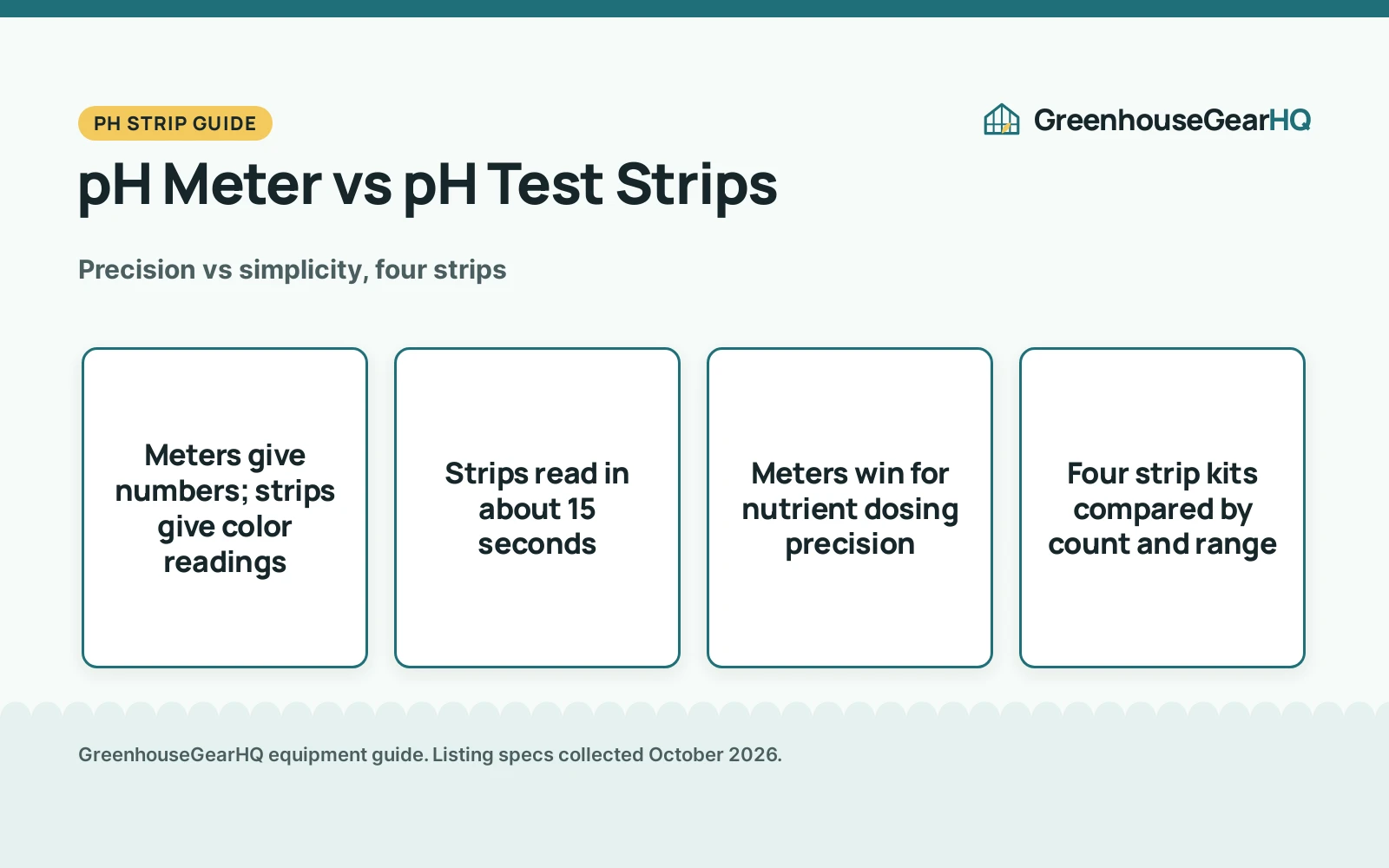
The pH meter vs pH test strips choice is precision vs simplicity: a pH meter gives a digital number, while pH test strips give a color reading you match to a chart. Choose a meter for exact dosing in hydroponics; choose strips for quick checks. The four kits here are all test strips, the simple side of the choice.
Other options worth a look
 HoneForest TDS MeterCheck price on Amazon
 4-in-1 Soil Moisture Meter Digital Plant Temperature/SoilCheck price on Amazon
 Digital pH Tester for WaterCheck price on Amazon
 Digital Soil EC Meter 2-in-1 Porfessional Plants ECCheck price on Amazon
 PAR and UVA Meter for Grow LightsCheck price on Amazon
GreenhouseGearHQ earns a commission when you buy through links on this page, at no extra cost to you. As an Amazon Associate I earn from qualifying purchases. Affiliate disclosure.
pH meter vs pH test strips: the short answer
Strips are fast, need no batteries or calibration, and read in about 15 seconds by color match. Meters are more precise: they read to a decimal and suit nutrient solutions where a half point matters. For growers dosing nutrients, a meter pays off; for spot checks of water or soil, strips are enough. See our best pH meter for water picks for the meter side.
The four test strip kits, ranked
The LabAider leads: 3 packs of 240 pH 1-14 strips with a storage case, 45mm x 7mm paper, read within about 15 seconds. The JNW Direct is next: 150 strips in a 4.5-9.0 range for urine and saliva. The Just Fitter is third: 125 body pH test strips with a color chart and PDF instructions. The LabRat Supplies is last: 100 plastic pH strips with a universal 0-14 range for water, urine, saliva, soil, soap and skincare.
How strips work
Dip a strip, wait about 15 seconds and match the color to the chart. The LabAider listing states the smaller the number, the stronger the acid. The LabRat listing states laboratory and diagnostic grade strips. Strips trade resolution for convenience: you read a range, not a number. Compare more options in our pH meter vs EC meter guide.
When a meter wins
A meter wins when precision matters: nutrient dosing, reservoirs and repeated measuring where a half point changes the recipe. Meters need calibration and care, strips do not. If you check daily in hydroponics, see our best pH EC meter for hydroponics picks.
The kits compared
| Kit | Count | Range | Extras |
|---|---|---|---|
| LabAider | 240 (3-pack) | pH 1-14 | Storage case |
| JNW Direct | 150 | pH 4.5-9.0 | Urine/saliva focused |
| Just Fitter | 125 | Not stated | Color chart, PDF guide |
| LabRat | 100 | pH 0-14 | Plastic strips |
The LabAider gives the most strips per kit at 240 with a storage case. The LabRat is the only plastic-strip kit, suited to wet samples. The JNW Direct narrows the range to 4.5-9.0 for body fluids. The Just Fitter bundles instructions for first-time users.
Caring for accuracy
Keep strips dry: the LabAider storage case exists for that. Read within the stated window, about 15 seconds per the LabAider listing; colors drift after that. Do not touch the reactive pad with wet hands. Old or damp strips read wrong, so replace them when the colors look faded.
Strip size, count and handling
Strip count decides cost per reading. The LabAider gives 240 strips across 3 packs with a storage case, the most per kit here. The JNW Direct gives 150 strips in a 4.5-9.0 range, the Just Fitter 125 strips with a color chart and PDF instructions, and the LabRat 100 plastic strips with a universal 0-14 range. More strips suit daily checking; a smaller kit suits occasional spot checks.
Paper size affects handling. The LabAider states 45mm x 7mm paper, small enough to dip without wetting your fingers. The LabRat states plastic strips rather than paper, which suits wet samples like water and soil where paper softens. The JNW Direct and Just Fitter state litmus paper strips without a stated size.
Range decides what you can measure. The LabAider and LabRat cover the full 1-14 and 0-14 ranges, which suit water, soil and solutions. The JNW Direct narrows to 4.5-9.0 for urine and saliva. The Just Fitter listing does not state a range. Buy the full range for growing and the narrow range for body fluids.
Kit extras close the loop. The LabAider storage case keeps strips dry between uses. The Just Fitter color chart and PDF instructions guide first-time users. The LabRat listing states laboratory and diagnostic grade strips. Read every strip within about 15 seconds and compare against the chart in good light.
What this guide does not cover
This guide covers the four test strip kits listed here only. It does not cover digital pH meters, pH pens or calibration solutions. For meters, see our pH pen vs pH meter guide.
FAQ for growers
How fast do strips read?
About 15 seconds, per the LabAider listing: dip, wait and match the color chart.
Which kit includes a storage case?
The LabAider 3-pack includes a storage case.
Which strips suit wet samples?
The LabRat plastic strips, stated for water, urine, saliva and soil.
When should I buy a meter instead?
When you need a decimal reading for nutrient dosing rather than a color range.
Keep reading
See every indoor growing guide. Also see our pH meter vs EC meter. Also see our best pH meter for water.
More picks: best pH EC meter, indoor growing guides.