On this page
Top picks at a glance
As an Amazon Associate I earn from qualifying purchases.
- 1
 2 Pack Greenhouse Auto Roof Vent Opener Heat Sensitive Single9.7/10View on Amazon
- 2
 Unistyle 2 Zone Ball Valve Sprinkler Timer9.7/10View on Amazon
- 3
 Vibrant Yard 25 PSI Brass Water Pressure Regulator9.7/10View on Amazon
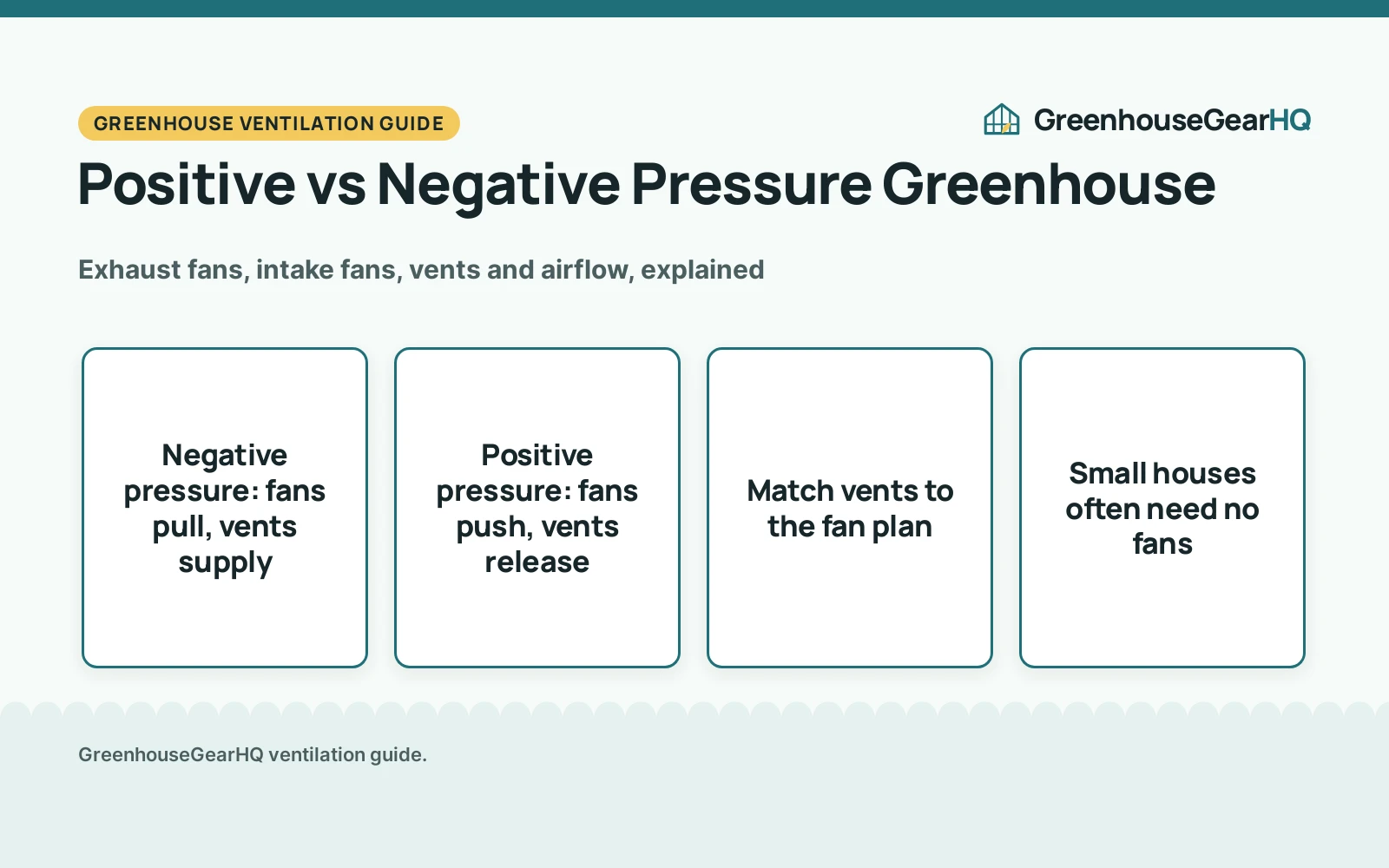
On a hot July afternoon, the air inside a closed greenhouse stops moving and the heat just sits there, which is when most growers start asking about a positive vs negative pressure greenhouse. The short answer: in a negative pressure setup, exhaust fans pull stale air out and fresh air is drawn in through vents; in a positive pressure setup, intake fans push fresh air in and stale air is forced out through vents. Both keep air moving through the house; the difference is which end does the pushing and which does the pulling.
GreenhouseGearHQ earns a commission when you buy through links on this page, at no extra cost to you. As an Amazon Associate I earn from qualifying purchases. Affiliate disclosure.
Positive vs negative pressure greenhouse: what actually changes
Air always moves from high pressure to low pressure. A fan changes which side of the greenhouse is high and which is low. Put the fan on the exhaust side and it pulls air out, dropping the pressure inside so outside air pushes in through every vent and crack; that is negative pressure. Put the fan on the intake side and it pushes air in, raising the pressure inside so inside air pushes out through the vents; that is positive pressure. The vents do the opposite job in each setup, but both setups need them.
Negative pressure: exhaust fans pull, vents supply
In a negative pressure house, the work happens at the exhaust end. Fans mounted high pull hot air out, and replacement air streams in through vents or louvers on the opposite side, sweeping across the plants on its way through. This is the setup growers reach for when heat is the enemy, because it exchanges the inside air steadily. Listings show the hardware this needs: the Modern Shade 6.5 by 10 ft greenhouse lists four fans arranged front to back for circulation, the KING BIRD walk-in lists 5 vents, and the AMERLIFE 6 by 20 ft greenhouse lists 2 top windows plus a lockable swing door for airflow control.
For negative pressure to work, the intake side must actually let air in. A house with too few vents chokes the fans: they pull hard against closed walls and move little air. Check the vent count on the listing before you plan fans around it. The Garvee 6 by 8 ft greenhouse lists a roof vent, the Benass 10 by 10 ft lists 1 adjustable roof vent, and the Aoodor 6 by 3 by 3 ft mini lists 2 roll-up windows that serve as vents. Our greenhouse exhaust fans with thermostat roundup compares fans built for the exhaust side.
Positive pressure: intake fans push, vents release
Positive pressure flips the job around. Intake fans blow outside air into the house, and the slightly higher pressure inside pushes stale air out through vents and louvers. Because air leaks outward rather than inward, dust and insects have a harder time drifting in through gaps, so growers pair the two goals this way: positive pressure favors pest exclusion, negative pressure favors cooling. The vents still matter; they are the release valves. The Benass 10 by 10 ft greenhouse lists an adjustable roof vent for releasing excess heat and humidity, and the Yesker 36 by 18 by 33 in mini lists 2 vents plus two semi-circular zippered doors for airflow.
Which one should you buy?
| Setup | Fan job | Vent job | Suits |
|---|---|---|---|
| Negative pressure | Exhaust fans pull air out | Vents supply replacement air | Heat control |
| Positive pressure | Intake fans push air in | Vents release stale air | Pest and dust exclusion |
Match the setup to the problem you actually have. If summer heat cooks your plants, negative pressure with exhaust fans is the usual answer: it pulls hot air out and draws cooler air across the beds. If pests and dust are the bigger trouble and heat is manageable, positive pressure with intake fans keeps the inside air pushing outward through every gap. Most small hobby houses need neither: the Aoodor 6 by 3 by 3 ft and the Yesker 36 by 18 by 33 in minis rely on their 2 vents and roll-up or zippered openings alone, and that passive airflow suits a few shelves of seedlings. Fan-driven pressure setups belong on larger houses with real vent counts, like the AMERLIFE 6 by 20 ft with its 2 top windows or the Modern Shade with its four fans. See our greenhouse fans with thermostat picks to size the fan side of either setup.
FAQ for growers
Can I ventilate a greenhouse with vents alone?
Yes, for a small house. The Aoodor 6 by 3 by 3 ft mini lists 2 roll-up windows and the Yesker mini lists 2 vents with two zippered doors; opening them is enough airflow for seedlings and a few shelves of pots.
Where do exhaust fans go in a negative pressure setup?
High on one end of the house, with intake vents on the opposite end, so incoming air sweeps across the plants. The Modern Shade greenhouse lists four fans in a front-to-back arrangement as one listing’s take on circulation.
Does positive pressure really keep pests out?
It helps: with inside pressure slightly higher, air leaks outward through gaps instead of drifting in, so insects and dust have a harder time entering. Vents still release the stale air, so keep them working.
How many vents do the listings state?
The KING BIRD walk-in lists 5 vents, the AMERLIFE 6 by 20 ft lists 2 top windows, the Benass 10 by 10 ft lists 1 adjustable roof vent, and the Velway 4-tier mini lists 1 vent with a roll-up door. Match the vent count to the fan plan before you buy.
Keep reading
See every greenhouse fans guide and all air and water guides.
More picks: greenhouse exhaust fans with thermostat, small greenhouse exhaust fans, greenhouse thermostats with app.