On this page
Top picks at a glance
As an Amazon Associate I earn from qualifying purchases.
- 1
 MT-92H Light Meter with Split Sensor Lux/Foot Candles MeterView on Amazon
- 2
 AH-Reef PAR MeterView on Amazon
Quantum sensor vs lux meter: pick a quantum sensor when you want PPFD in μmol/m²/sec for plant light, and a lux meter when you want a simple brightness reading in lux or foot-candles. The short verdict: the DANOPLUS quantum example measures photosynthetic light up to 4000 μmol/m²/sec with a waterproof sensor, while the Extech lux example reads to 400000 lux for white LED and standard lighting.
Other options worth a look
 MT-92H Light Meter with Split Sensor Lux/Foot Candles MeterCheck price on Amazon
 AH-Reef PAR MeterCheck price on Amazon
GreenhouseGearHQ earns a commission when you buy through links on this page, at no extra cost to you. As an Amazon Associate I earn from qualifying purchases. Affiliate disclosure.
Quantum sensor vs lux meter: what separates them
The two sides measure different things. A quantum sensor measures photosynthetic photon flux density (PPFD) in μmol/m²/sec over the 400 to 700 nm band, which is the light plants use. A lux meter measures illuminance in lux or foot-candles, which is brightness as the human eye sees it. The listings below are concrete examples of each side; a figure from one listing describes that listing only.
The quantum sensor side
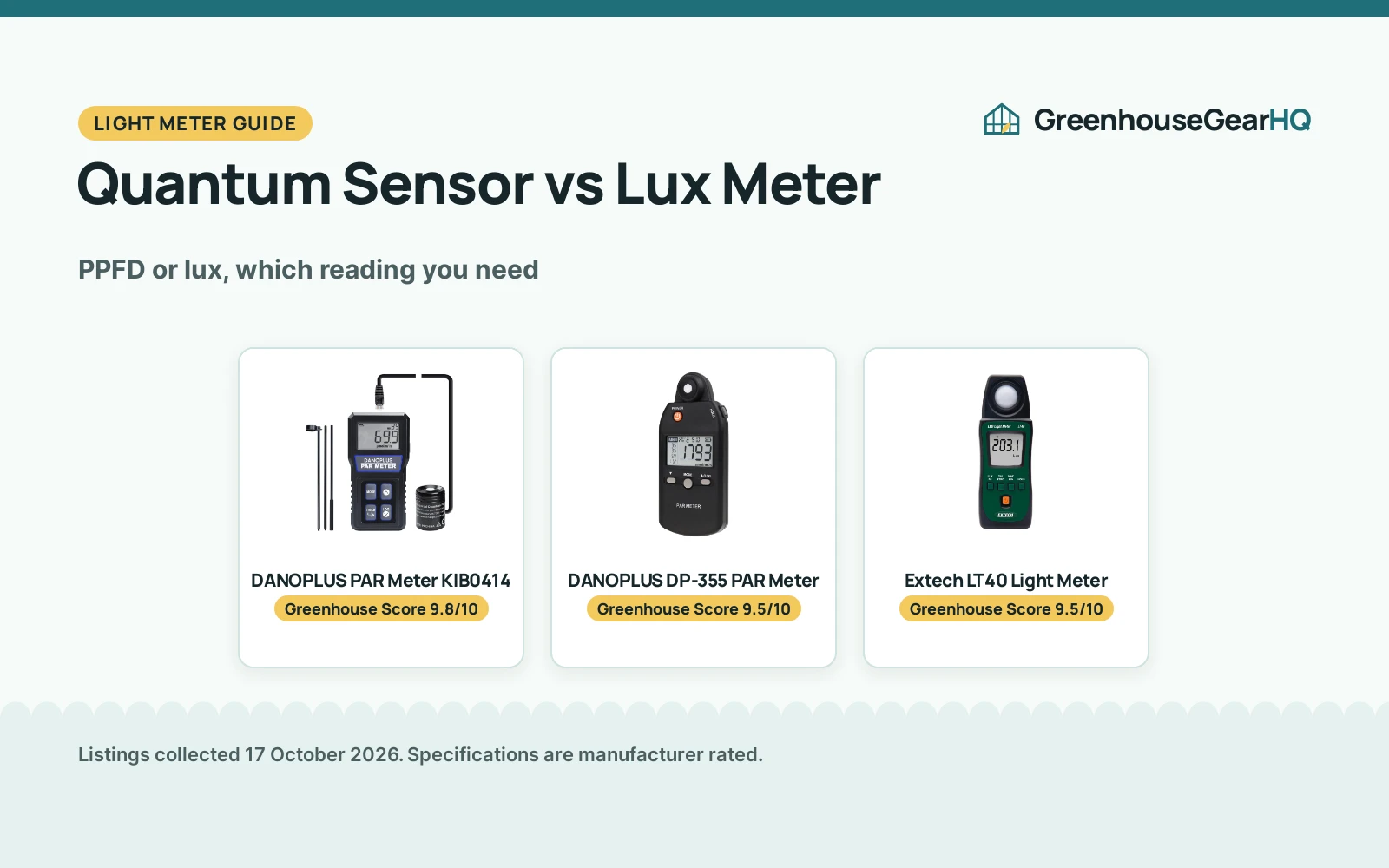
The DANOPLUS PAR meter is the quantum-sensor example. Its IP68 waterproof quantum sensor measures 0 to 4000 μmol/m²/sec, with a cut-on wavelength of 400 nm and cut-off of 700 nm (±10 nm). It records up to 100 measured values and includes a 79 inch cable with a 37 inch solid telescopic pole. Real-time measurement, calibration, HOLD and data logging are stated. Note the fine print: the main unit is not waterproof, per the listing, and the listing positions it for reef tanks and aquariums rather than greenhouses.
The lux meter side
Two listings sit on the lux-meter side. The DANOPLUS DP-355 measures 0 to 5000 μmol/m²/sec over 400 to 700 nm with ±10 nm tolerance, stores up to 100 values, shows the last four in real time, and has a tripod socket (tripod not included). Its own title calls it a quantum PAR meter, so the naming is unclear; treat it as the listing describes. The Extech LT40 is the clearest lux example: lux and foot-candle for white LED and standard lighting, reading to 400000 lux (40000 Fc) on a 4000-count backlit LCD, with MIN/MAX/avg, data hold and auto power off, running on 2 AAA batteries.
Verdict: which should you pick?
| Meter | Side | Range stated | Waterproof |
|---|---|---|---|
| DANOPLUS PAR Meter KIB0414 | Quantum sensor | 0 to 4000 μmol/m²/sec | IP68 sensor; main unit not waterproof |
| DANOPLUS DP-355 | Lux meter | 0 to 5000 μmol/m²/sec | Not stated |
| Extech LT40 | Lux meter | To 400000 lux (40000 Fc) | Not stated |
Choose the quantum sensor when you manage plant light and want PPFD readings; the waterproof sensor suits wet environments, though the main unit stays dry. Choose a lux meter when you want a quick brightness check: the Extech gives lux and foot-candle in a simple package, while the DP-355 adds logging and a tripod socket. Pair the meter with the right fixtures; see our grow lights with timer picks.
FAQ for growers
What does a quantum sensor measure?
Photosynthetic photon flux density (PPFD) in μmol/m²/sec over the 400 to 700 nm band. The DANOPLUS quantum example states a 0 to 4000 μmol/m²/sec range with ±10 nm tolerance.
What does a lux meter measure?
Illuminance in lux or foot-candles. The Extech LT40 example states readings to 400000 lux (40000 Fc) for white LED and standard lighting.
Can I compare the 4000 μmol range with 400000 lux?
No. They are different units for different things, and none of the listings converts between them. Do not treat one side as better on range; the listings leave that comparison unclear.
Which meter is waterproof?
The DANOPLUS quantum example states an IP68 waterproof sensor, but its main unit is not waterproof, per the listing. The other two listings state no waterproof rating.
Keep reading
See every grow lights guide and all light and heat guides.
More picks: grow lights with timer, grow lights for basil, grow lights for microgreens.