On this page
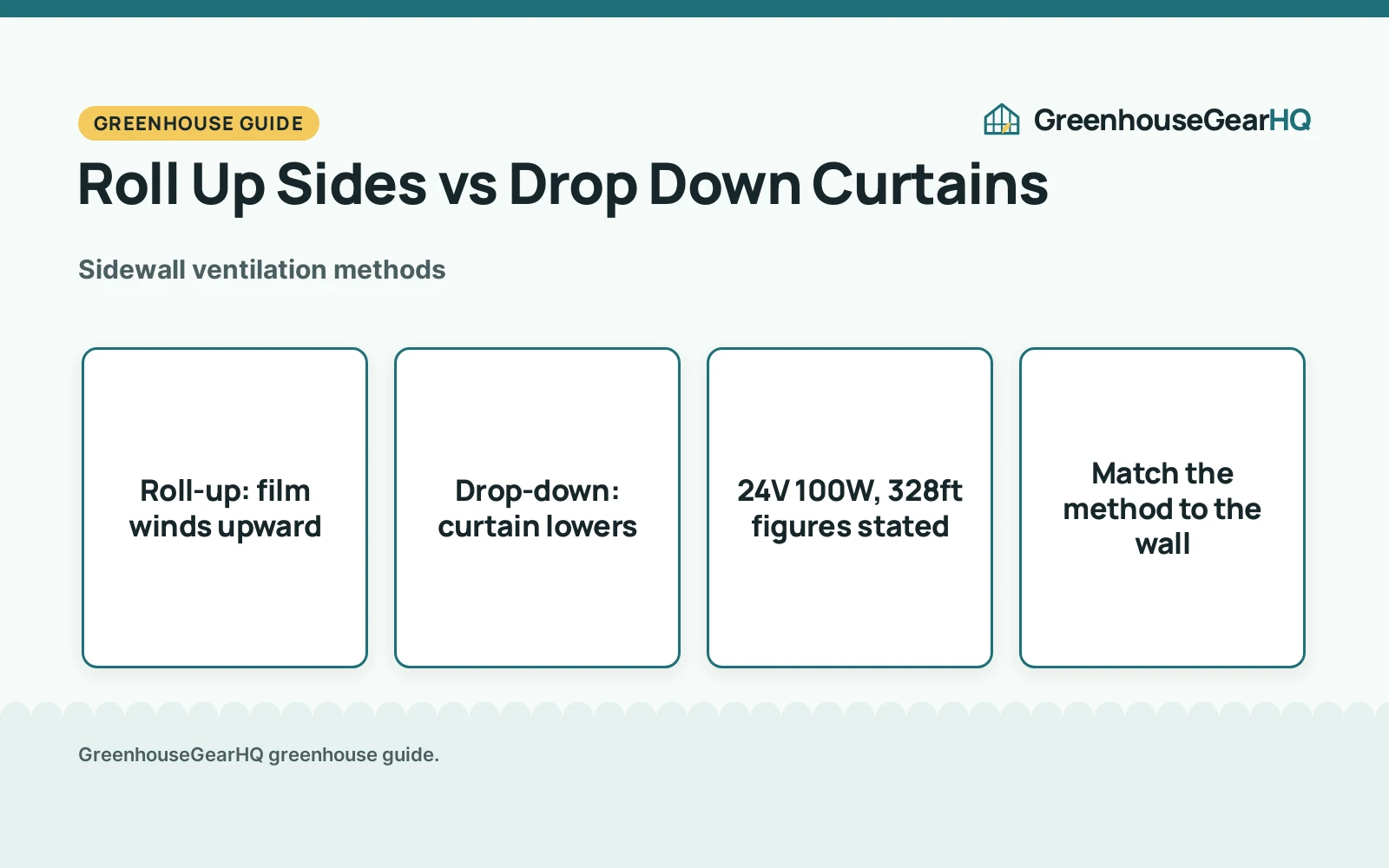
Roll up sides vs drop down curtains: the short answer is that roll-up sides wind the sidewall film upward for maximum ventilation, while drop-down curtains hang from a top rail and lower to close. One opens from the bottom up; the other closes from the top down. The reference listings give concrete figures for roll-up sides; drop-down curtains are explained without figures where none are stated.
GreenhouseGearHQ earns a commission when you buy through links on this page, at no extra cost to you. As an Amazon Associate I earn from qualifying purchases. Affiliate disclosure.
Roll up sides vs drop down curtains: how they differ
Both ventilate the sidewalls of a tunnel or greenhouse, but they move in opposite directions. A roll-up side attaches the bottom of the film to a rolling tube; turning the tube winds the film upward, opening the wall from the bottom. A drop-down curtain hangs from the top of the wall and unrolls or lowers downward to close it. The direction decides how the air moves and what hangs in the way.
Roll-up sides: wind the wall film upward
Roll-up sides are the workhorse of high tunnel ventilation. The film bottom edge attaches to a rolling tube, and a crank or motor winds the tube to raise the wall. The PREMILITY listing describes a DC 24V 100W roll-up motor kit for sidewall and roof ventilation that supports up to 100 meters of film length and a maximum height of 4 meters, weighing 8.9 lbs. For manual setups, the Mefape listing describes a hand crank roll-up unit with a 4:1 gear ratio that rolls film up or down for up to 328ft in length, with a built-in self-locking device and chrome alloy steel components. Roll-up sides open the wall fully from the bottom, giving the biggest air exchange on hot days.
Choose roll-up sides when ventilation is the priority, when you want the wall to open fully, and when you will automate with a motor.
Drop-down curtains: hang and lower
Drop-down curtains work like a window blind in reverse. The curtain hangs from the top rail of the sidewall; lowering it closes the wall, raising it opens it. They suit shade cloth and insect screen as well as film, since the curtain can hang free without a rolling tube pressing on it. Drop-down curtains give fine control over partial openings and keep the mechanism simple at the top. No drop-down curtain listings appear in this data set, so check each listing for the curtain material and the rail it needs.
Choose drop-down curtains when you want simple partial ventilation, when the sidewall carries shade cloth or insect screen, and when a top-hung mechanism suits the frame.
Which one should you buy?
| Method | Motion | Example figure | Suits |
|---|---|---|---|
| Roll-up sides | Film winds upward | 24V 100W motor, 100 meters | Maximum ventilation, automation |
| Roll-up sides | Film winds upward | Manual crank, 4:1, 328ft | Budget manual setups |
| Drop-down curtains | Curtain lowers from top | Not stated | Shade cloth, fine control |
Match the method to the wall. Full ventilation and automation lean roll-up: see our budget greenhouses for kit examples. Shade cloth and simple partial openings lean drop-down; browse every walk-in greenhouse guide for more.
FAQ for growers
How much film can a roll-up motor handle?
The PREMILITY 24V 100W motor listing states it supports up to 100 meters of film length and a maximum height of 4 meters, and the unit weighs 8.9 lbs.
How far can a manual crank roll?
The Mefape hand crank roll-up listing states a 4:1 gear ratio and film lengths up to 328ft, with a self-locking device to stop the rolling where you want.
Which vents better on hot days?
Roll-up sides: the wall opens fully from the bottom, giving the largest air exchange. Drop-down curtains open from the top down and give finer partial control.
Can drop-down curtains use shade cloth?
Yes. Drop-down curtains hang free from a top rail, which suits shade cloth and insect screen as well as film; no curtain listings appear in this data set, so check the material per listing.
Keep reading
See every walk-in greenhouse guide and all greenhouse guides.
More picks: budget greenhouses, greenhouse plastic for cold climates, greenhouse fans.