On this page
Top picks at a glance
As an Amazon Associate I earn from qualifying purchases.
- 1
 OUTPRIZE Remote Control RV Roof Vent Fan with Rain Shield9.7/10View on Amazon
- 2
 RDUIGT 4 Inch Turbine Roof Vent Stainless Steel TurbineView on Amazon
- 3
 8in Roof Vent Cap Attic FanView on Amazon
- 4
 YLFFFZZZ 12in Wind Turbine Roof Vent CapView on Amazon
- 5
 ROOFIVENT IVENT ROTO Roof Turbine Roof Vent 6" Oblong HeadView on Amazon
- 6
 ROOFIVENT IVENT ROTO Roof Turbine Roof Vent 6" Round HeadView on Amazon
- 7
 ROOFIVENT IVENT ROTO Roof Turbine Roof Vent 4" Oblong HeadView on Amazon
On a hot July afternoon the shed roof turns into a radiator, and the air inside the attic or the shed goes stale and damp. Roof turbine vent vs attic fan is the choice between a wind-driven spinner that needs no power and a powered fan that moves air on still days. This guide explains how each one works, what the turbine vent listings state about sizes and materials, and when a powered fan fits instead.
Other options worth a look
 RDUIGT 4 Inch Turbine Roof Vent Stainless Steel TurbineCheck price on Amazon
 8in Roof Vent Cap Attic FanCheck price on Amazon
 YLFFFZZZ 12in Wind Turbine Roof Vent CapCheck price on Amazon
 ROOFIVENT IVENT ROTO Roof Turbine Roof Vent 6" Oblong HeadCheck price on Amazon
 ROOFIVENT IVENT ROTO Roof Turbine Roof Vent 6" Round HeadCheck price on Amazon
 ROOFIVENT IVENT ROTO Roof Turbine Roof Vent 4" Oblong HeadCheck price on Amazon
GreenhouseGearHQ earns a commission when you buy through links on this page, at no extra cost to you. As an Amazon Associate I earn from qualifying purchases. Affiliate disclosure.
What a roof turbine vent is
A roof turbine vent is a spinning cap that sits on the roof and exhausts hot air and moisture from the space below. Wind turns the turbine, and the PATIKIL listing states its vent also uses the temperature difference between indoor and outdoor air to create convection, driving the turbine to rotate. The Tandefio listing states its 12 inch vent is wind driven with power free operation and low noise rotation, and the DioOnes listing states its 7.9 inch vent harnesses wind power to exhaust hot air and moisture without requiring electricity. A turbine vent runs on wind, so no listing in this guide states a power cord or a motor.
Roof turbine vent vs attic fan: side by side
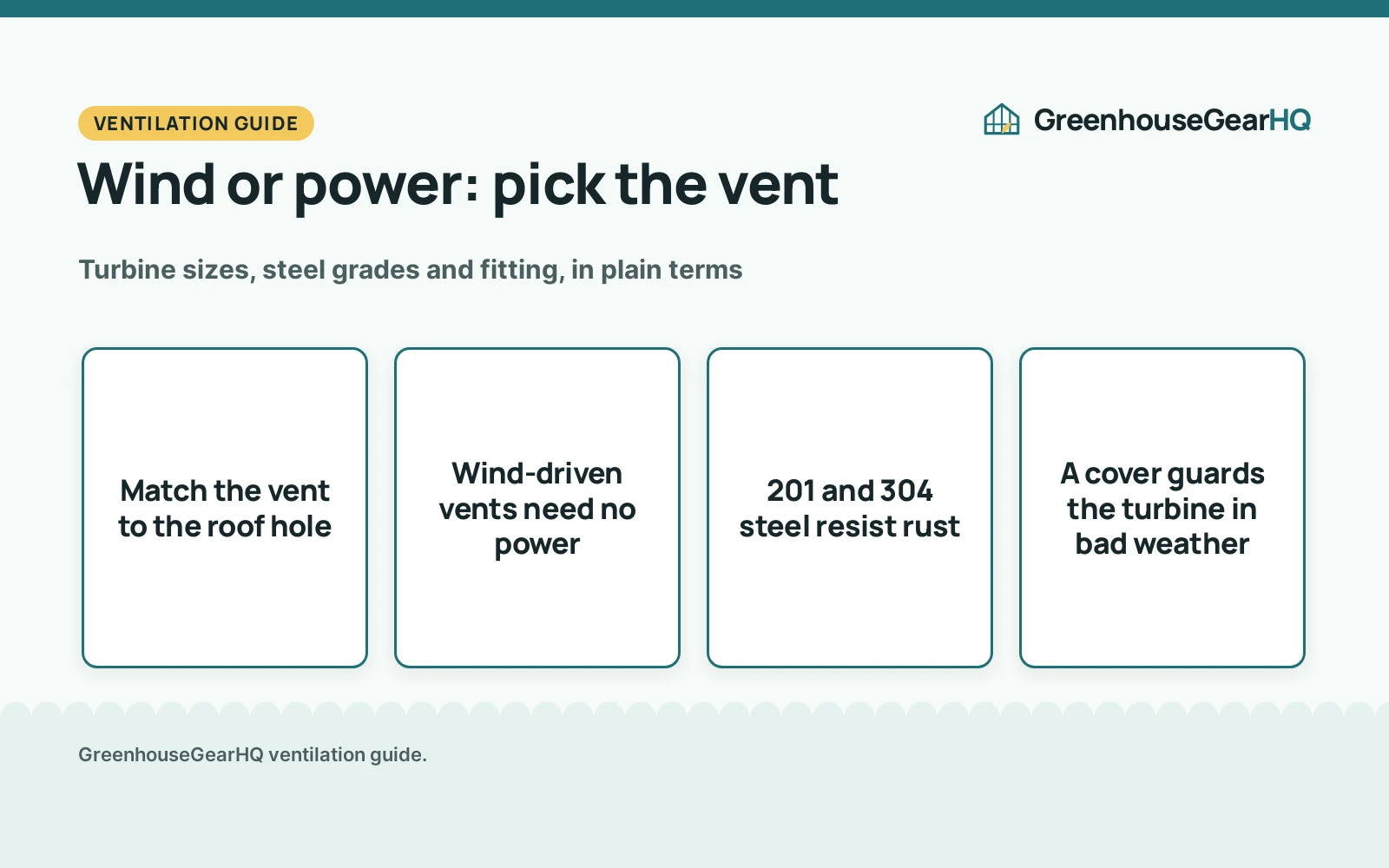
An attic fan is a powered fan that moves air with a motor, so it works on still days when no wind turns a turbine. A turbine vent is wind driven, so it spins when the wind blows and slows when the air is still. The listings in this guide are turbine vents and a turbine vent cover, so the fan side is described from the choice itself, not from a listing. Pick a turbine vent for a roof hole that gets wind, and a powered fan for a space that needs air movement when the wind drops.
| Listing | Stated size | Material | Power |
|---|---|---|---|
| Tandefio turbine roof vent | 12 inch | 201 stainless steel | Wind, no power |
| DioOnes turbine roof vent | 7.9 inch | 304 stainless steel | Wind, no power |
| PATIKIL exhaust cap | 11.8 inch bottom diameter | Stainless steel | Wind and convection, no power |
| Luxiv turbine vent cover | 20D x 20W in | 420D Oxford cloth | Cover, not a vent |
Sizes: match the vent to the roof hole
Measure the roof hole, then match it to the tube or bottom diameter the listing states. The Tandefio listing is designed for 12-inch roof vents, with a tube diameter of about 11.89 inches and a turbine diameter of about 16.54 inches. The DioOnes listing states a 7.9 inch diameter. The PATIKIL listing states a bottom diameter of 300 mm, or 11.8 inch, with a total size of 400 by 400 mm, or 15.75 by 15.75 inch: the title names the 11.8 inch bottom diameter, while the total size is larger, so measure the hole and the cap. The Luxiv cover measures 20D by 20W inches, or 50D by 50W cm, and the listing states it fits most roof covers.
Materials: steel grade and the cover
The listings state the steel grade, and the grades differ. Tandefio states 201 stainless steel with corrosion resistance. DioOnes states 304 grade stainless steel with rust resistance. PATIKIL states stainless steel with corrosion resistance, high strength and heat resistance, without naming a grade. The listings do not compare the grades, so the grade is a fact to check on the listing, not a ranking. The Luxiv cover is 420D Oxford cloth with a silver layer inside, and the listing states it protects the turbine from rain, snow, wind and dust.
Fitting and upkeep
Fit the vent where air moves best, then fasten it firmly to the roof. The PATIKIL listing states to install the vent in a location that allows for optimal airflow, fasten the vent to the roof, and inspect the vent for debris or obstructions. The Tandefio listing states its vent fits a standard roof vent hole. The DioOnes listing states easy installation. The Luxiv cover has an adjustable drawstring at the bottom, and the listing states it is easy to install and remove and keeps the cover from blowing away in the wind.
FAQ for growers
Does a roof turbine vent need power?
No. The Tandefio listing states power free operation, the DioOnes listing states its vent exhausts hot air and moisture without requiring electricity, and the PATIKIL listing states its vent requires no external power source. A turbine vent runs on wind, so it spins when the wind blows and slows when the air is still.
What size turbine vent fits a 12 inch roof hole?
The Tandefio listing is designed for 12-inch roof vents, with a tube diameter of about 11.89 inches and a turbine diameter of about 16.54 inches. Measure the roof hole and match it to the tube diameter the listing states.
What is the difference between 201 and 304 stainless steel?
The listings state the grade but do not compare them. Tandefio states 201 stainless steel with corrosion resistance, and DioOnes states 304 grade stainless steel with rust resistance. Check the grade on the listing for the vent you buy.
Do I need a cover for a turbine vent?
A cover guards the turbine in bad weather. The Luxiv listing states a 2 pack of covers in 420D Oxford cloth, sized 20D by 20W inches, with an adjustable drawstring at the bottom. It states the cover protects the turbine from rain, snow, wind and dust.
Keep reading
See every backyard structures guide and all storage sheds guides.
More picks: greenhouse fans, small vent fans for sheds, ceiling fans for sheds and greenhouse fan guides.