On this page
Top picks at a glance
As an Amazon Associate I earn from qualifying purchases.
- 1
 Gardzen 5-Set Seed Starter Tray Kits9.7/10View on Amazon
- 2
 Burpee SuperSeed 16 XL Cell Reusable Seed Starting Tray9.7/10View on Amazon
- 3
 Organic Mechanics Seed Starting Potting Soil Blend9.7/10View on Amazon
On a cold morning in late winter, seed packets pile up on the bench while the ground outside stays frozen, and a seed starting chart turns that pile into a plan. A seed starting chart is a table that lists each crop with when to sow it indoors, read by finding the crop row and counting back from the last frost date. This guide explains how to read a chart, how to use it with trays, lights and heat, and what to do when the chart and the seed packet disagree.
GreenhouseGearHQ earns a commission when you buy through links on this page, at no extra cost to you. As an Amazon Associate I earn from qualifying purchases. Affiliate disclosure.
What a seed starting chart shows
A seed starting chart is a grid with crops down the side and timing across the top. Each row names a crop, and the columns show when to sow it indoors, when to move it outside, and how long it takes to sprout. The chart gathers the timing that each seed packet states on its own, so a grower can see the whole season at a glance instead of reading packet after packet. Charts differ in detail: some show a sowing window, some show a transplant window, and some add notes on light and heat. The shape varies, but the reading stays the same: find the crop, read across the row, and work back from the last frost date.
- Sow indoors: when to sow the crop under cover, counted back from the last frost date.
- Transplant: when to move seedlings outside, after the last frost date.
- Days to sprout: how long germination takes, as the seed packet states it.
- Notes: light, heat and spacing hints for the crop.
How to use a seed starting chart, step by step
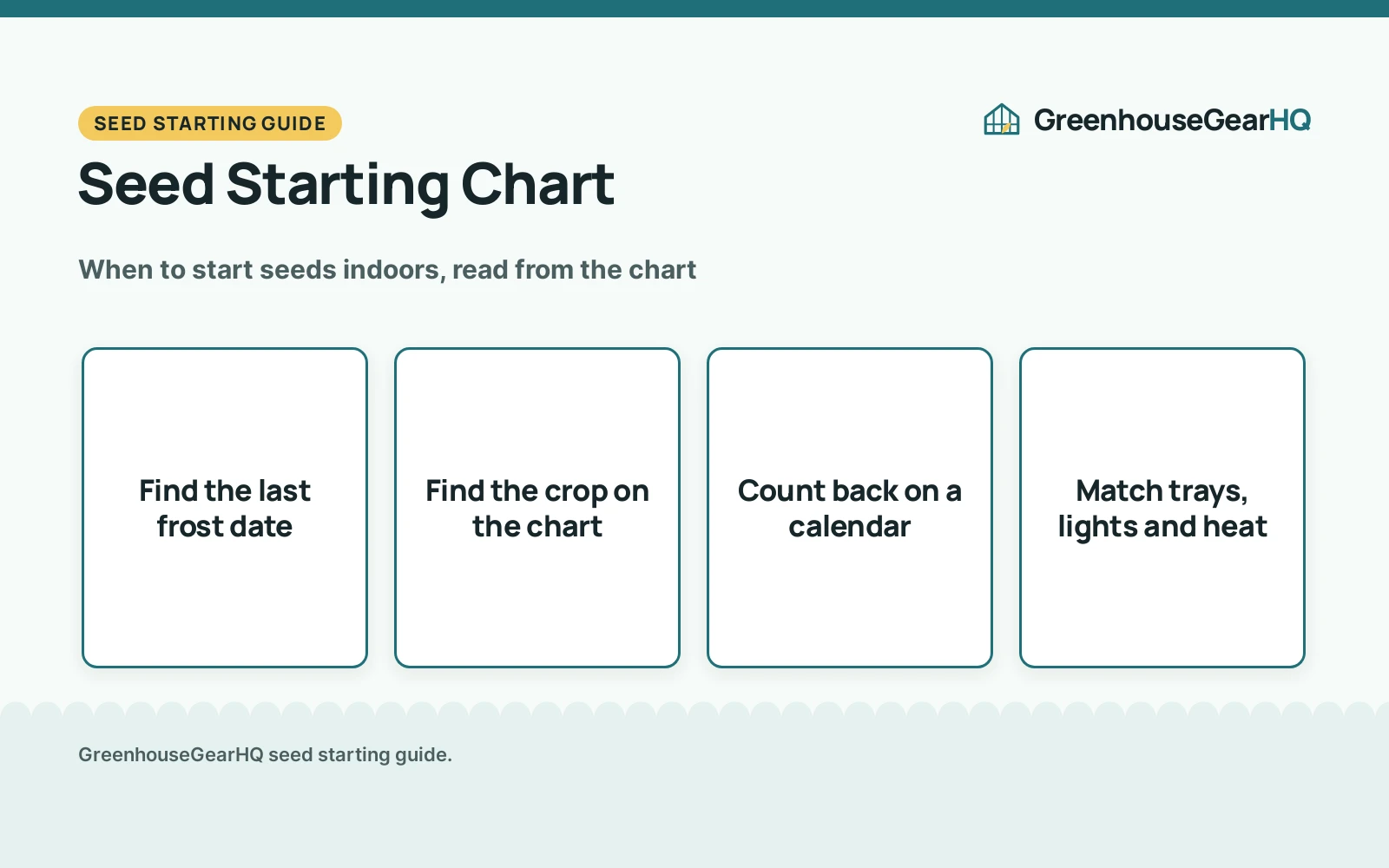
Find the last frost date for the area
Every date on a chart hangs on the last frost date, so find that date before reading any row. The local extension office lists frost dates for the area, and seed catalogues often print a regional chart with the date marked. A chart made for another region will mislead, because its frost date belongs to a different climate, so use a chart that matches the area or adjust the reading to the local date. When no local date is at hand, the extension office is the place to ask.
Find the crop on the chart
With the frost date in hand, find the crop row and read across it. Crops are usually grouped by family or by season, so a missing crop may sit under a group name rather than its own row. When a crop is missing from the chart entirely, the seed packet is the fallback: it states the sowing timing for that crop, and the chart is only a summary of packet timings. Mark the rows that matter for the season ahead, and leave the rest for later.
Count back from the frost date
Take the lead time from the crop row and count back from the last frost date on a calendar. The count lands on the sowing day for that crop, and repeating the count for each row builds the sowing calendar for the season. Write the dates on the calendar as they come up, and work through the rows in sowing order so early crops go in before late ones. When a row gives a range rather than a set day, the early end suits a warm shelf under lights, and the late end suits a cool windowsill.
Match trays, lights and heat to the chart
A chart only helps when the gear matches the plan. The Bonviee kit lists 5 trays with 60 cells in total, 12 cells per tray, a 12-LED light per tray and 10 labels, in a size of 5.5 x 7.25 x 4.4 inches, and the listing notes that the compact size fits windowsills, grow tents and small indoor spaces. That shape suits a chart with many small sowings, because each tray holds 12 cells under its own light. Label every tray as it is sown, since seedlings of different crops look alike at the sprout stage, and the labels keep the chart and the bench in step. The seed starting trays guide compares more trays for larger sowings, and the seedling heat mat picks cover heat for crops that want warmth from below.
| Chart column | What it tells | Where the figure comes from |
|---|---|---|
| Sow indoors | When to sow under cover | Seed packet timing |
| Transplant | When to move seedlings outside | Last frost date |
| Days to sprout | How long germination takes | Seed packet timing |
| Notes | Light, heat and spacing hints | Packet and chart notes |
When the chart and the packet disagree
Charts are summaries, and packets are specific, so trust the packet when they disagree. A chart may group crops that share a season, while the packet gives the timing for the exact variety in hand, and the variety is what grows on the bench. The same rule holds for trays and lights: when a listing states a size or a cell count, that figure rules over any general advice. When the packet and the chart agree, the sowing date is settled, and the chart can go back on the wall until the next crop comes up.
What this guide does not cover
This guide gives no frost dates and no sowing dates, because those belong to the area and the crop, and the chart and the packet hold them. It gives no germination temperatures or light hours either, because those differ by crop and by light, and the packet and the light manual state them. For dates that fit a particular area, check the local extension office. This guide also does not cover fertilizer or pest products; follow the product label.
FAQ for growers
What is a seed starting chart?
A seed starting chart is a table that lists each crop with when to sow it indoors, read by finding the crop row and counting back from the last frost date.
How is a seed starting chart used?
Find the last frost date for the area, find the crop row on the chart, and count back from the frost date on a calendar. The count lands on the sowing day for that crop.
What if a crop is not on the chart?
Use the seed packet. It states the sowing timing for that crop, and the chart is only a summary of packet timings.
Do seeds started indoors need grow lights?
Many do, because windowsill light is weak in late winter. The Bonviee kit lists a 12-LED light per tray, and the grow lights for seedlings guide compares more lights for indoor sowings.
Keep reading
See every seed starting guide and all seed starting trays guides.
More picks: browse seed starting trays, seedling heat mats and grow lights for seed starting.