On this page
Top picks at a glance
As an Amazon Associate I earn from qualifying purchases.
- 1
 Burpee Organic Coconut Coir Seed Starting Mix9.6/10View on Amazon
- 2
 Back to the Roots Organic Coir9.6/10View on Amazon
- 3
 SunGro Horticulture Seedling Mix9.5/10View on Amazon
- 4
 Vermiculite for PlantsView on Amazon
- 5
 Verdana Coco Coir Potting Soil BrickView on Amazon
- 6
 Vermont Compost Company Fort Vee Organic Potting MixView on Amazon
- 7
 MAQIHAN 14OZ Vermiculite for PlantsView on Amazon
- 8
 Fort VeeView on Amazon
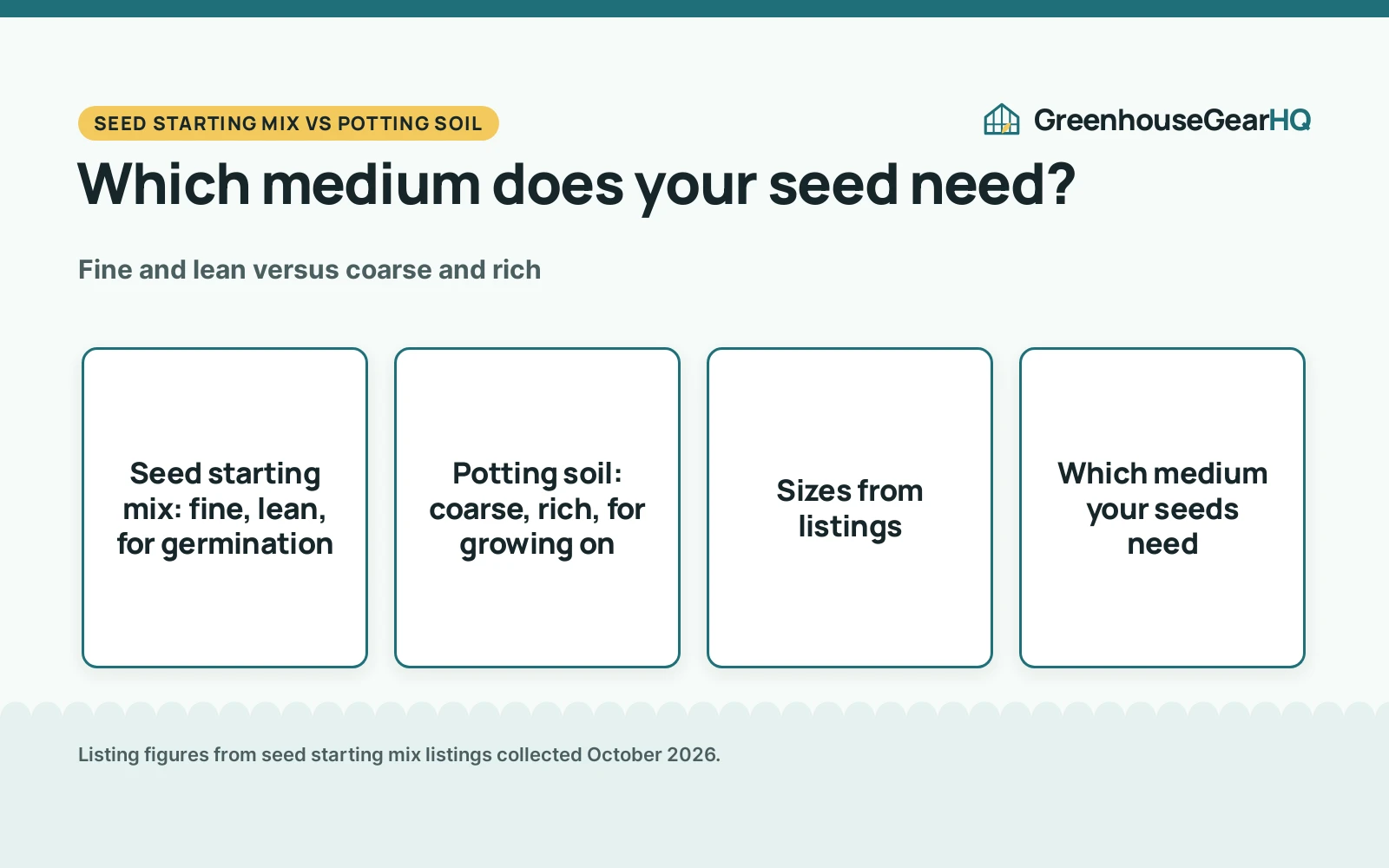
Seed starting mix vs potting soil is the choice between a fine, low-nutrient medium for germination and a richer, chunkier medium for growing on. Seed starting mix gives seeds a light, airy home to sprout in: fine texture, little fertilizer, fast drainage. Potting soil is for transplanting up: coarser, richer, built to feed a growing plant. Start seeds in mix; move seedlings to potting soil when they have true leaves.
Other options worth a look
 Burpee Organic Coconut Coir Seed Starting MixCheck price on Amazon
 Vermiculite for PlantsCheck price on Amazon
 Verdana Coco Coir Potting Soil BrickCheck price on Amazon
 Vermont Compost Company Fort Vee Organic Potting MixCheck price on Amazon
 MAQIHAN 14OZ Vermiculite for PlantsCheck price on Amazon
 Fort VeeCheck price on Amazon
GreenhouseGearHQ earns a commission when you buy through links on this page, at no extra cost to you. As an Amazon Associate I earn from qualifying purchases. Affiliate disclosure.
What seed starting mix is
Seed starting mix is a fine-textured, low-nutrient blend designed for germination. The listings we compared show the range: Burpee’s organic coconut coir expands to 16 quarts; Espoma sells an 8-quart pack of 2 and a 16-quart bag with mycorrhizae; Midwest Hearth offers 4 and 8 dry quart bags of peat moss, perlite and vermiculite; Back to the Roots sells a compressed block that expands to 12 quarts; Coast of Maine offers an 8-quart mycorrhizae-enhanced blend; Legigo sells 50 coco coir pellets at 30mm; Mosser Lee sells 244 cubic inch (4L); Doter offers a 1-quart starter.
Fine texture
Mix is fine because seeds are small. A coarse chunk can block a sprout or hold it too wet. The coir pellets, peat and perlite blends all share this fine, open structure.
Low nutrients
Seeds carry their own food for the first days; rich fertilizer can burn a new root. Starting mixes stay lean on purpose, so germination is safe and roots chase water instead of salts.
What potting soil is
Potting soil is a coarser, nutrient-richer blend meant for growing plants, not germinating seeds. No potting soil listings were in the reference set, so the sizes below are general practice, not listing figures.
Coarser and richer
Potting soil has larger particles and real fertilizer: compost, bark, slow-release feed. A seedling with true leaves is ready for that food; a fresh seed is not.
Built for containers
Potting soil holds its structure for months in a pot. It is the medium you transplant into, top up, and reuse with refresh.
Seed starting mix vs potting soil: the differences
Texture
Mix is fine and airy; potting soil is coarse and chunky. Fine texture suits seeds; chunky structure suits roots.
Nutrients
Mix is deliberately lean; potting soil feeds the plant. Starting seeds in rich soil risks fertilizer burn; growing seedlings in lean mix starves them.
When to use each
Use mix for sowing and germination, in trays, cells or the 30mm coir pellets. Use potting soil when seedlings have true leaves and move to larger pots. One follows the other, not one instead of the other.
Cost and quantity
Mix comes in smaller bags for trays: 1 quart, 4 dry quarts, 8 quarts, up to 16 quarts. Potting soil comes in bigger bags for pots. Buy mix for the seed trays, soil for the transplanting.
Which one should you buy?
Buy seed starting mix if you are sowing seeds indoors or in a greenhouse. The 16-quart bags and the 12-quart compressed block cover a full tray season; the 30mm pellets suit single seeds.
Buy potting soil if your seedlings are ready to move up, or if you are planting directly into containers. Skip the mix for that job: seedlings need the food.
Most growers buy both: mix for the trays in spring, potting soil for the pots after. See our seed starting guides for the trays and domes to pair with them.
In the Greenhouse
- Sow seeds in mix, not in rich potting soil.
- Transplant up to potting soil at true-leaf stage.
- Keep mix evenly moist, never soggy.
- Label every tray; mixes look alike.
FAQ for growers
Can I start seeds in potting soil?
You can, but germination is poorer: the texture is coarse and the nutrients can burn new roots.
Can I grow seedlings to maturity in seed starting mix?
No. Mix is lean by design; seedlings need the food in potting soil once they have true leaves.
How much seed starting mix do I need?
A tray season runs on 8 to 16 quarts: the listings show 8-quart bags, 16-quart bags and a 12-quart compressed block.
What are coir pellets for?
Single seeds: the 30mm compressed pellets expand into a tiny pot, one seed each, and transplant whole.
Do I need both?
Most growers keep both: mix for sowing, potting soil for transplanting up.
Keep reading
See every seed starting guide, including seed starting trays and humidity domes.
More picks: seed starting trays and humidity domes.