On this page
Top picks at a glance
As an Amazon Associate I earn from qualifying purchases.
- 1
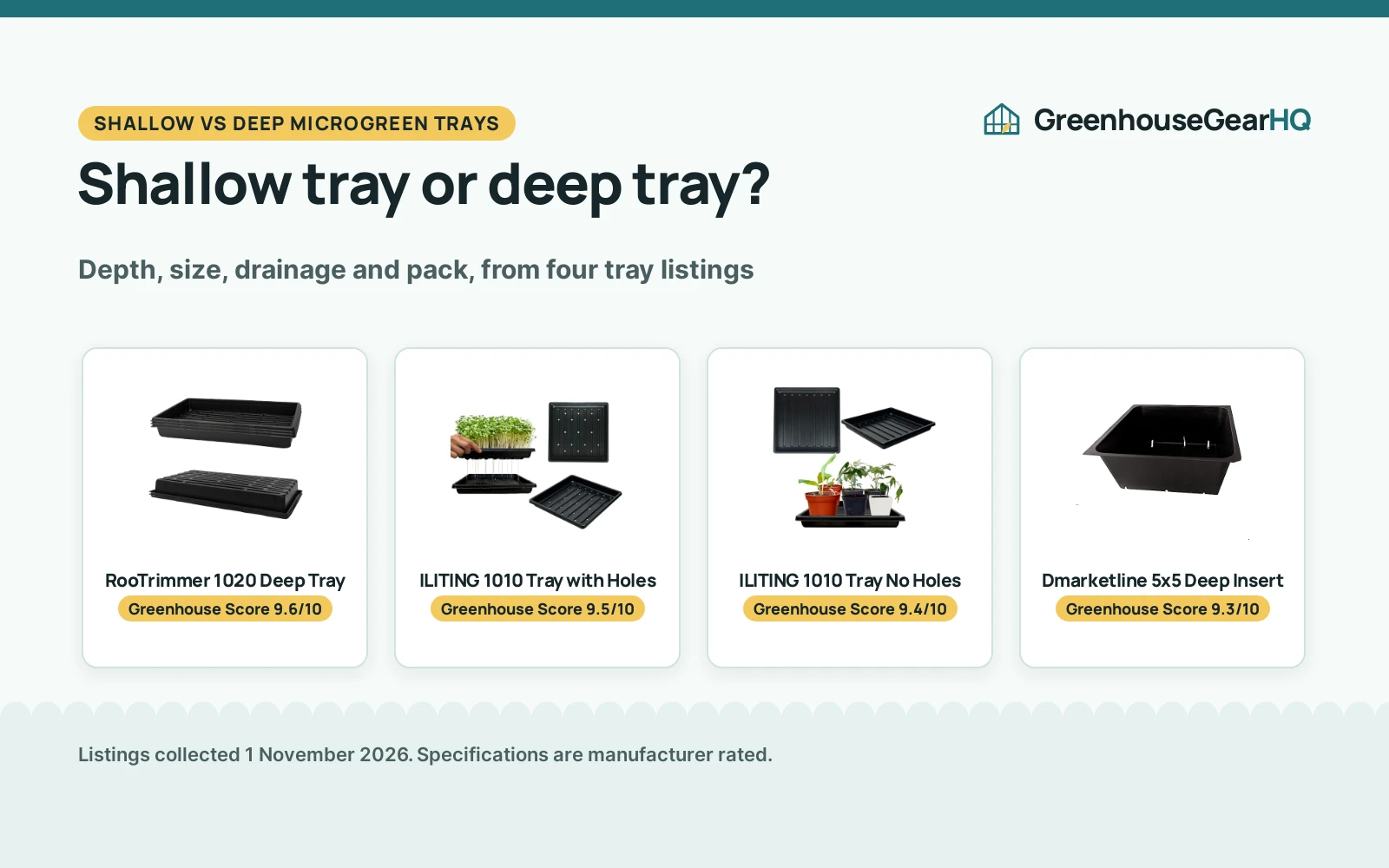
 RooTrimmer 1020 Deep Tray9.6/10View on Amazon
- 2
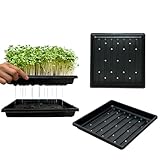 ILITING 1010 Tray with Holes9.5/10View on Amazon
- 3
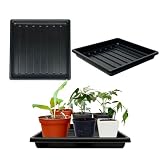 ILITING 1010 Tray No Holes9.4/10View on Amazon
- 4
 Dmarketline 5x5 Deep Insert9.3/10View on Amazon
When seed trays go out in late winter, the shallow vs deep microgreen trays choice decides how much soil each tray holds and how the grower waters. A shallow tray saves soil for shallow-rooted greens, while a deep tray gives roots more depth. This comparison shows where each depth fits.
GreenhouseGearHQ earns a commission when you buy through links on this page, at no extra cost to you. As an Amazon Associate I earn from qualifying purchases. Affiliate disclosure.
Quick verdict: choose shallow for wheatgrass and shallow-rooted greens in a small space, saving soil, with the ILITING 1010 trays at 1.3 inches deep. Choose deep for a larger tray or a small insert with more depth: the RooTrimmer 1020 tray at 2.52 inches deep, or the Dmarketline insert at 2 inches deep.
The four examples
| # | Product | Greenhouse Score | Buy |
|---|---|---|---|
| 1 | RooTrimmer 1020 Deep Tray | 9.6/10 | Buy on Amazon |
| 2 | ILITING 1010 Tray with Holes | 9.5/10 | Buy on Amazon |
| 3 | ILITING 1010 Tray No Holes | 9.4/10 | Buy on Amazon |
| 4 | Dmarketline 5x5 Deep Insert | 9.3/10 | Buy on Amazon |

RooTrimmer 1020 Deep Tray
A deep 1020 tray at 2.52 inches deep with no holes, in BPA free PS at 1.8mm thickness, for growers who want a large soil volume for microgreens and seed starting.
Pros
- 2.52 inches deep, deeper than the 1.3-inch shallow examples
- 21.6 x 11.2 inches, holds standard 10 x 20 plug trays
- BPA free PS, 1.8mm thickness, resisting twisting and bending
- No drainage holes, for use as a microgreens growing tray
Cons
- No holes, so growers who want drainage must choose a different tray
- No warranty term is stated

ILITING 1010 Tray with Holes
A shallow 1010 tray at 1.3 inches deep with drain holes, for shallow-rooted plants, wheatgrass and seed germination on a balcony or in a greenhouse.
Pros
- 1.3 inches deep, shallower than traditional seedling trays, saving soil
- Drain holes included, so no drilling is needed
- Holds 9 3.5-inch square pots, or small nursery pots
- Thickened material with a strong load-bearing capacity
Cons
- 5 trays in the pack, fewer than the 10-pack no-holes version
- 10.7 x 10.7 inches, smaller than a 1020 footprint
- Listed for shallow-rooted plants only
- No warranty term is stated

ILITING 1010 Tray No Holes
A shallow 1010 tray at 1.3 inches deep with no holes, for use as a drip tray under pots and for shallow-rooted planting on a balcony or in a greenhouse.
Pros
- 1.3 inches deep, shallower than traditional seedling trays, saving soil
- 10 trays in the pack, for a larger set of trays
- No holes, for use as a drip tray under pots
- Holds 9 3.5-inch square pots, or small nursery pots
Cons
- No holes, so it works as a drip tray rather than a draining growing tray
- Listed for shallow-rooted plants only
- No thickness figure is stated
- No warranty term is stated

Dmarketline 5x5 Deep Insert
A small 5 x 5 inch insert at 2 inches deep with drain holes, for garden germination in a greenhouse.
Pros
- 2 inches deep, deeper than the 1.3-inch shallow examples
- Drain holes included
- 20 trays, for a larger set of inserts
- 5 x 5 inches, for small germination inserts
Cons
- No material is stated
- Bullets state shape and mounting only
- Small footprint, so it suits inserts rather than a full 1020 tray
- No warranty term is stated
As an Amazon Associate I earn from qualifying purchases.
Other options worth a look
 ILITING 1020 Trays SetCheck price on Amazon
 Bootstrap Farmer 5 Trays Shallow 1020 Trays No Hole ExtraCheck price on Amazon
 Bootstrap Farmer Microgreen TraysCheck price on Amazon
 Bootstrap Farmer 1010 Microgreen Trays with HolesCheck price on Amazon
 TO Plastics Microgreen Trays NO Holes Heavy Duty Shallow 1020Check price on Amazon
 SUNPACK 10" x 20" Heavy Duty Shallow Plastic Seed StartingCheck price on Amazon
Shallow vs deep microgreen trays: side by side
| Tray | Greenhouse Score | Depth | Size | Holes | Pack | Warranty | Amazon |
|---|---|---|---|---|---|---|---|
| RooTrimmer 1020 Deep Tray | 9.6/10 | 2.52 inches | 21.6 x 11.2 inches | No holes | 5 trays | Not stated | View on Amazon |
| ILITING 1010 Tray with Holes | 9.5/10 | 1.3 inches | 10.7 x 10.7 inches | Drain holes | 5 trays | Not stated | View on Amazon |
| ILITING 1010 Tray No Holes | 9.4/10 | 1.3 inches | 10.7 x 10.7 inches | No holes | 10 trays | Not stated | View on Amazon |
| Dmarketline 5×5 Deep Insert | 9.3/10 | 2 inches | 5 x 5 inches | Drain holes | 20 trays | Not stated |
Each figure is the brand’s own rating, taken from its product page on 1 November 2026.
Depth and soil
Depth is the clearest split in this comparison. The two ILITING examples are 1.3 inches deep, and the listing calls that shallower than traditional seedling trays, saving soil, with roots not easily damaged when transplanting. The RooTrimmer example is 2.52 inches deep and holds a large amount of soil for starting seeds and growing microgreens, while the Dmarketline example is 2 inches deep. A shallow tray suits a thin soil layer for shallow-rooted greens, while deep examples give more vertical room.
The two deep examples are not interchangeable, though: one is a large tray, the other a small insert.
Size and footprint
Footprint separates the four examples as much as depth does. The ILITING examples are 10.7 x 10.7 inch square trays that hold 9 3.5-inch square pots or small nursery pots. The RooTrimmer example is 21.6 x 11.2 inches and holds standard 10 x 20 seedling plug trays. The Dmarketline example is 5 x 5 inches, far smaller than either, and suits a set of small inserts. For more on the two standard sizes, see 1010 vs 1020 seed trays.
Drainage and watering
Drainage cuts across both sides, so it must be checked per tray, not per side. The ILITING with-holes example and the Dmarketline example have drain holes, while the ILITING no-holes example and the RooTrimmer example have none. The no-holes ILITING tray is positioned as a drip tray, while the no-holes RooTrimmer tray is positioned as a microgreens growing tray. A grower who wants water to drain from the growing tray should pick a with-holes example. For drip options, see drip trays for seed trays.
Which should you choose?
Choose a shallow ILITING tray for wheatgrass and shallow-rooted greens, picking the with-holes version for drainage or the no-holes version as a drip tray. Choose the RooTrimmer deep tray for a large 1020 footprint with plug trays. Choose the Dmarketline deep insert for small germination inserts with drainage, accepting its thin listing detail.
In the Greenhouse
- Set the ILITING trays on a balcony or in a greenhouse, where the listing places them.
- Use the no-holes ILITING tray as a drip tray under pots, per its listing.
- Use the RooTrimmer tray for microgreens in a greenhouse, per its listing.
- Check the RooTrimmer 2.52-inch depth against the spec table size before ordering.
Scoring notes
The Greenhouse Score weighs performance, build, value, safety and warranty. For trays, safety means material safety, such as the BPA free PS on the RooTrimmer example. None of the four listings states a warranty term, so all four score zero for warranty. How we pick explains the weights.
| Product | Greenhouse Score | Perf. /35 | Build /25 | Value /25 | Safety /10 | Warranty /5 |
|---|---|---|---|---|---|---|
| RooTrimmer 1020 Deep Tray | 9.6 | 30 | 21 | 21 | 5 | 0 |
| ILITING 1010 Tray with Holes | 9.5 | 29 | 20 | 21 | 0 | 0 |
| ILITING 1010 Tray No Holes | 9.4 | 28 | 20 | 21 | 0 | 0 |
| Dmarketline 5×5 Deep Insert | 9.3 | 23 | 18 | 20 | 0 | 0 |
We rescale the weighted total onto a range that ends at 9.2 and 9.8; nothing in the conversion can reorder two picks.
FAQ for growers
Is a shallow tray better for microgreens?
The shallow ILITING examples list wheatgrass and shallow-rooted plants, while the deep RooTrimmer example is listed as a microgreens growing tray, so neither depth wins for every microgreen.
Do microgreen trays need drain holes?
The ILITING with-holes example and the Dmarketline example have drain holes, while the ILITING no-holes example serves as a drip tray and the RooTrimmer example grows microgreens without holes.
What size tray holds 10 x 20 plug trays?
The RooTrimmer example holds standard 10 x 20 plug trays, while the ILITING examples hold 9 3.5-inch square pots.
Can a deep tray grow wheatgrass?
Wheatgrass is named only on the shallow ILITING listings. The deep examples list microgreens and germination, so a grower set on wheatgrass should start shallow.
Keep reading
See every seed starting tray guide and all seed starting guides.
More picks: microgreen growing trays, grow lights for seed trays, 1010 vs 1020 seed trays and drip trays for seed trays.