On this page
Top picks at a glance
As an Amazon Associate I earn from qualifying purchases.
- 1
 Hurricane 6-Inch Inline Fan with Steel Housing9.7/10View on Amazon
- 2
 iLivingView on Amazon
- 3
 VEVOR 12 Inch Shutter Exhaust Fan Wall Mounted 1347 CFMView on Amazon
- 4
 VEVOR 10'' Exhaust FanView on Amazon
- 5
 VEVOR Shutter Exhaust FanView on Amazon
- 6
 iLIVING 12" Wall Mounted Shutter Exhaust FanView on Amazon
- 7
 KEN BROWN 20 Inch Shutter Exhaust Fan With 1.65 Meters PowerView on Amazon
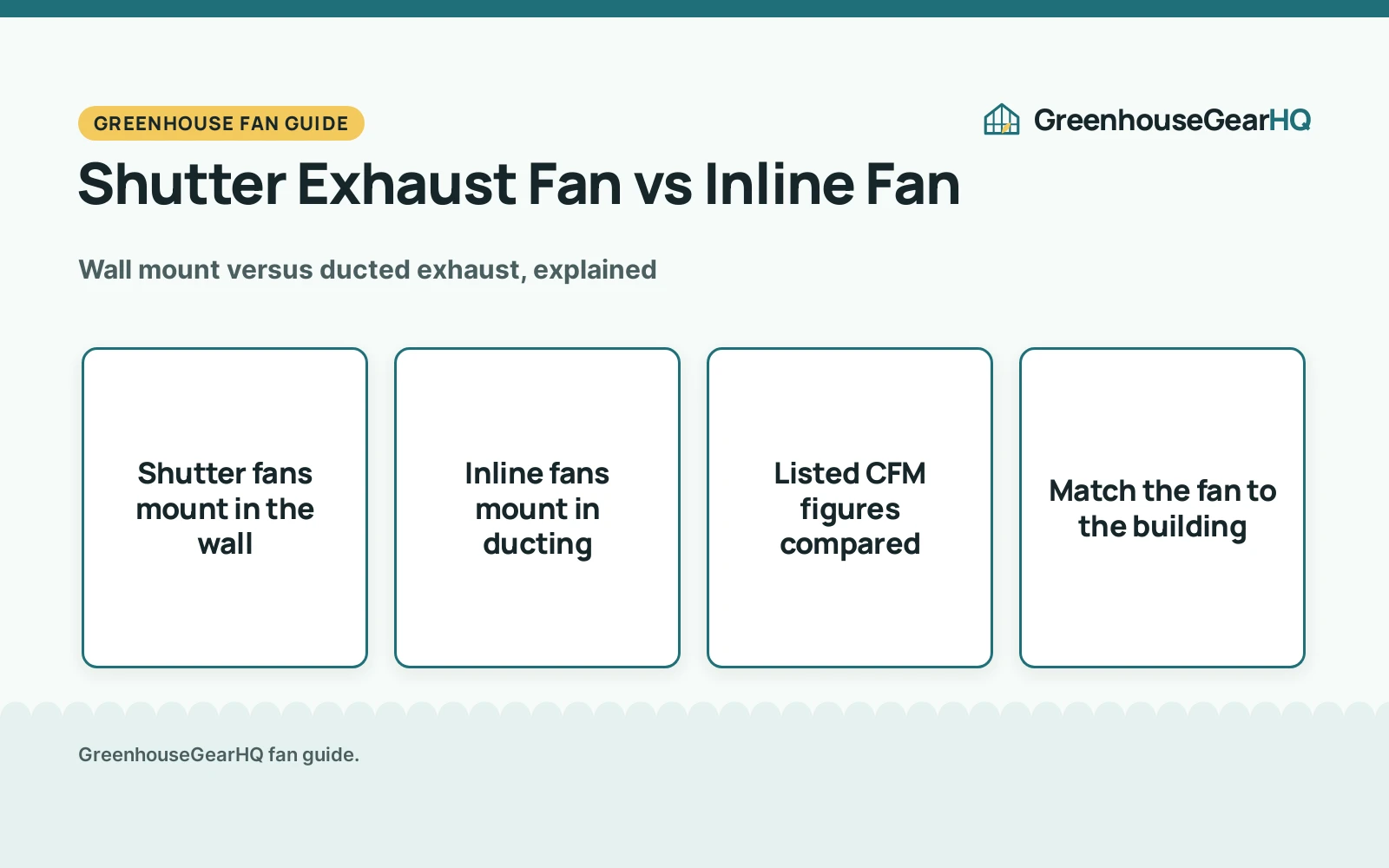
On the first hot afternoon of the season, a greenhouse can climb past comfortable long before the plants show it, and growers start weighing a shutter exhaust fan vs inline fan. The short answer: a shutter exhaust fan mounts in the wall and blows inside air straight outside, with louvers that close when it stops; an inline fan mounts inside a duct run and pushes air through the duct to an outside vent. One is a hole in the wall, the other is a fan in a tube.
Other options worth a look
 iLivingCheck price on Amazon
 VEVOR 12 Inch Shutter Exhaust Fan Wall Mounted 1347 CFMCheck price on Amazon
 VEVOR 10'' Exhaust FanCheck price on Amazon
 VEVOR Shutter Exhaust FanCheck price on Amazon
 iLIVING 12" Wall Mounted Shutter Exhaust FanCheck price on Amazon
 KEN BROWN 20 Inch Shutter Exhaust Fan With 1.65 Meters PowerCheck price on Amazon
GreenhouseGearHQ earns a commission when you buy through links on this page, at no extra cost to you. As an Amazon Associate I earn from qualifying purchases. Affiliate disclosure.
Shutter exhaust fan vs inline fan: what each one does
A shutter exhaust fan sits in a wall or window opening and moves inside air directly to the outside in one step. Its shutters open when the fan runs and close when it stops, which blocks rain and debris. An inline fan sits inside a run of ducting and moves air along the duct to wherever the vent is, so the fan itself does not need to be in the wall. The listings in this guide are all shutter exhaust fans, so the figures below describe that side; the inline side is explained without figures, since no inline listing is in the data.
Shutter exhaust fans: the wall-mounted option
Airflow figures show how much air a shutter fan moves. The VEVOR 24 inch lists 7030 CFM at 1400 rpm, the iLiving 24 inch lists 4244 CFM at 1050 rpm with 24 inch aluminum blades, the VEVOR 12 inch variable-speed model lists 1347 CFM at 1600 rpm, and the VEVOR 10 inch lists 820 CFM at 1650 rpm. The iLiving 12 inch DC model lists 960 CFM and can exchange air in spaces up to 1400 square feet, per its listing.
Controls differ across the listings. Several VEVOR models include a variable speed controller, while the basic VEVOR 10 inch states that a speed control switch and plug are not included and must be wired separately. The iLiving 12 inch DC model lists 12 speeds with temperature control from 50 to 99 degrees F, humidity control and a 24 hour timer. Noise runs from 50 dB on the VEVOR 10 inch variable model to 73 dB on the VEVOR 24 inch. The iLiving 24 inch lists a UL mark and a 1-year parts and components limited warranty; the iLiving 12 inch DC lists an ETL certified motor.
Choose a shutter fan when the greenhouse has a wall or window opening where the fan can sit. Our greenhouse exhaust fans with thermostat roundup compares more wall-mounted exhaust fans.
Inline fans: the ducted option
An inline fan does the same exhaust job through ducting. Because it mounts in the duct run rather than the wall, it suits houses where the exhaust point is far from where the fan can sit, or where ducting already exists. Air travels the duct and leaves through an outside vent, while fresh air enters through vents elsewhere. Both types need a clear intake path on the opposite side of the house to move air well.
Which one should you buy?
| Fan type | Mounting | Air path | Suits |
|---|---|---|---|
| Shutter exhaust fan | Wall or window opening | Straight outside in one step | Simple installs with an open wall |
| Inline fan | Inside a duct run | Through ducting to an outside vent | Ducted layouts and distant vent points |
Match the fan to the building. If the greenhouse has a wall opening where a fan can sit, a shutter exhaust fan is the direct answer, and the listings above give CFM figures from 820 to 7030 to size it. If the exhaust has to travel, through an existing duct or to a far vent, an inline fan fits that layout. Either way, pair the exhaust with inside circulation; see our greenhouse fans with thermostat picks for that side.
FAQ for growers
How much air can a shutter exhaust fan move?
The listings here range from 820 CFM on the VEVOR 10 inch to 4244 CFM on the iLiving 24 inch and 7030 CFM on the VEVOR 24 inch. The iLiving 12 inch DC model lists 960 CFM for spaces up to 1400 square feet.
Do shutter exhaust fans need a speed controller?
It depends on the listing. Several VEVOR models include a variable speed controller, while the basic VEVOR 10 inch states that a speed control switch and plug are not included. The iLiving 12 inch DC model lists 12 speeds with temperature and humidity control built in.
What do the shutters do?
The shutters open when the fan is powered and close when it stops, which the VEVOR listings say helps block rain and small debris. The iLiving 24 inch lists aluminum shutters that resist moisture and heat.
Can an inline fan replace a shutter exhaust fan?
Both move inside air outside; the difference is the air path. A shutter fan exhausts straight through the wall, while an inline fan moves air through ducting to a vent, which suits ducted layouts.
Keep reading
See every greenhouse fans guide and all air and water guides.
More picks: greenhouse exhaust fans with thermostat, small greenhouse exhaust fans, greenhouse fans with thermostat.