On this page
Top picks at a glance
As an Amazon Associate I earn from qualifying purchases.
- 1
 iLIVING Exhaust Fan Thermospeed Temperature and Speed9.6/10View on Amazon
- 2
 AC Infinity AC Fan Speed ControllerView on Amazon
- 3
 MAXXAIR Maxxfan Mini Plus Vent 6"" Single Speed Exhaust FanView on Amazon
- 4
 VIVOSUN Variable Speed Controller Cordless Vent Blower SpeedView on Amazon
- 5
 DIGITEN Variable Speed ControllerView on Amazon
- 6
 Leviton Trimatron Rotary Fan Speed Control SwitchView on Amazon
- 7
 2 Inch Inline Duct Fan with Variable Speed Controller 12v 6wView on Amazon
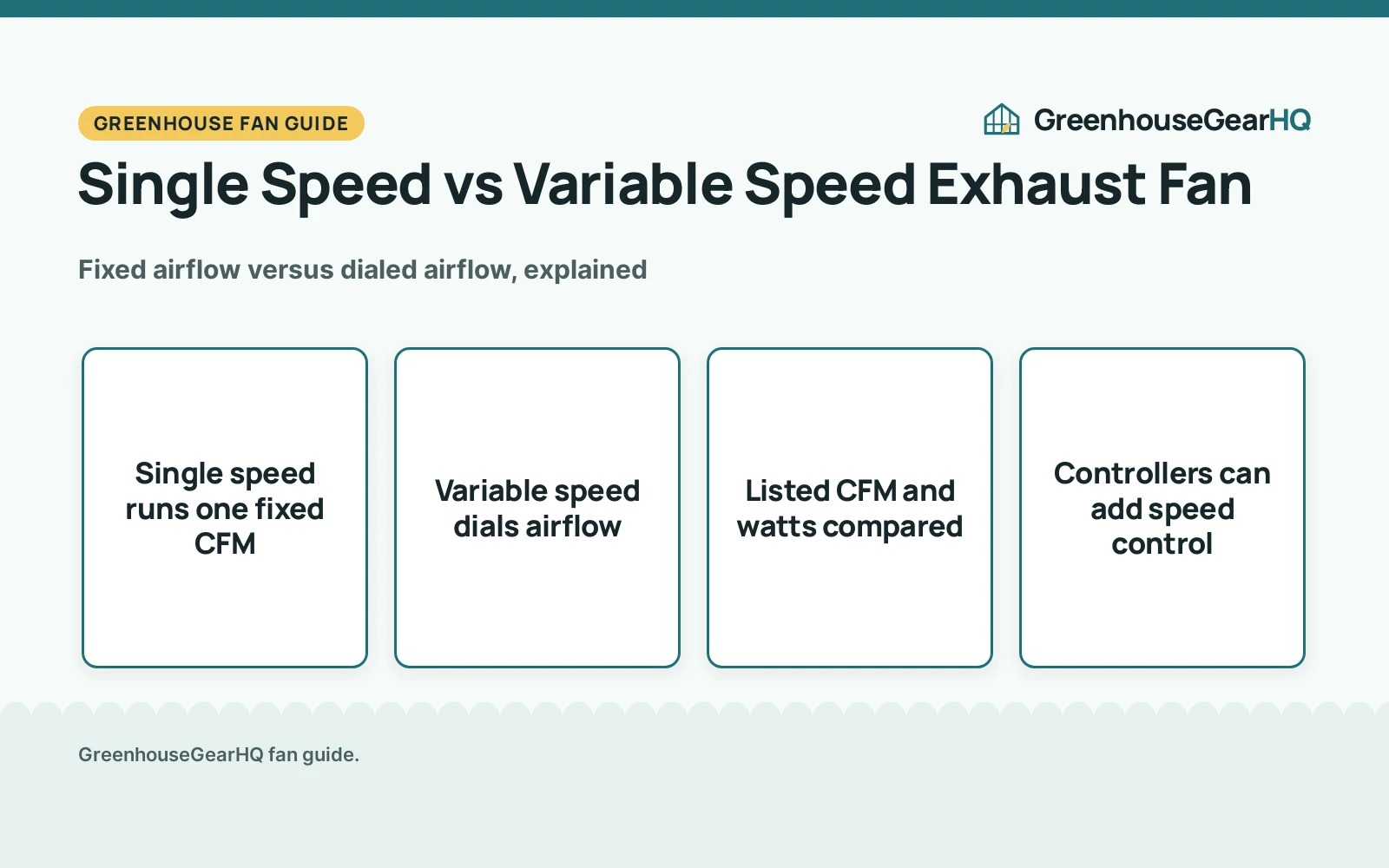
On a mild spring morning, an exhaust fan can clear a greenhouse in minutes, and on a scorching afternoon it may run all day, which is when growers ask about a single speed vs variable speed exhaust fan. The short answer: a single-speed fan runs at one fixed airflow every time it switches on; a variable-speed fan lets you dial the airflow up or down to match the moment. One is simple and predictable, the other is flexible.
Other options worth a look
 AC Infinity AC Fan Speed ControllerCheck price on Amazon
 MAXXAIR Maxxfan Mini Plus Vent 6"" Single Speed Exhaust FanCheck price on Amazon
 VIVOSUN Variable Speed Controller Cordless Vent Blower SpeedCheck price on Amazon
 DIGITEN Variable Speed ControllerCheck price on Amazon
 Leviton Trimatron Rotary Fan Speed Control SwitchCheck price on Amazon
 2 Inch Inline Duct Fan with Variable Speed Controller 12v 6wCheck price on Amazon
GreenhouseGearHQ earns a commission when you buy through links on this page, at no extra cost to you. As an Amazon Associate I earn from qualifying purchases. Affiliate disclosure.
Single speed vs variable speed exhaust fan: what each one does
A single-speed exhaust fan has one airflow figure: when it is on, it moves that much air, and when it is off, it moves none. A variable-speed exhaust fan can run at several levels, so the same fan can push a gentle breeze or full blast. The listings in this guide include both kinds, so the figures below name the brand only where a figure is cited.
Single-speed exhaust fans: one setting
Single-speed listings state one CFM each. The iLiving 30 inch lists 5088 CFM at 825 rpm on 1/3 HP and 3.30 amps, with 7500 square feet of coverage; the iLiving 24 inch corrosion model lists 5448 CFM at 1075 rpm; the iLiving 18 inch corrosion model lists 2616 CFM at 328 watts; the iLiving 12 inch corrosion model lists 900 CFM at 1625 rpm and 146 watts with UL and cUL marks; and the VEVOR 10 inch lists 820 CFM at 1650 rpm and 45 watts with a 50 dB noise level.
Single speed does not mean dumb control. The iLiving 14 inch gable model is single speed at 2339 CFM and 1010 rpm, but it lists a built-in adjustable thermostat and cools up to 3400 square feet of attic space, so it switches its one speed on and off by temperature. The iLiving 12 inch corrosion model lists a 1-year parts and components limited warranty; the 18 inch lists 90 days.
Choose single speed when the job is binary: the house needs full exhaust or none. It is the simplest wiring, and the listings show the range clearly, from 820 to 5448 CFM here. See our greenhouse exhaust fans with thermostat roundup for single-speed picks with temperature control.
Variable-speed exhaust fans: dialed airflow
Variable-speed listings let the airflow move. The VEVOR 10 inch variable model lists 900 CFM at 1650 rpm and 45 watts with a stepless variable-speed controller included. The Vornado TRANSOM window fan lists 4 speed settings with a reversible exhaust mode, 25 watts, 45 dB and a 5 year manufacturer warranty. The Panasonic WhisperValue is a dual-speed bath fan with customizable airflow from 30 to 100 CFM: it runs continuously at a preset lower level in 10 CFM increments, then rises to 80 or 100 CFM, at 12.4 watts, 0.8 sones and Energy Star certification.
Speed can also be added. The AC Infinity listing is a speed controller for 100 to 125V AC axial fans up to 50W, designed to adjust speed to optimize airflow and noise. The basic VEVOR 10 inch, by contrast, states that no speed control switch or plug is included and both must be purchased and wired separately.
Choose variable speed when noise or power matters at part load: a fan on low moves less air and makes less noise, which suits shoulder seasons and night hours. Our greenhouse fans with thermostat picks include more multi-speed models.
Which one should you buy?
| Fan type | Airflow | Control | Suits |
|---|---|---|---|
| Single speed | One listed CFM | On or off, often by thermostat | Simple full-exhaust jobs |
| Variable speed | Dialed up or down | Speed settings or controller | Noise control and shoulder seasons |
Match the fan to how the house runs. If the exhaust is either needed at full power or not at all, a single-speed fan with a thermostat, like the iLiving gable model at 2339 CFM, is the straightforward pick. If the fan runs long hours and full blast is overkill half the time, variable speed earns its keep in lower noise and lower draw. Either way, size the CFM to the space first; the listings here run from 820 to 5448 CFM.
FAQ for growers
How much power does a single-speed exhaust fan use?
The listings here range from 45 watts on the VEVOR 10 inch to 146 watts on the iLiving 12 inch corrosion model, 328 watts on the 18 inch, and 600 watts on the 24 inch. Bigger single-speed fans draw more at their one setting.
Can I add variable speed to a single-speed fan?
Sometimes. The AC Infinity listing is a speed controller for 100 to 125V AC axial fans up to 50W. The basic VEVOR 10 inch states that no speed control switch is included and one must be purchased separately, so check the listing before assuming.
Do variable-speed fans run quieter?
They can, on lower settings. The Vornado lists 45 dB across its 4 speeds and the Panasonic lists 0.8 sones; a fan dialed down moves less air and makes less noise than the same fan at full speed.
Which type works with a thermostat?
Both. The single-speed iLiving 14 inch gable model lists a built-in adjustable thermostat that switches its one speed by temperature, and variable models can pair with external controls.
Keep reading
See every greenhouse fans guide and all air and water guides.
More picks: greenhouse exhaust fans with thermostat, greenhouse fans with thermostat.