On this page
Top picks at a glance
As an Amazon Associate I earn from qualifying purchases.
- 1
 Spider Farmer G5000 480W Bar-Style LED Grow Light9.7/10View on Amazon
- 2
 AC Infinity IONBOARD S22View on Amazon
- 3
 Spider Farmer Glow30 LED Grow Lights KitsView on Amazon
- 4
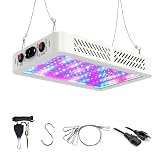 Beelux 1000w LED Grow Light for Indoor Plants Full SpectrumView on Amazon
- 5
 LED Grow Light 4FT Full Spectrum Compact Linkable LightingView on Amazon
- 6
 LED Grow Light 2FT Full Spectrum Compact Linkable LightingView on Amazon
- 7
 Spider Farmer GlowR40 LED Plant Grow LightView on Amazon
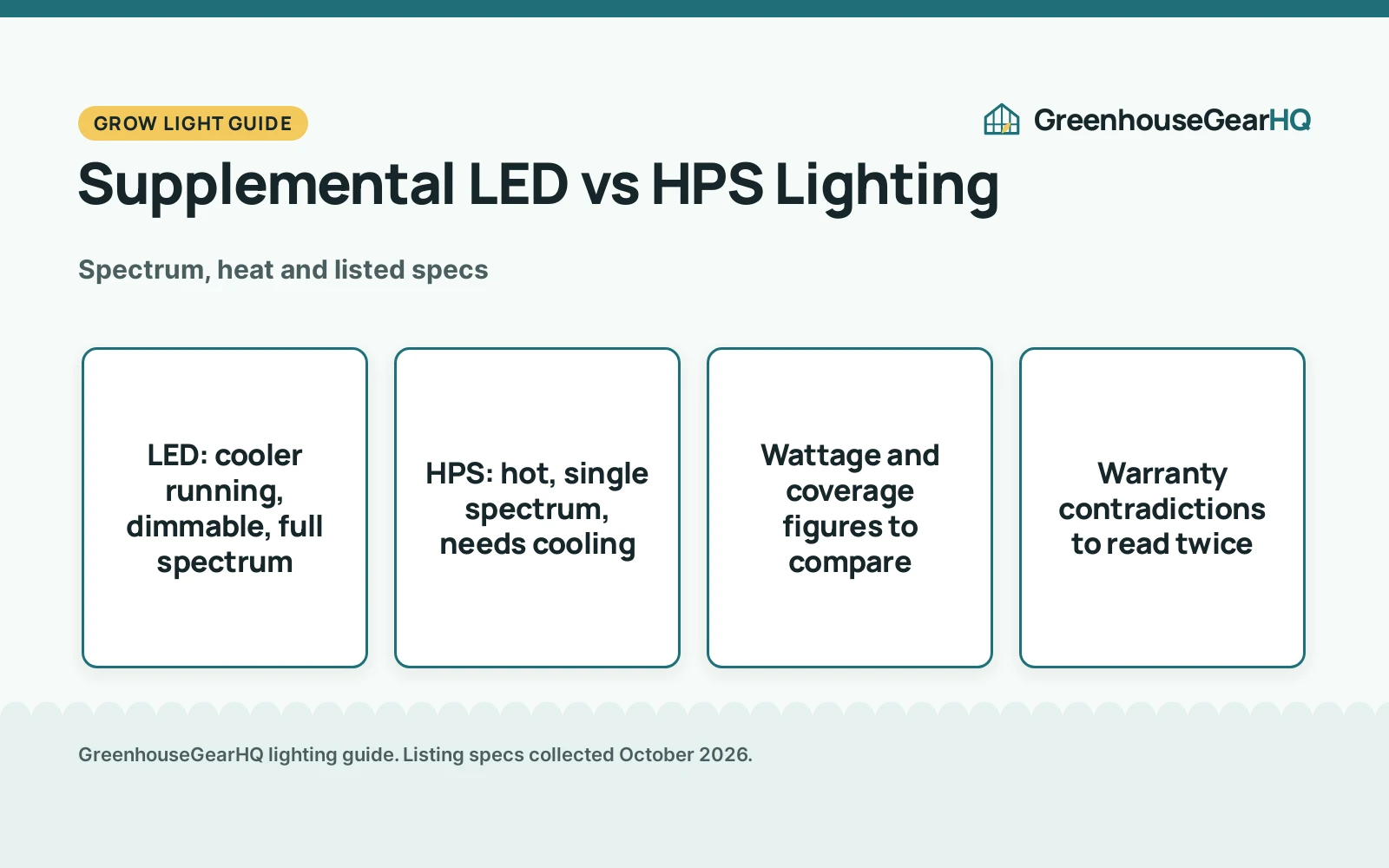
In December, when the sun sets before dinner and the greenhouse tomatoes stall, supplemental light is what keeps the winter crop moving. The question of supplemental greenhouse lighting LED vs HPS comes down to this: LEDs give full-spectrum light with little heat and dimming, while HPS gives intense single-spectrum light with a lot of heat that you then have to vent. We compared LED grow light listings, including one maker that positions its LED against a traditional 200W HPS, to explain what each option does and which winter grows each suits. Every number below comes from a product listing; where a listing gives no figure, we say so.
Other options worth a look
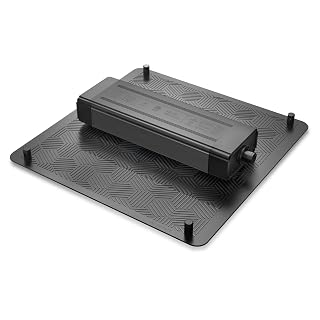 AC Infinity IONBOARD S22Check price on Amazon
 Spider Farmer Glow30 LED Grow Lights KitsCheck price on Amazon
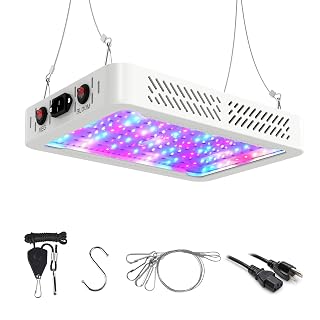 Beelux 1000w LED Grow Light for Indoor Plants Full SpectrumCheck price on Amazon
 LED Grow Light 4FT Full Spectrum Compact Linkable LightingCheck price on Amazon
 LED Grow Light 2FT Full Spectrum Compact Linkable LightingCheck price on Amazon
 Spider Farmer GlowR40 LED Plant Grow LightCheck price on Amazon
GreenhouseGearHQ earns a commission when you buy through links on this page, at no extra cost to you. As an Amazon Associate I earn from qualifying purchases. Affiliate disclosure.
Supplemental greenhouse lighting LED vs HPS: the short answer
Choose LED when you want light without extra heat: full-spectrum bars and boards that dim and hang close to the plants. Choose HPS when you want raw intensity plus free winter heat in a big house, and you can vent the warmth in summer. If you would rather go straight to the products, our LED vs HPS grow lights comparison goes deeper.
How LED supplemental lighting works
LED fixtures turn most of their power into light, so they run cool enough to hang near the canopy. The listings we compared show the range: Wiaxulay’s 3-bar 16-inch strip set lists 15 watts, 6000K with 660nm red beads, a 380 to 800nm range, 5 brightness levels and a 6/12/16-hour timer. AC Infinity’s IONBOARD S22 board lists 115 watts, Samsung LM301H diodes, dimming from 0 to 100% and an IP65 rating for humid, hot grow spaces.
For under-canopy fill, VIVOSUN’s LumaRay lists 100 watts on a 3.28 ft bar with dimming from 25% to 100%, and Spider Farmer’s Glow30 lists four 13-inch supplemental bars at 32 watts with an IP65 waterproof lampshade. The pattern is consistent: LEDs are sold on spectrum control, dimming and cool operation, and several listings name supplemental or inter-canopy use outright.
How HPS supplemental lighting works
HPS, high-pressure sodium, is the old greenhouse workhorse: a gas-discharge lamp that throws intense orange-weighted light and a great deal of heat. None of the listings we compared is an HPS fixture; they are all LED. The closest reference is WZDRAGON’s BW1000, whose maker says it can replace a traditional 200W HPS, which tells you the comparison buyers actually make: one LED panel against one hot HPS lamp.
That heat is the whole tradeoff. In a winter greenhouse, HPS waste heat warms the house for free; in summer, or in a small tent, it becomes a cooling problem that needs venting. HPS also needs a ballast and usually a reflector, while the LED listings here are self-contained bars, boards and panels. Spectrum is fixed on HPS, while LED listings offer switches and modes: the WZDRAGON lists veg and bloom switches, and the Garpsen panel lists 6000K, 3500K and 5000K modes with 5 dimmable levels.
LED vs HPS at a glance
| Option | Light and heat | Suits | Watch for |
|---|---|---|---|
| LED bars and boards | Full spectrum, dimmable, cool running | Seed starting, main tent light | Check wattage and stated coverage |
| LED supplemental bars | Side and inter-canopy fill | Tents with a main light already | Small coverage per bar |
| HPS | Intense single spectrum, much heat | Big winter houses where heat helps | Needs venting, ballast and reflector |
Which should you buy?
Match the light to the season and the space. For winter seed starting on shelves, LED bars win on simplicity: the Wiaxulay 16-inch 3-bar set and the GYTF T5 4-pack both list timers and multiple brightness levels, and they sip power at 15 and 80 watts. For side fill under an existing main light, the Spider Farmer 13-inch bars and the VIVOSUN 3.28 ft under-canopy bar are built for exactly that job. For a large winter greenhouse where every spare degree counts, HPS heat stops being waste and starts being useful, but plan the venting for spring.
Compare wattage against the maker’s stated coverage before you buy: the WZDRAGON lists a 23.6 by 23.6 inch area at 25 inches of height, and the GYTF lists 4000 lumens from 80 watts. Read our 100 watt LED grow lights and grow lights for seedlings roundups for scored picks.
Read the listing twice
Grow light listings contradict themselves, usually on wattage, LED counts and warranty:
- WZDRAGON BW1000: the bullets promise 2 years of after-sale service while the spec table claims 5 years from purchase.
- AC Infinity IONBOARD S22: the spec table lists 100 watts maximum compatible against 115 watts light source wattage.
- Wiaxulay strips: the bullets count up to 180 LEDs in total while the spec table’s diode quantity field says 120.
Trust the title and bullets over the spec table, and confirm the warranty term in the spec table’s warranty field before you count on it.
What this guide does not cover
This guide covers light type only. It does not cover hanging height, daily light hours or spectrum recipes, which depend on the crop and the fixture. The light maker’s manual gives those figures, and your local extension office can advise on timing for your area.
FAQ for growers
Is LED or HPS better for a winter greenhouse?
LED suits most winter grows: it adds light without much heat, and listings like the AC Infinity board dim from 0 to 100% for control. HPS suits a large house where its waste heat warms the space, but you will need to vent it.
Can LEDs replace HPS one for one?
Makers say so: WZDRAGON’s listing says its LED can replace a traditional 200W HPS, and GYTF’s 80W strip set says it replaces 200W plant lights. Compare the maker’s stated coverage, not just the wattage.
What spectrum do these LEDs list?
Most list full spectrum: Wiaxulay gives 6000K with 660nm red from 380 to 800nm, Garpsen offers 6000K, 3500K and 5000K modes, and Spider Farmer lists 5000 to 5500K white plus 650 to 660nm red.
Do any of these lights list a timer?
Yes. Wiaxulay and Garpsen list 6/12/16-hour timers, LORDEM lists 6/8/12/16 hours, and RWNTAO lists 4/8/12 hours. Wiaxulay and Garpsen also list 5 brightness levels.
Keep reading
See every grow light guide and all light and heat guides.
More picks: LED vs HPS grow lights, 100 watt LED grow lights, grow lights for seedlings and T5 vs LED grow lights.