On this page
Top picks at a glance
As an Amazon Associate I earn from qualifying purchases.
- 1
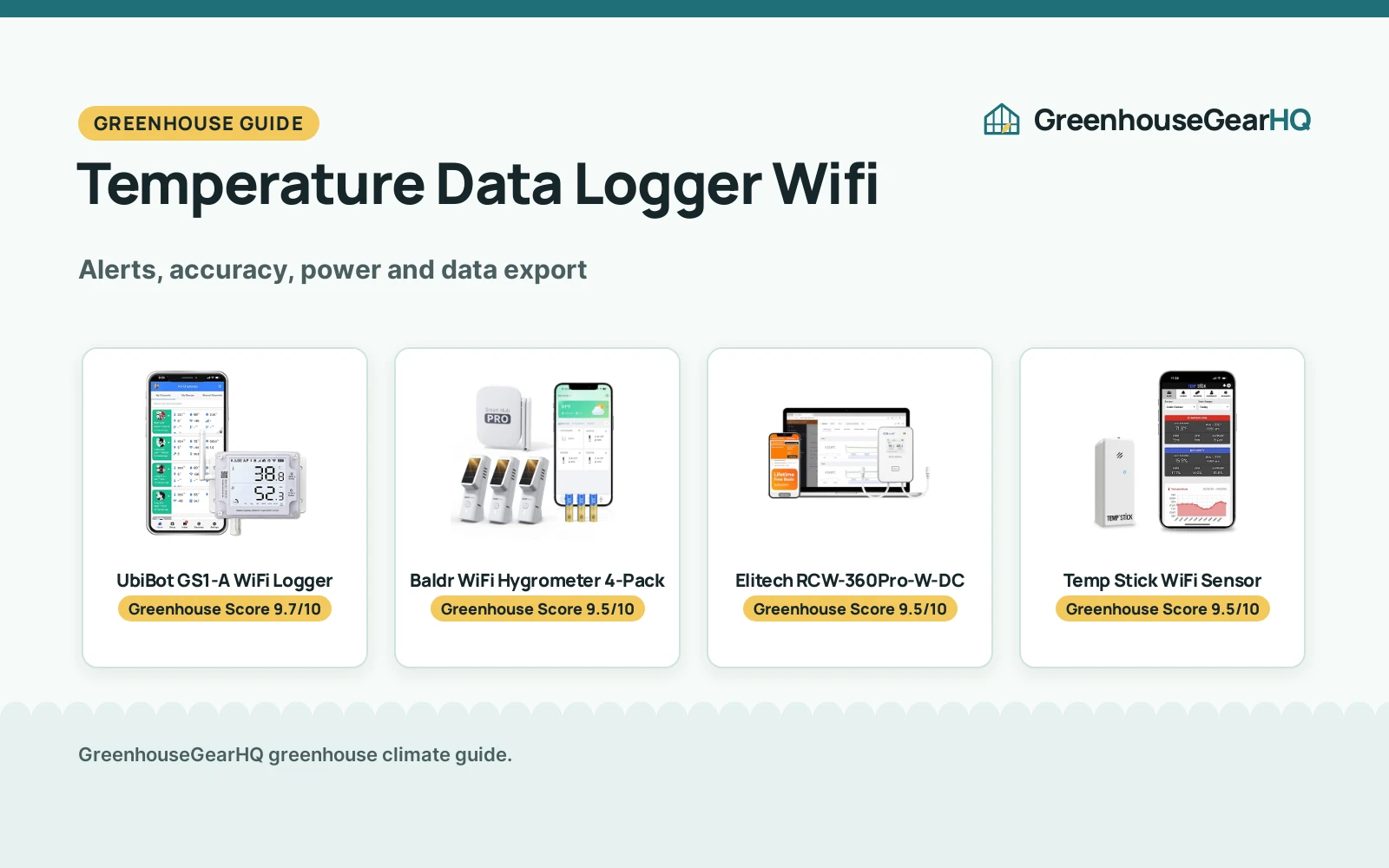
 UbiBot GS1-A WiFi Logger9.7/10View on Amazon
- 2
 Baldr WiFi Hygrometer 4-Pack9.5/10View on Amazon
- 3
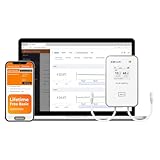 Elitech RCW-360Pro-W-DC9.5/10View on Amazon
- 4
 Temp Stick WiFi Sensor9.5/10View on Amazon
On a frost night in late winter, with seed trays waiting under cover, a temperature data logger wifi is the tool that tells you whether the greenhouse held its heat while you slept. It records the temperature through the night and sends the readings to your phone, so a cold dip shows up as a line on a chart instead of a tray of dead seedlings. The steps below show what to look for and which logger fits which job.
GreenhouseGearHQ earns a commission when you buy through links on this page, at no extra cost to you. As an Amazon Associate I earn from qualifying purchases. Affiliate disclosure.
| # | Product | Greenhouse Score | Buy |
|---|---|---|---|
| 1 | UbiBot GS1-A WiFi Logger | 9.7/10 | Buy on Amazon |
| 2 | Baldr WiFi Hygrometer 4-Pack | 9.5/10 | Buy on Amazon |
| 3 | Elitech RCW-360Pro-W-DC | 9.5/10 | Buy on Amazon |
| 4 | Temp Stick WiFi Sensor | 9.5/10 | Buy on Amazon |

UbiBot GS1-A WiFi Logger
An IP65 WiFi logger with ±0.2°C accuracy that handles the precision measurement step in a damp greenhouse.
Pros
- ±0.2°C temperature accuracy and ±2% RH humidity accuracy
- IP65-rated enclosure for dust and low-pressure water jets
- 200MB cloud storage with PDF and CSV export
Cons
- No warranty term is stated
- No external sensor expansion; the model does not support extra probes
- No power source or battery life is stated

Baldr WiFi Hygrometer 4-Pack
A 4-pack hub set with 2-year data export that handles the long-term logging step across several rooms or beds.
Pros
- 2-second updates with ±0.9°F accuracy across -40°F to 158°F
- 2 years of data storage and export with no subscription
- Solar plus battery power lasts up to 12 months per sensor
Cons
- No warranty term is stated
- Sensors have no screen; readings show on the phone only
- 2.4GHz WiFi only, no 5GHz band stated
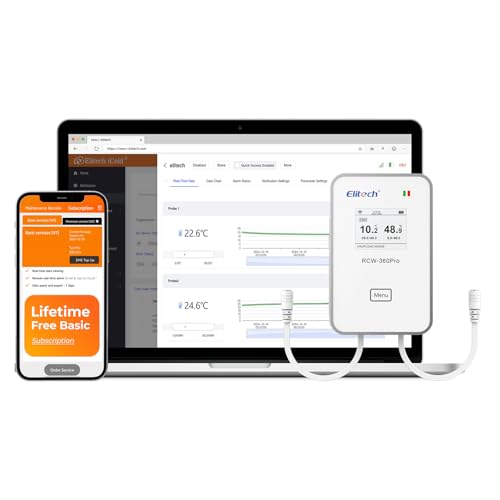
Elitech RCW-360Pro-W-DC
A dual-probe WiFi logger with 100,000-record storage that handles the logging step with 2 measurement points.
Pros
- Dual external probe channels for 2 measurement points
- Built-in battery runs up to 60 days during outages
- Stores up to 100,000 records with adjustable intervals
Cons
- Device only, no probe included, so probes are an extra purchase
- No warranty term is stated
- No accuracy figure is stated

Temp Stick WiFi Sensor
A WiFi sensor with unlimited text alerts that handles the alerting step for a greenhouse you cannot visit daily.
Pros
- Unlimited text, app and email alerts with no subscription
- Monitors every second and stores up to 1 month of data offline
- Battery life of 1-2 years on 2xAA batteries
Cons
- 2.4GHz WiFi only, no 5GHz band
- No accuracy figure is stated
- One sensor only, with no multi-sensor option stated
As an Amazon Associate I earn from qualifying purchases.
Other options worth a look
 Temp Stick Remote WiFi Temperature & Humidity SensorCheck price on Amazon
 Lascar EL-WIFI-TP Wireless Temperature Data Logger w/Check price on Amazon
 Govee WiFi Thermometer Hygrometer H5179 with App NotificationCheck price on Amazon
 MOCREO WiFi Thermometer Freezer AlarmCheck price on Amazon
 Sainlogic Weather StationCheck price on Amazon
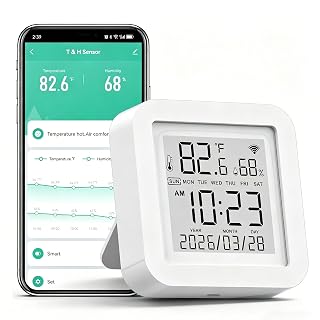 Smart Temperature Humidity Monitor: WiFi ThermometerCheck price on Amazon
What a wifi temperature logger needs to do
Every working wifi logger has the same parts: a sensor that reads temperature and humidity, a WiFi link that carries the readings to your phone, alerts that warn you when readings leave the range you set, power that lasts the season, and storage that keeps the history for later. Buy them in that order, because the sensor accuracy decides whether the alerts mean anything.
- Sensor: reads temperature and humidity on a steady schedule. The UbiBot GS1-A (on Amazon) states ±0.2°C accuracy, while the Baldr set states ±0.9°F.
- WiFi link: carries readings to the app. Most loggers here use 2.4GHz WiFi only, and the Elitech logger states 5G and 2.4G WiFi.
- Alerts: warn you when readings leave the range you set. The Temp Stick states unlimited text, app and email alerts.
- Power: a battery or solar panel that lasts the season. The Baldr sensors (on Amazon) state solar plus battery power for up to 12 months.
- Storage: keeps the history for export. The Baldr set states 2 years of data storage and export, and the Elitech logger stores up to 100,000 records.
How to choose a temperature data logger wifi
Match the range to your greenhouse
Check the stated range against the coldest night and the warmest afternoon your greenhouse sees. The Baldr set states -40°F to 158°F, the UbiBot logger states -4°F to 140°F, and the Temp Stick states no range figure, so check the listing before you buy for a cold frame or an unheated house. See the temperature data logger guide for the basics.
Check the alerts and the data export
Alerts are the point of a wifi logger: the Temp Stick states unlimited text alerts, the Baldr set states app alerts for up to 39 sensors, and the UbiBot logger states email, app, HTTP, API, Alexa and IFTTT alerts. For records, the Baldr set exports up to 2 years of history, the UbiBot logger exports PDF and CSV files, and the Elitech logger stores up to 100,000 records. See the data logger vs wireless thermometer comparison when you weigh a logger against a simple display.
Check the power and the WiFi band
Power decides how often you visit the logger. The Temp Stick runs on 2xAA batteries for 1-2 years, the Baldr sensors run on solar plus battery for up to 12 months, and the Elitech logger runs up to 60 days on its built-in battery during outages. On WiFi, the Temp Stick, Baldr and UbiBot loggers state 2.4GHz only, so check that your greenhouse router offers that band before you buy.
The loggers that fit this guide
Each logger below covers one of the steps above: the Temp Stick for unlimited text alerts, the Baldr set for long-term logging across several spots, the UbiBot logger for precise readings in a damp house, and the Elitech logger for 2 measurement points with deep record storage.
FAQ for growers
Do wifi temperature loggers need a subscription?
The Temp Stick states no subscription, the Baldr set states no subscription, and the UbiBot logger states a cloud platform with no mandatory subscription. The Elitech listing states cloud data storage and names no subscription.
How long does a wifi temperature logger run on battery power?
That depends on the logger. The Temp Stick states 1-2 years on 2xAA batteries, the Baldr sensors state up to 12 months on solar plus battery power, and the Elitech logger states up to 60 days on its built-in battery during outages.
Can I use a wifi temperature logger in a damp greenhouse?
Check the stated IP code. The UbiBot logger states an IP65-rated enclosure for dust and low-pressure water jets. The other listings here state no protection code, so check the listing before you place a logger where water can reach it.
How many sensors can one wifi logger system cover?
That depends on the system. The Baldr set states support for up to 39 sensors from one app, while the Temp Stick and UbiBot loggers list 1 sensor each. The Elitech logger states 2 expandable channels for external probes.
Keep reading
See every Light and Heat guide and all Thermometers and Hygrometers guides.
More picks: greenhouse data loggers, wireless thermometers, hygrometer uses and temperature and humidity controllers.