On this page
Top picks at a glance
As an Amazon Associate I earn from qualifying purchases.
- 1
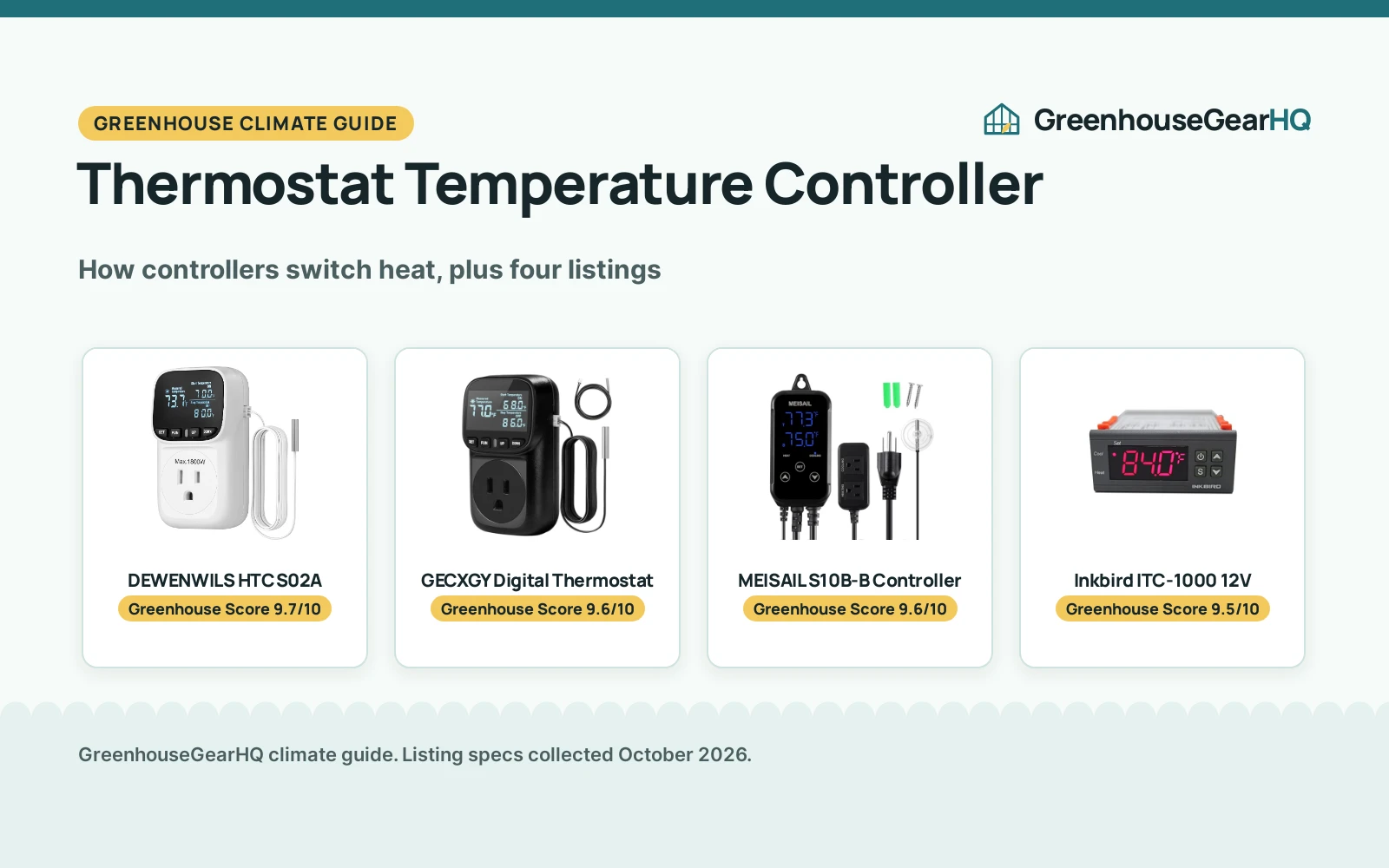
 DEWENWILS HTCS02A9.7/10View on Amazon
- 2
 GECXGY Digital Thermostat9.6/10View on Amazon
- 3
 MEISAIL S10B-B Controller9.6/10View on Amazon
- 4
 Inkbird ITC-1000 12V9.5/10View on Amazon
A cold snap can undo weeks of seed starting overnight, and a thermostat temperature controller is the part that watches the temperature when you cannot. This guide explains what a controller does, how heating and cooling modes differ, and which of the 4 listings we compared fits a greenhouse, a heat mat or a fan.
GreenhouseGearHQ earns a commission when you buy through links on this page, at no extra cost to you. As an Amazon Associate I earn from qualifying purchases. Affiliate disclosure.
| # | Product | Greenhouse Score | Buy |
|---|---|---|---|
| 1 | DEWENWILS HTCS02A | 9.7/10 | Buy on Amazon |
| 2 | GECXGY Digital Thermostat | 9.6/10 | Buy on Amazon |
| 3 | MEISAIL S10B-B Controller | 9.6/10 | Buy on Amazon |
| 4 | Inkbird ITC-1000 12V | 9.5/10 | Buy on Amazon |

DEWENWILS HTCS02A
Suits a grower who wants heating and cooling from one plug-in outlet, with a range of -40~210°F and 1800W of output.
Pros
- Heating and cooling in one outlet
- Wide range: -40~210°F at 0.1 degree precision
- 1800W through a 15A output
Cons
- No humidity control is stated
- Button-only control with no dial
- No probe cable length is stated

GECXGY Digital Thermostat
A plug-in controller with a -40 to 210 F range and 1800W of switching power that handles heating and cooling for a greenhouse, a heat mat or a fan.
Pros
- Range of -40 to 210 F covers greenhouse heating and cooling
- 15A and 1800W switching power for heaters, heat mats and fans
- Cyclic timing, countdown and dimming modes plus a VA display
Cons
- No warranty term is stated
- Listing leans on reptile and homebrew uses, with greenhouse as one of many
- No sensor or probe detail is stated

MEISAIL S10B-B Controller
A 2-stage outlet controller with dual relay output and a buzzer alarm that handles heating and cooling for a greenhouse, a fermenter or a terrarium at 1100W.
Pros
- Dual relay output switches heating and cooling
- 1100W output at 110V and 10A for greenhouse gear
- Dual display window plus a buzzer alarm for temperature swings
Cons
- No temperature range is stated
- No warranty term is stated

Inkbird ITC-1000 12V
A dual stage 12V controller with 2 relay outputs and alarms that handles heating and cooling for a greenhouse, a fridge or an incubator on 12V power.
Pros
- Dual stage control switches between heating and cooling on its own
- 2 relay outputs for separate heating and cooling gear
- Alarms when the temperature passes the preset high or low, or the sensor errors
Cons
- Runs on 12V, so it needs a 12V source rather than a wall outlet
- No temperature range is stated
- No warranty term is stated
As an Amazon Associate I earn from qualifying purchases.
Other options worth a look
 SENSTREE Greenhouse Temperature Controller Digital WaterproofCheck price on Amazon
 Inkbird ITC-308 Digital Temperature Controller ThermostatCheck price on Amazon
 DEWENWILS Temperature Controller Outlet 2 PackCheck price on Amazon
 BN-LINK Digital Cooling Thermostat Temperature ControllerCheck price on Amazon
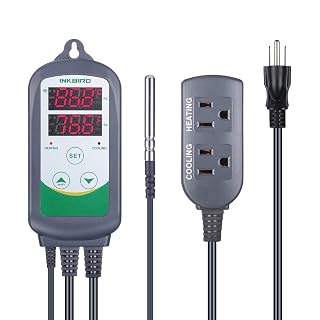 Inkbird WiFi ITC-308 Digital Temperature ControllerCheck price on Amazon
 JumpStart Digital Thermostat Controller for Heat MatsCheck price on Amazon
What a thermostat temperature controller does
A thermostat temperature controller reads the air around its sensor and switches an outlet on or off at the temperature you set. Plug a heater into the outlet and the controller runs it when the greenhouse cools; plug a fan in and it runs the fan when the greenhouse warms. The controller replaces the habit of checking the greenhouse at night, and it holds the set temperature steadier than a heater with a dial alone.
Heating mode and cooling mode
Heating mode and cooling mode decide which way the controller switches. In heating mode the outlet turns on when the temperature falls below the set point, so a heater or a heat mat warms the space. In cooling mode the outlet turns on when the temperature rises above the set point, so a fan moves hot air out. The GECXGY, MEISAIL and Inkbird listings all offer heating and cooling modes, and the Inkbird switches between the two on its own. A dual stage controller can run a heater on each relay and a fan on the other, which suits a greenhouse that needs heat at night and airflow by day.
The controllers we compared
A controller earns its place at the step where steady heat decides whether seeds sprout, so these 4 listings are the gear that holds the temperature you set.
Matching power to your heater or fan
Power decides which loads a controller can switch. The GECXGY listing is rated 15A and 1800W, which covers heaters, heat mats and fans on a standard outlet. The MEISAIL listing is rated 110V and 10A with a maximum output load of 1100W. The Inkbird listing runs on 12V, with 2 relay outputs, so it suits gear wired for 12V power such as a chest cooler or a car battery setup. Match the controller to the load the maker states, and check the watts on your heater or fan against the controller limit before you plug it in.
Timers, alarms and displays
A few extras separate these listings. The GECXGY listing adds cyclic timing, a countdown and dimming modes, plus a VA display that reads in Fahrenheit or Celsius. The MEISAIL listing adds a dual display window and a buzzer alarm that alerts you when the temperature swings. The Inkbird listing adds alarms for high and low temperatures and for a sensor error, plus a calibration setting. The DEWENWILS listing gives a title only, so it states none of these extras. Pick the extras that match how you run the greenhouse: a timer suits a day and night cycle, an alarm suits a greenhouse you cannot check often, and a clear display suits a dim corner.
What this guide does not cover
We do not give target temperatures, because they depend on the crop, the season and the greenhouse. Your seed packet and the controller manual give those figures, and your local extension office can advise on timing for your area. We also do not cover heaters, fans or heat mats themselves; follow the product label for each.
FAQ for growers
What does a thermostat temperature controller do?
It reads the temperature and switches an outlet on or off at the point you set, so a heater runs when the greenhouse cools and a fan runs when it warms.
What is the difference between heating mode and cooling mode?
Heating mode turns the outlet on when the temperature falls below the set point, while cooling mode turns it on when the temperature rises above it. The GECXGY, MEISAIL and Inkbird listings all offer each mode.
How much power can these controllers switch?
The GECXGY listing is rated 15A and 1800W, the MEISAIL listing 110V and 10A with a maximum output load of 1100W, and the Inkbird listing runs on 12V.
Do I need a thermostat controller for a seedling heat mat?
A controller helps hold a set temperature under the trays. The GECXGY listing covers heat mats among its uses, and our best seedling heat mat picks compare mats that pair with one.
Keep reading
See every thermostats and controllers guide and all light and heat guides.
More picks: best digital thermostat controller, best wifi thermostat controller for greenhouse, best seedling heat mat and thermostat vs timer greenhouse fan.