On this page
Top picks at a glance
As an Amazon Associate I earn from qualifying purchases.
- 1
 hYwecy Rechargeable Circulation Desk Fan with 360-Degree9.4/10View on Amazon
- 2
 DREO Tower Fan for BedroomView on Amazon
- 3
 DREO Smart Tower Fan for BedroomView on Amazon
- 4
 Lasko Oscillating Tower Fan with RemoteView on Amazon
- 5
 Lasko Oscillating Tower Fan with Remote ControlView on Amazon
- 6
 PELONIS 40-inch Bladeless Tower Fan for BedroomView on Amazon
- 7
 Levoit Tower Fan for BedroomView on Amazon
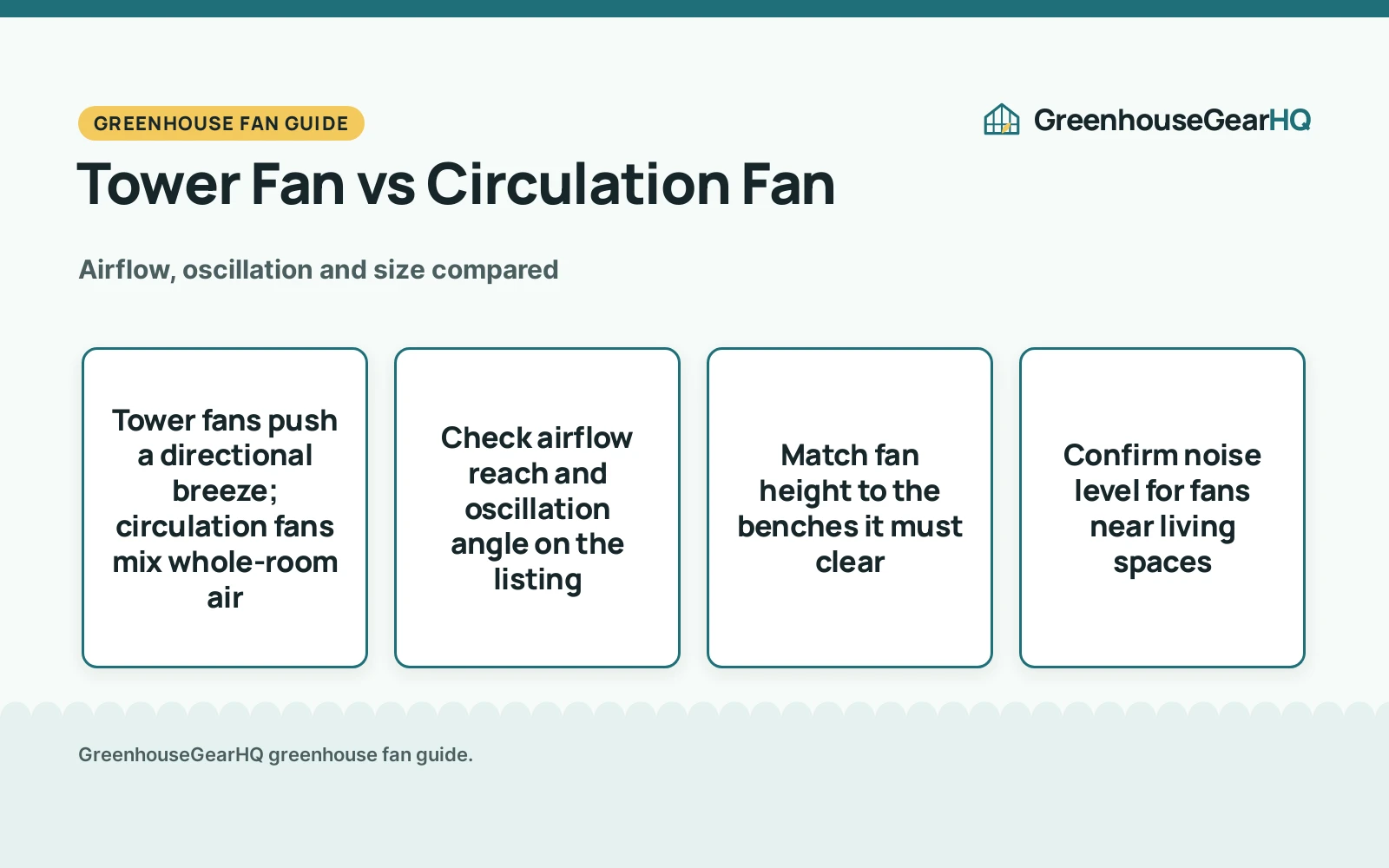
On a hot July afternoon the greenhouse air sits still, and the corner plants wilt while the vent fan hums somewhere out of reach. That is the moment growers ask about tower fan vs circulation fan: which one actually fixes dead air. A tower fan throws a directional breeze across a bench or aisle, and its oscillation sweeps that breeze side to side. A circulation fan keeps the whole volume of air moving so hot spots do not settle. For a single bench or a hot corner, the tower fan fits; for evening out air across the whole structure, circulation wins. This guide compares the two types and ranks four tower fan listings by their stated specs.
Other options worth a look
 DREO Tower Fan for BedroomCheck price on Amazon
 DREO Smart Tower Fan for BedroomCheck price on Amazon
 Lasko Oscillating Tower Fan with RemoteCheck price on Amazon
 Lasko Oscillating Tower Fan with Remote ControlCheck price on Amazon
 PELONIS 40-inch Bladeless Tower Fan for BedroomCheck price on Amazon
 Levoit Tower Fan for BedroomCheck price on Amazon
GreenhouseGearHQ earns a commission when you buy through links on this page, at no extra cost to you. As an Amazon Associate I earn from qualifying purchases. Affiliate disclosure.
How the two fan types differ: tower fan vs circulation fan
A tower fan is a tall, narrow column that pushes air forward. The listings here show the pattern: 90° oscillation on both DREO models and 60-degree oscillation on both Lasko models, with stated airflow reach up to 33ft and 36ft on the DREOs. A circulation fan works differently: instead of a directional breeze, it is built to keep air moving around the room, which suits whole-structure mixing rather than one bench. Neither type replaces ventilation; both move the air that ventilation brings in.
The tower fan listings, ranked
Ranked by stated airflow and features, the DREO 42-inch DC model leads with 1473 CFM, 28 ft/s air speed, 9 speeds and a 12H timer. Next is the DREO DR-HTF017 with 892 cfm, 26ft/s air speed, 4 speeds, 3 modes and a 28dB noise rating. The Lasko T42951 follows with 262 cfm, 3 speeds, 60-degree oscillation, a 7.5-hour timer, an ETL listing and a 1-year limited warranty term. The Lasko 2510 rounds out the four with 210 cfm, 3 speeds, a 7-hour timer, an ETL listing and a 1-year limited warranty term.
How to choose between a tower fan and a circulation fan
Measure the space the fan must serve
A tower fan suits a bench, an aisle or one hot corner: the DREO models state airflow reach of 33ft and 36ft with 90° oscillation. A circulation fan suits the whole structure, where air needs to keep moving rather than blow in one direction. If the problem is one dead corner, buy the tower fan; if the whole house runs hot, look at circulation and exhaust options like our evaporative cooler vs exhaust fan comparison.
Compare oscillation and speeds
Oscillation decides how wide the breeze spreads: 90° on the DREO listings, 60-degree on the Lasko listings. Speeds decide how fine the control is: 9 speeds on the DREO DC model against 3 speeds on both Lasko models and 4 speeds on the smaller DREO. More speeds help when the fan also cools a workspace. See our oscillating fan vs tower fan comparison for more on the tradeoffs.
| Tower fan listing | Airflow | Oscillation | Speeds |
|---|---|---|---|
| DREO 42-inch DC tower fan | 1473 CFM | 90° | 9 |
| DREO DR-HTF017 tower fan | 892 cfm | 90° | 4 |
| Lasko T42951 tower fan | 262 cfm | 60-degree | 3 |
| Lasko 2510 tower fan | 210 cfm | 60-degree | 3 |
Check noise, timer and safety listings
The DREO DR-HTF017 lists 28dB; the Lasko models list 55.4 db and 54.5 db. Timers run from 7 hours to 12 hours across the four listings. Both Lasko listings show an ETL specification and a 1-year limited warranty term. For a fan that runs near a workspace, the noise figure matters as much as the airflow; see our tower fan vs clip on fan guide for smaller-space options.
FAQ for growers
Which tower fan moves the most air here?
The DREO 42-inch DC model lists 1473 CFM and 28 ft/s air speed, the highest airflow figure of the four listings.
Do any of these tower fans oscillate?
All four do. The DREO models list 90° oscillation and the Lasko models list 60-degree oscillation.
Which listings state a warranty?
Both Lasko listings state a 1-year limited warranty term and an ETL specification. The DREO listings state no warranty term.
Can a tower fan replace a circulation fan?
Not for whole-structure mixing. A tower fan pushes a directional breeze, which suits a bench or corner; a circulation fan keeps air moving around the room. Match the fan type to the size of the dead-air problem.
Keep reading
See every greenhouse fans guide and all air and water guides. Also see our louver vs shutter greenhouse fan. Also see our best box fan for greenhouse.
More picks: greenhouse fan for a sunroom, exhaust fan for mini greenhouse.