On this page
Top picks at a glance
As an Amazon Associate I earn from qualifying purchases.
- 1
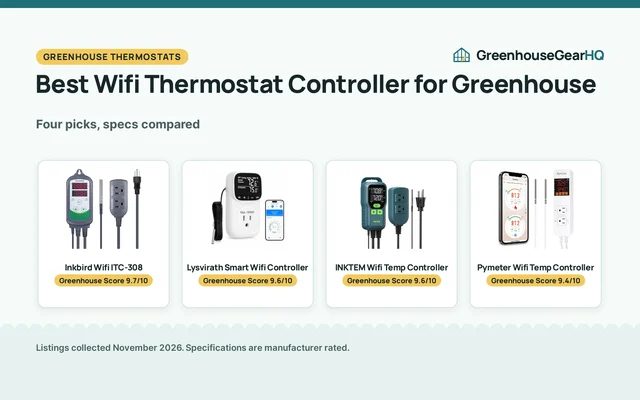
 Inkbird WiFi ITC-308 Digital Temperature Controller with Dual9.7/10View on Amazon
- 2
 EconoHome Adjustable Plug-in Heating and Cooling Thermostat9.6/10View on Amazon
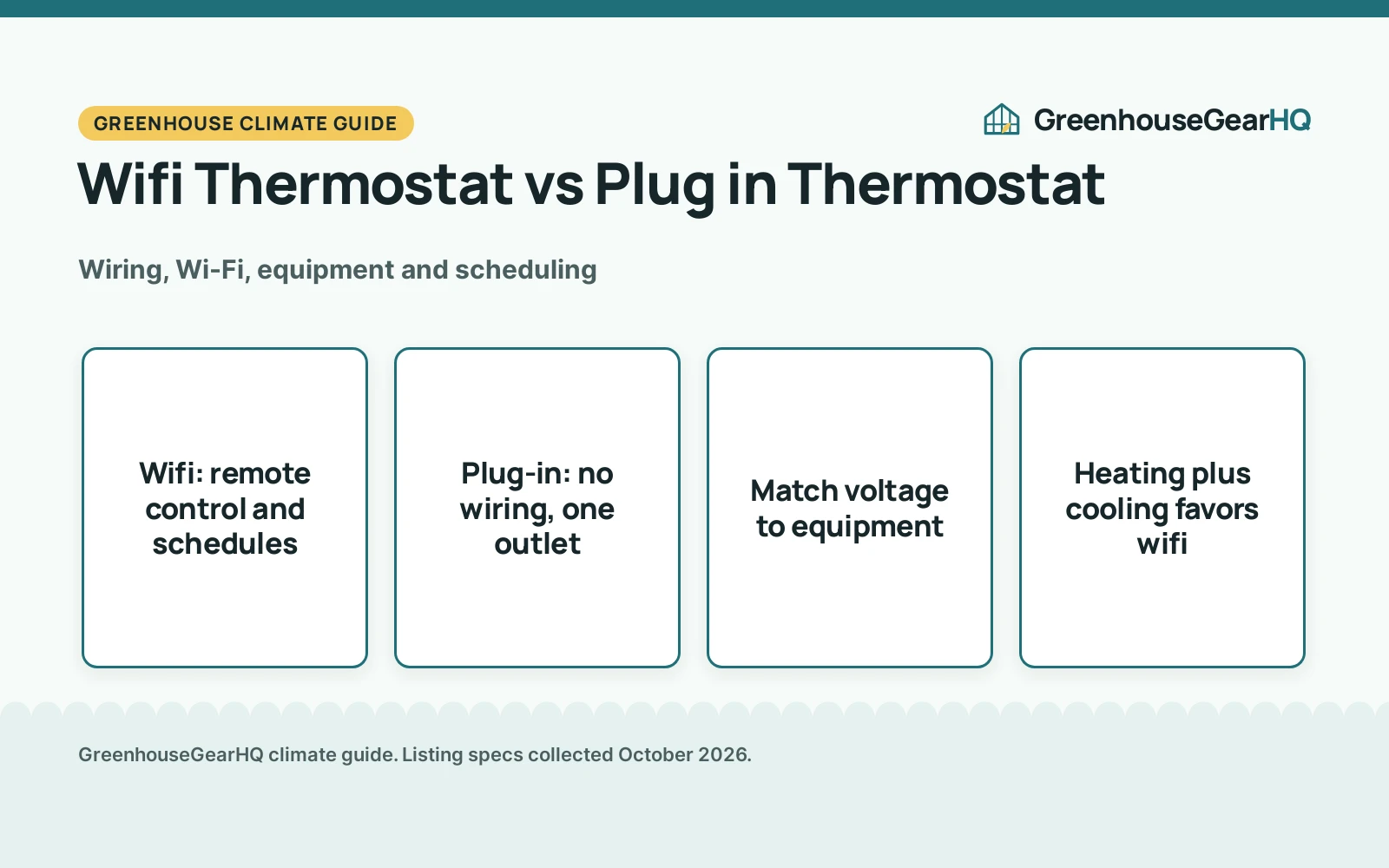
Wifi thermostat vs plug in thermostat comes down to control against simplicity: a wifi thermostat wires into the heating or cooling equipment and is adjusted from a phone app, while a plug-in thermostat plugs into a wall outlet and switches whatever is plugged into it on and off at a set temperature. For a greenhouse with permanent heating, wifi gives remote control and scheduling; for a portable heater or fan, a plug-in gives automatic on/off with no wiring. This guide explains both, with real figures from wifi thermostat listings where numbers appear.
GreenhouseGearHQ earns a commission when you buy through links on this page, at no extra cost to you. As an Amazon Associate I earn from qualifying purchases. Affiliate disclosure.
wifi thermostat vs plug in thermostat: the short answer
Choose a wifi thermostat when the greenhouse has wired heating or cooling equipment and Wi-Fi reaches it: the listings show 24V models like the Google Nest and ecobee that adjust from a phone, learn schedules and work with voice assistants. Choose a plug-in thermostat when the greenhouse uses a portable heater or fan: it sits between the outlet and the equipment, turns it on and off at the set temperature, and needs no wiring or app. Wifi needs installation and a network; plug-in needs an outlet and nothing else.
What a wifi thermostat does
A wifi thermostat replaces the wall thermostat on heating or cooling equipment and adds remote control. The Google Nest listings state 24 volts, Wi-Fi on 2.4 and 5 GHz, a 1 year manufacturer warranty, ENERGY STAR certification, and that the Nest is designed to work without a C wire in most homes. The ecobee Smart Thermostat Premium lists 24 volts, a 3 year manufacturer warranty, compatibility with 95% of HVAC systems, ENERGY STAR certification, and savings of up to 26% on energy bills. The Sensi Lite lists 24 volts, a 3 year manufacturer warranty, ENERGY STAR certification and savings of about 23% on HVAC energy. The Amazon Smart Thermostat lists ENERGY STAR certification and an EPA estimate of average yearly savings. The ecobee Smart Thermostat Essential lists savings of up to 23% every year and compatibility with 85% of systems, compared to a hold of 72°F. The Honeywell X2P lists a 5-2 day schedule, a 32°F low-heat setpoint and a 1-year warranty.
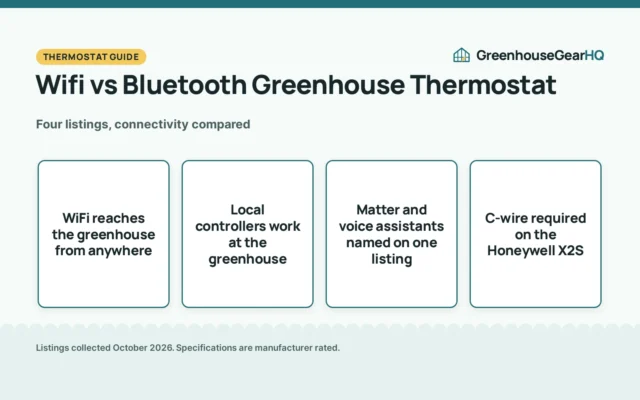
For a greenhouse, the relevant features are scheduling, remote access and equipment compatibility. The Nest listings mention creating an energy efficient schedule in the Google Home app and remote control from a phone, laptop or tablet. The ecobee Premium includes a Power Extender Kit for homes without a C-wire. Before buying, check the compatibility notes: the Nest and ecobee listings both point to online compatibility checkers, and some systems need a C wire. See the thermostat with app guide for app-controlled picks.
What a plug-in thermostat does
A plug-in thermostat is the simple alternative. It plugs into a standard outlet, and the heater or fan plugs into it. A built-in temperature sensor reads the air, and the device switches power on and off to hold the set temperature. There are no wires to run, no app to install and no compatibility checker: if the equipment plugs into an outlet, it works. The trade-off is that it controls one outlet only, and it cannot coordinate a heater and a fan together the way a wired thermostat can.
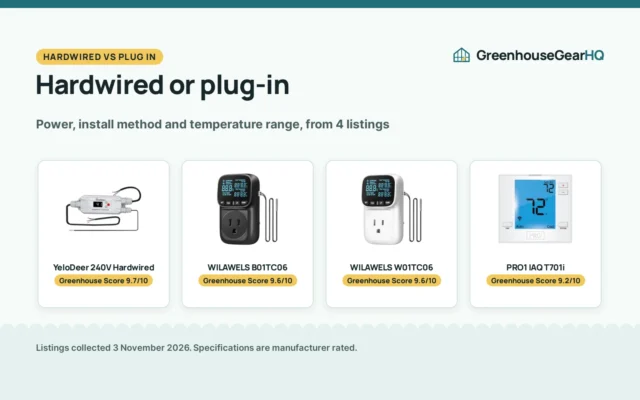
In a greenhouse, plug-in thermostats suit portable electric heaters, small fans and heat mats. They are a common way to automate a heater with a thermostat setup without touching the wiring. When the greenhouse grows past a single heater, or needs heating and cooling on one control, that is where a wired or wifi thermostat takes over. See the plug-in thermostat vs timer guide for the simplest automation comparison.
Choosing: wiring, Wi-Fi and equipment
Three questions decide it. First, what equipment does the greenhouse run? Portable heaters and fans with plugs suit a plug-in thermostat; wired furnaces, unit heaters and wired fans need a wired or wifi thermostat. Second, does Wi-Fi reach the greenhouse? Wifi thermostats need a network connection for the app features the listings describe; without it they work only as wall thermostats. Third, how complex is the climate? One heater on a setpoint is a plug-in job. Heating plus cooling, staging, or schedules that change through the day favor wifi: the Honeywell T6 Pro lists stages up to 2 heat/1 cool, and the Nest listings describe schedules and away modes.
Safety notes cut across both types. Match the thermostat’s voltage and load rating to the equipment: the listings show 24 volts for the Nest, ecobee and Sensi models and 30 volts for the Honeywell T6 Pro, which are control voltages, not heater loads. A plug-in thermostat must be rated for the heater’s wattage, and heaters should never be left running unattended in a structure with plants and dry material. See the analog vs digital greenhouse thermostat comparison for display and accuracy trade-offs.
What this guide does not cover
This guide does not cover integrated environmental controllers, fan speed controllers, or solar-powered fans. It does not cover Bluetooth-only thermostats. For those, see the related guides below.
FAQ for growers
Do wifi thermostats work without a C wire?
The Google Nest listings state the Nest is designed to work without a C wire in most homes. The ecobee Premium includes a Power Extender Kit for homes without a C-wire.
What voltage do the wifi thermostats list?
The Google Nest, ecobee Premium and Sensi Lite list 24 volts. The Honeywell T6 Pro lists 30 volts.
Which listings state a warranty?
The Google Nest states 1 year, the ecobee Premium and Enhanced state a 3 year manufacturer warranty, the Sensi Lite states 3 years, and the Honeywell X2P states a 1-year warranty.
How much do the listings claim to save?
The ecobee Premium claims up to 26% on energy bills, the Amazon Smart Thermostat cites an EPA estimate of average yearly savings, the Sensi Lite about 23% on HVAC energy, and the ecobee Essential up to 23% every year.
Keep reading
See every thermostats and controllers guide and all light and heat guides.
More picks: thermostat with app, plug-in thermostat vs timer, fan speed controller vs thermostat and thermostat fan setting auto vs circulation.