On this page
Top picks at a glance
As an Amazon Associate I earn from qualifying purchases.
- 1
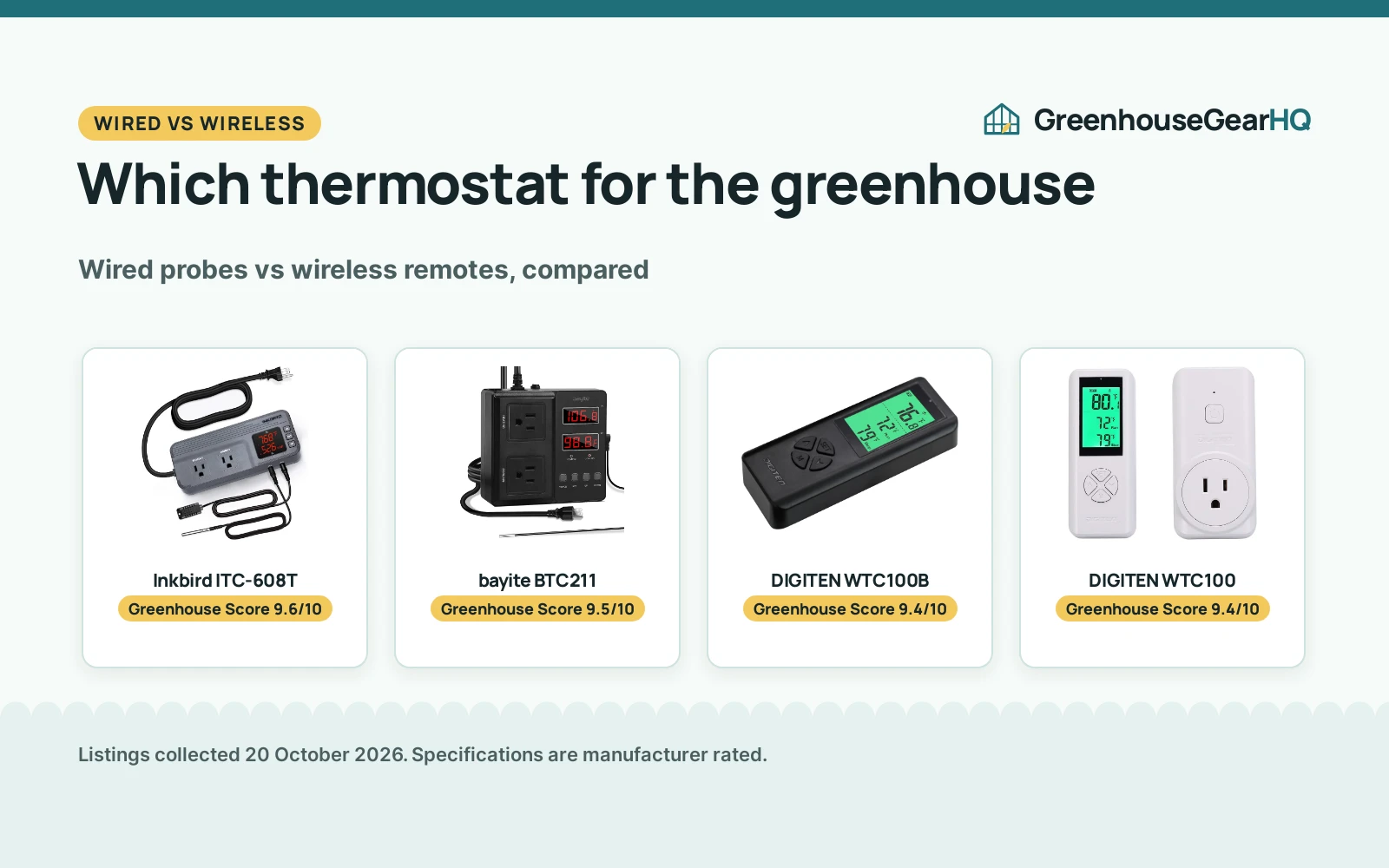
 Inkbird ITC-608T9.6/10View on Amazon
- 2
 bayite BTC2119.5/10View on Amazon
- 3
 DIGITEN WTC100B9.4/10View on Amazon
- 4
 DIGITEN WTC1009.4/10View on Amazon
The wired vs wireless greenhouse thermostat choice comes down to where the sensor lives. A wired thermostat has a probe on a cable that sits in the greenhouse; a wireless one has a remote with a built-in sensor you place where you want to measure. We compared four listings that show the difference: the Inkbird ITC-608T and bayite BTC211 on the wired side, and two DIGITEN WTC100 wireless models. The comparison rests on what each listing publishes: load, range, sensors and warranties.
GreenhouseGearHQ earns a commission when you buy through links on this page, at no extra cost to you. As an Amazon Associate I earn from qualifying purchases. Affiliate disclosure.
Quick verdict: choose a wired thermostat if you want the sensor on a cable in the greenhouse and the highest stated load, the Inkbird handles 1800W and is ETL listed. Choose a wireless thermostat if you want to place the remote sensor where you measure, both DIGITEN models here offer a 50 to 100 meter range. The bayite gives the widest stated temperature range at minus 58 to 230 degrees Fahrenheit with a 1-year warranty.
Two wired, two wireless
| # | Product | Greenhouse Score | Buy |
|---|---|---|---|
| 1 | Inkbird ITC-608T | 9.6/10 | Buy on Amazon |
| 2 | bayite BTC211 | 9.5/10 | Buy on Amazon |
| 3 | DIGITEN WTC100B | 9.4/10 | Buy on Amazon |
| 4 | DIGITEN WTC100 | 9.4/10 | Buy on Amazon |

Inkbird ITC-608T
A wired temperature and humidity controller with 1800W load, ETL listing and dual-stage outlets.
Pros
- Controls temp and humidity
- 1800W maximum load
- ETL listed
- Compressor delay protection
Cons
- No warranty term is stated
- Wired probe only, no remote
- 607 g
- Gray only

bayite BTC211
A wired temperature controller with 1650W load, minus 58 to 230 degree range and a 1-year warranty.
Pros
- -58 to 230 F range
- 1-year warranty
- 3m waterproof probe
- Dual relay output
Cons
- Temperature only, no humidity
- No safety certification is stated
- 1650W load
- Black only

DIGITEN WTC100B
A wireless thermostat outlet with a remote sensor, 50 to 100 meter range and 1650W load.
Pros
- Wireless remote sensor
- 50-100m range
- High and low temp alarms
- Plug-and-play design
Cons
- No warranty term is stated
- 32 to 158 F range is narrow
- No safety certification is stated
- Black only

DIGITEN WTC100
A wireless thermostat outlet with a remote sensor, 50 to 100 meter range and minus 10 to 80 degree range.
Pros
- Wireless remote sensor
- 50-100m range
- minus 10 to 80 C range
- High and low temp alarms
Cons
- No warranty term is stated
- No safety certification is stated
- 1650W load
- 2 AAA batteries required
As an Amazon Associate I earn from qualifying purchases.
Other options worth a look
 Neoteck Wired Indoor Outdoor Thermometer Hygrometer with 1.5mCheck price on Amazon
 VIVOSUN Humidity ControllerCheck price on Amazon
 6 Pack Digital Thermometer Wired for Car Greenhouse IndicatorCheck price on Amazon
Wired vs wireless greenhouse thermostat: side by side
| Factor | Inkbird ITC-608T (wired) | bayite BTC211 (wired) | DIGITEN WTC100B (wireless) | DIGITEN WTC100 (wireless) | Amazon |
|---|---|---|---|---|---|
| Side | Wired | Wired | Wireless | Wireless | |
| Controls | Temp + humidity | Temp only | Temp only | Temp only | |
| Max load | 1800W | 1650W | 1650W | 1650W | |
| Temp range | -40 to 212 F | -58 to 230 F | 32 to 158 F | minus 10 to 80 C | |
| Sensor | Wired probe | Wired probe | Remote, 50-100m | Remote, 50-100m |
We reproduce the maker’s listed specs without adjustment (collected 20 October 2026).
How the sensor reaches the greenhouse
The wired side uses a probe on a cable. The Inkbird ITC-608T includes a temperature probe and a humidity probe on a 2-meter sensor cable, with a 1.5-meter input power cable. The bayite BTC211 includes a 3-meter waterproof probe sensor. The wireless side puts the sensor in the remote: both DIGITEN WTC100 models list the sensor as built into the remote, with a communication range of 50 to 100 meters in open area. Place the remote where you want to measure, and it controls the outlet.
What each one controls
The Inkbird is a dual-stage temperature and humidity controller: WORK1 for a heating or cooling device, WORK2 for a humidifier or dehumidifier, with a temperature range of minus 40 to 212 degrees Fahrenheit and humidity from 5 to 99 percent RH. The other three control temperature only. The bayite measures minus 58 to 230 degrees Fahrenheit, the widest range here. The DIGITEN WTC100B covers 32 to 158 degrees Fahrenheit; the WTC100 covers minus 10 to 80 degrees Celsius.
Load and power
Maximum output load: 1800W on the Inkbird, 1650W on the bayite and both DIGITEN models at 110V. The DIGITEN listings also state 3300W at 220V. The Inkbird is ETL listed; the others state no safety certification. On alarms, the bayite and both DIGITEN models list high and low temperature alarms; the Inkbird lists a compressor delay to protect cooling devices.
Warranties
The bayite states a 1-year warranty. The Inkbird, DIGITEN WTC100B and DIGITEN WTC100 state no warranty term. Judge the wireless models on their stated range and load, not on a warranty figure that is not there.
| Product | Greenhouse Score | Perf. /35 | Build /25 | Value /25 | Safety /10 | Warranty /5 |
|---|---|---|---|---|---|---|
| Inkbird ITC-608T | 9.6 | 32 | 21 | 20 | 8 | 0 |
| bayite BTC211 | 9.5 | 30 | 20 | 20 | 0 | 4 |
| DIGITEN WTC100B | 9.4 | 30 | 20 | 19 | 0 | 0 |
| DIGITEN WTC100 | 9.4 | 29 | 20 | 19 | 0 | 0 |
Every score falls within 9.2 and 9.8, and a pick moves toward the top end only by earning more weighted points.
The Greenhouse Score weighs performance, build, value, safety and warranty, as explained on our How we pick page. For thermostats, safety reflects a stated safety certification or protection feature; the Inkbird earns safety points for its ETL listing. The bayite earns warranty points for its stated 1-year term. The wireless models score on value for their remote range.
Which should you choose?
Choose a wired thermostat if you want a probe on a cable in the greenhouse, the highest stated load at 1800W, and an ETL listing, as on the Inkbird ITC-608T. The bayite BTC211 is the wired pick for the widest temperature range and a 1-year warranty.
Choose a wireless thermostat if you want the sensor in a remote you place where you measure, with a 50 to 100 meter range, as on both DIGITEN WTC100 models. They control heating and cooling from the outlet with high and low temperature alarms.
In the Greenhouse
- Place the wireless remote at plant height, away from direct heater airflow.
- Run the wired probe to the center of the greenhouse, not against the wall.
- Match the heater wattage to the controller load: 1800W on the Inkbird, 1650W on the others at 110V.
- Use the compressor delay on the Inkbird to protect cooling devices.
FAQ for growers
Is a wired or wireless greenhouse thermostat better?
It depends on placement. Wired puts a probe on a cable in the greenhouse; wireless puts a sensor in a remote with a 50 to 100 meter range. Both switch heating and cooling devices on and off.
Which handles the most power?
The Inkbird ITC-608T at 1800W. The bayite and both DIGITEN models list 1650W at 110V.
Which has the widest temperature range?
The bayite BTC211 at minus 58 to 230 degrees Fahrenheit. The Inkbird covers minus 40 to 212.
Do any of these control humidity?
Only the Inkbird ITC-608T, with a humidity range of 5 to 99 percent RH and a second outlet for a humidifier or dehumidifier.
Which have a warranty?
The bayite with a stated 1-year warranty. The others state no warranty term.
Keep reading
See our greenhouse climate hub for more heating and cooling options.