On this page
Top picks at a glance
As an Amazon Associate I earn from qualifying purchases.
- 1
 TempPro TempAir 500 FT Indoor Outdoor Thermometer Wireless9.6/10View on Amazon
- 2
 Newentor Weather Station Wireless Indoor Outdoor ThermometerView on Amazon
- 3
 Taylor in/Out Wireless Thermometer with Remote Sensor andView on Amazon
- 4
 AcuRite Wireless Home Weather Station with Color DisplayView on Amazon
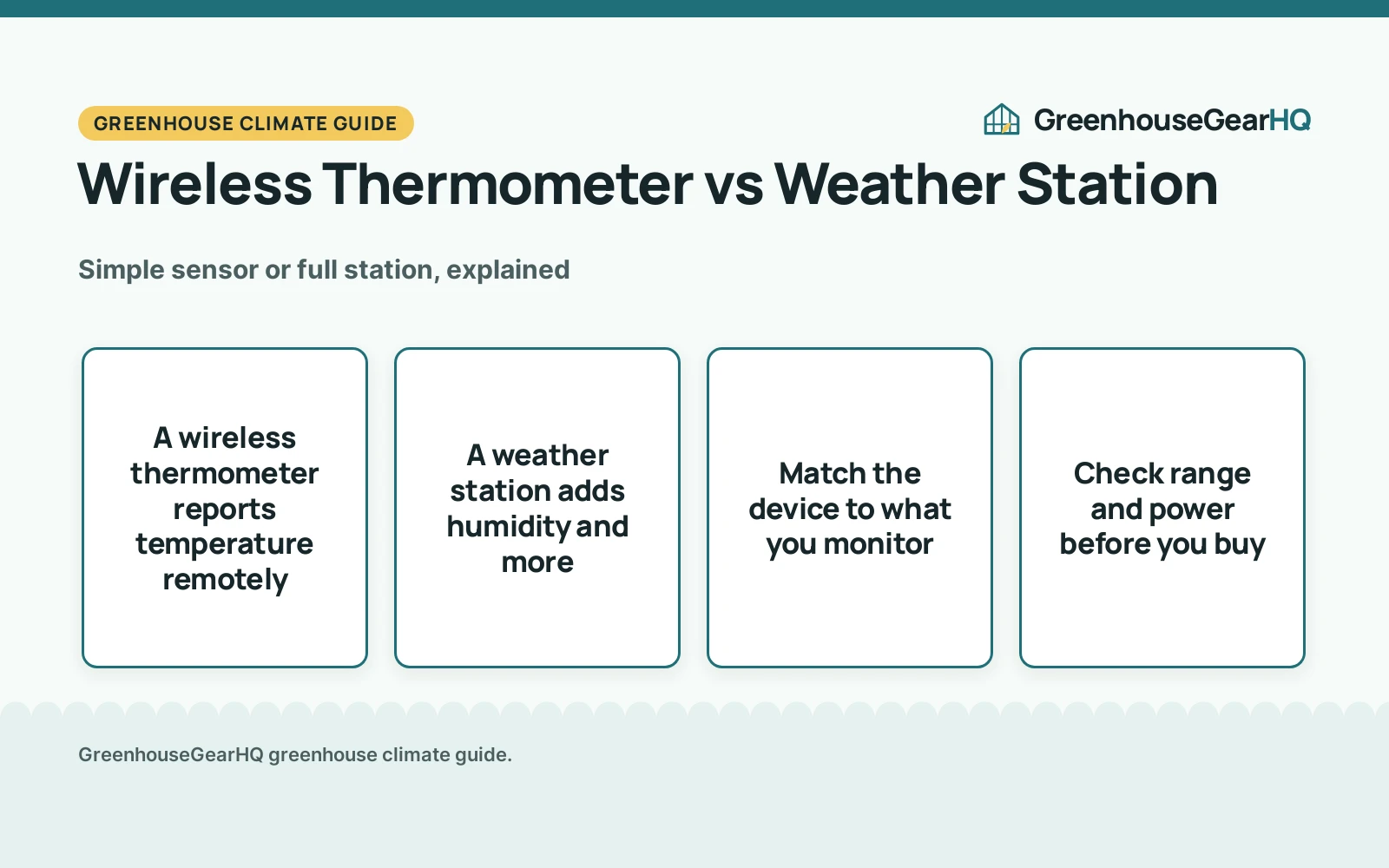
A wireless thermometer tells you the temperature from a sensor placed in the greenhouse, read on a display or phone elsewhere; a weather station does that plus humidity and often more, like logged highs and lows. If you only need to know whether the house is too hot or too cold, a wireless thermometer is enough. If you manage humidity for seedlings or want to see the night’s low without getting up to check, choose a weather station. This wireless thermometer vs weather station guide explains the difference, then ranks the wireless thermometer listings we compared.
Other options worth a look
 Newentor Weather Station Wireless Indoor Outdoor ThermometerCheck price on Amazon
 Taylor in/Out Wireless Thermometer with Remote Sensor andCheck price on Amazon
 AcuRite Wireless Home Weather Station with Color DisplayCheck price on Amazon
GreenhouseGearHQ earns a commission when you buy through links on this page, at no extra cost to you. As an Amazon Associate I earn from qualifying purchases. Affiliate disclosure.
Wireless thermometer vs weather station: what differs
A wireless thermometer is a simple sensor-and-display pair: a sensor sits in the greenhouse, and the temperature shows on a receiver or phone app. A weather station is a fuller instrument: it reports temperature and humidity, and many log daily highs and lows so you can see how cold the night got. The thermometer answers one question, how hot or cold it is right now; the station answers several, which matters when humidity swings leave condensation on the glazing.
The listings we compared are all wireless thermometers, not weather stations. They report temperature from probes or sensors over Bluetooth or WiFi. None of them lists a humidity sensor, which is the feature that separates a thermometer from a station. If humidity is what you need to track, look for a station instead; if temperature alone guides your vents and heaters, a thermometer does the job.
What to compare before you buy
Wireless range
Range decides whether the reading reaches your kitchen. The CHEF iQ lists WiFi with unlimited range, the ROUUO lists 2.4GHz WiFi up to 360 feet, and the TempPro titles list 1000FT and 500ft. Walls, metal framing and distance all shorten real-world reach, so match the listed range to the gap between your greenhouse and your house.
Power and battery life
A sensor that dies in midwinter is worse than none. The CHEF iQ lists up to 50 hours per charge on rechargeable probes, and the ROUUO lists 150-plus hours of base life on a 12V battery, with a 15-minute charge fueling 12-plus hours. The TempPro titles state no power figures. Rechargeable probes suit daily use; a long-life base suits a sensor you rarely touch.
Probes and sensors
More probes mean more spots monitored. The CHEF iQ lists four ultra-thin probes and five sensors, while the ROUUO lists dual probes. The TempPro TempSync title lists four probes; the TempSpike title states no probe count. For a greenhouse, one well-placed sensor often suffices, but extra probes let you compare the bench level with the ridge.
App and alerts
Both full-data listings pair with a phone app: the CHEF iQ with guided presets and the ROUUO with customizable temp presets and instant alerts. App alerts matter when a cold snap hits overnight, so check that the app runs on your phone before you rely on it.
The wireless thermometer listings, ranked
We ranked the four wireless thermometer listings by stated features and warranty. The CHEF iQ Sense lists four ultra-thin probes, WiFi with unlimited range, a 1000°F heat rating, five sensors and up to 50 hours per charge; note that its bullets promise a two-year assurance while the spec table says 3 Year, so confirm the term before you buy. The ROUUO lists dual probes, 2.4GHz WiFi up to 360 feet, a 572°F ceramic handle, IP67 waterproof probes and 150-plus hours of base life, with no warranty stated. The TempPro TempSync 1000FT lists four probes and 1000FT wireless range by title only, and the TempPro TempSpike 500ft lists Bluetooth and 500ft range by title only.
| Listing | Probes | Wireless | Top heat rating |
|---|---|---|---|
| CHEF iQ Sense | 4 probes | WiFi, unlimited range | 1000°F |
| ROUUO M02-M1 | 2 probes | 2.4GHz WiFi, 360 ft | 572°F |
| TempPro TempSync | 4 probes | 1000FT wireless | Not stated |
| TempPro TempSpike | Not stated | Bluetooth, 500ft | Not stated |
Which should you choose for a greenhouse?
Choose a wireless thermometer when a single temperature reading is enough: one sensor in the house, one display in the kitchen, and you glance at it on cold nights. Choose a weather station when you also track humidity, or when you want to see the night’s low without getting up to check. Either way, place the sensor out of direct sun and away from heaters, since sun and heat skew the reading.
Placing the sensor
Hang the sensor at plant height, out of direct sun and away from heaters. Avoid the ridge where hot air pools and the door where cold drafts hit. If the listing gives an indoor and outdoor rating, follow it; the CHEF iQ and ROUUO both list indoor and outdoor use.
FAQ for growers
What is the difference between a wireless thermometer and a weather station?
A wireless thermometer reports temperature from a remote sensor. A weather station reports temperature plus humidity and often logs highs and lows.
Do I need a weather station for a small greenhouse?
Not necessarily. If you only watch for frost or heat spikes, a wireless thermometer covers it. Add a station when humidity matters to your crops.
How far can a wireless thermometer transmit?
It varies by listing. The ROUUO lists up to 360 feet on 2.4GHz WiFi, the CHEF iQ lists unlimited range via WiFi, and the TempPro titles list 1000FT and 500ft. Walls and metal framing shorten real-world range.
Do wireless thermometers need WiFi?
Some use WiFi, some use Bluetooth or their own radio. The CHEF iQ and ROUUO list WiFi and Bluetooth, while the TempPro TempSpike lists Bluetooth. Check the listing for what your phone needs.
Can I use a meat thermometer as a greenhouse thermometer?
The listings here are sold as meat thermometers, with probes built for food temperatures. For greenhouse air, use a sensor rated for indoor and outdoor use and place it at plant height, not in a roast. Match the tool to the job.
Keep reading
See every greenhouse climate guide.
More picks: browse thermometer hygrometers for greenhouses, min-max thermometers and thermometer hygrometers for home.